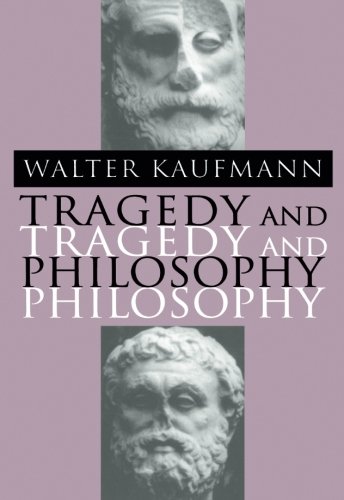
Ebook Info
- Published: 2005
- Number of pages: 480 pages
- Format: PDF
- File Size: 15.77 MB
- Authors: Walter A. Kaufmann
Description
The description for this book, Tragedy and Philosophy, will be forthcoming.
User’s Reviews
Editorial Reviews: Review “[Kaufmann] has attempted a searching analysis of the essence of tragedy. He offers a new definition and, without raising his voice, his version of poetics as against that of Aristotle.” ― The New York Times””[This] is not only a book of great importance on the fundamental problem of the aesthetics of literature, but it is vastly entertaining and informed “”—Commonwealth
Reviews from Amazon users which were colected at the time this book was published on the website:
⭐I am a retired professor of Classics. So it is with painful humility that I must acknowledge that this book, written by a philosopher, is the most astute and insightful book I have ever read on ancient Greek tragedy and Aristotle’s Poetics. (It also offers perceptive and important observations on Homer and post-Classical drama and criticism.)Kaufmann has read Aeschylus, Sophocles, and Euripides carefully and sensitively in Greek and has approached them with a powerful beacon light and an equally powerful broom. The light illuminates them and enables the reader to see their greatness clearly. The broom sweeps away centuries (in some cases, millennia) of misconceptions, misdirections, and pseudo-problems.For example, on pages 64-68, Kaufmann points out that the Greek word hubris did not mean pride in Greek tragedy; it meant insult, insolence, and/or outrageous conduct. I will add that the same is true in Homer. For instance, in the first book of the Iliad (lines 203 and 214), both Achilles and the goddess Athena describe Agamemnon’s seizure of Achilles’ woman, Briseis, as hubris. (Douglas Cairns pointed out (Journal of Hellenic Studies 116, 1996, pages 1-32) that hubris sometimes means the state of mind that leads to such actions; and that state of mind can be translated as pride. However, Kaufmann is right: in Greek tragedy, hubris never means simply pride.)I will admit that I zealously searched for any mistakes that I, as a professional Classicist, could pounce on. I found only two. On page 155, footnotes 17 and 18, Kaufmann notes where he has changed Rieu’s translation of the passages he quotes from the Iliad in order to bring them closer to the Greek. On the rest of page 155 and on 156, he quotes verbatim Rieu’s translation of three other passages of the Iliad. In them are the words “best,” “better,” and “better.” However, when Homer applied the words being translated to a warrior, they always referred to his battle prowess; they meant “stronger-braver.” (The same word meant both strong and brave, because in the culture Homer described only results counted. One of Homer’s greatnesses was to make the leading Trojan, Hector, the most sympathetic character in the Iliad by portraying the tragic effect that this results-culture had on him and his family.)Kaufmann’s second mistake is on page 112. There he cites Bernard Knox for importance of Sophocles’ frequent punning on the similarity between Oedipus’ name and the ancient Greek word for “know” (oida”); a similarity that highlights the horror of Oedipus’ situation: his ignorance of who he is. Kaufmann writes (footnote 20), “but these are hardly, as he [Knox] puts it `puns;’ there is nothing funny about them, they are terrifying.” However, Knox did not mean for the word pun to indicate a humorous coincidence between the sounds of two words. Classicists know that ancient peoples – Greeks, Romans, and Israelites – thought that language inheres in the nature of objects and activities. So, similarity in sound between two words indicates that they have something important in common. In fact the word “etymology” comes from an ancient Greek word, the components of which are the study (logos) of what is true (etumos). (I refer the reader to pages 116-7 of the second edition (1960) of E. Dodds’ commentary on Euripides’ Bacchae, a book which Kaufmann cites. For the crucial importance of puns in the Odyssey, see G. Dimock, “The Name of Odysseus,” in Hudson Review, 9, 1956, pages 52-70.)
⭐A fascinating approach to Greek tragedy. The book provides for new inroads into the world of the Greek tragedy and its most outstanding students. Tragedy and Philosophy invites revisiting -and debating- from the basic notion of tragedy to the most nuanced views on its origins, decay and death.
⭐rich in thought!
⭐Walter Kaufmann, you are missed. In this age where intellectuals and academics seem able to justify their lives and works solely by how confusing or intimidating they are, Kaufmann’s work are respite, reprieve, and sanctuary.Sometimes I feel like the post-modern intellectual ferment is a phenomenon akin to Medieval Scholasticism (how many angels can dance on the head of a pin)- the rampantly tendentious obscurantism, the impenetrable jargon and idiotic linguistic play of theoretical discourse… If only Kaufamnn where here to call these post-modern charlatans (who all-too often pillage Kaufmann’s intellectual and spiritual predecessor, Nietzsche) out on their empty sophistry… As always, I’m getting off topic.This book is an exemplary work of scholarship- aproachable, insightful, clear, interesting, at times humorous, and unencumbered. It is so good and so readable it is at odds with our age. Kaufmann analyses not only the major tragedians of antiquity (Aeschylus, Sophocles, and Euripides) but also the commentators of antiquity- Plato and Aristotle, calling them on their glaring faults and presumptions. It takes serious [courage] (or it used to) to go messing with the two Grecian heavy-weights of western thought but Kaufamnn is up to the challenge. One walks away from the first half of the book STEEPED in ideas.Kaufamnn also examines Shakespearian Tragedy. Then he discusses the theories of both Nietzsche and Hegel as regards both tragedy and Greek culture in general. This, in my opinion is where Kaufmann truly shines, as a brilliant commentator on German philosophy and literature. (His book on Hegel was the first to enable me to understand Hegel, and I reccomend it whole-heartedly). He knows Nietzsche like the back of his hand and has the ability to call ol’ Fritz out when he falls prey to his own style, the shrill and willful naysaying. He is highly fond of Nietzsche but is also not an acolyte (the greatest disservice one can do to a thinker as profound as Nietzsche is to be a disciple and nothing more, and Nietzsche himself never tired of stating that), Kaufmann possessed a head level enough to work through N’s thought and avoid his missteps (Nietzsche, for example, points the finger at Euripides for the fall of tragedy. Kaufmann disagrees and clearly believes that the form continued on through other historical epochs, but not our own).Still, despite his differences, Kaufmann finds much in both Nietzsche and Hegel that is worthwhile and illuminating, and he delivers to the reader not only a thorough comprehension of both thinker’s perceptions of tragedy, but also a capacity to root both men in their historical context, so that one has a sense of WHY they thought and wrote as they did. Don’t underestimate that.He finally posits his own ‘ironic’ theory of tragedy against those of the thinkers he has perused and analysed (This is not surprising, as Kaufmann’s first and highest devotion, philosophically was to the ever-ironic Socrates). He also discusses why our age has been unable live up to the art of those who have come before, and why (in his opinion) our age has produced no fully realized tragedies of its own (though a few have tried… perhaps the form and all its particulars is no longer relevant, like epic poetry- it can be studied and of course enjoyed for its sublime nature, but to attempt to create one would be a farsical endeavor??? I’m just wondering aloud so to speak…) He briefly looks at Sartre’s ‘The Flies,’ in connection with Euripides and doesn’t fault JP too much. I’m very fond of that play and my copy of the book is underlined almost the whole way through on this chapter.I can’t think of any other text on tragedy (or even drama in general) that does so much for the reader. Why can’t all writers and scholars be this concise, enthralling and well-learned?I’ll end by repeating: the finest book on tragedy and thought I have come across.
Keywords
Free Download Tragedy and Philosophy in PDF format
Tragedy and Philosophy PDF Free Download
Download Tragedy and Philosophy 2005 PDF Free
Tragedy and Philosophy 2005 PDF Free Download
Download Tragedy and Philosophy PDF
Free Download Ebook Tragedy and Philosophy