

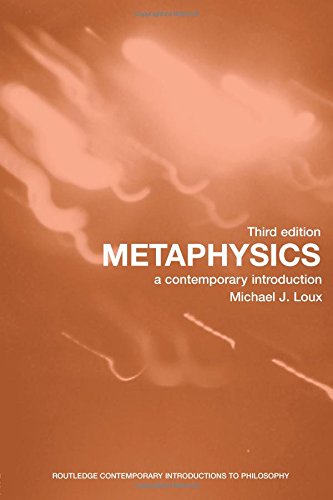
Ebook Info
- Published: 2006
- Number of pages: 328 pages
- Format: PDF
- File Size: 2.24 MB
- Authors: Michael Loux
Description
Metaphysics: A Contemporary Introduction is aimed at students of metaphysics who have already completed an introductory philosophy course. This third edition of the successful textbook provides a fresh look at key topics in metaphysics and includes two new chapters on time and causation.Wherever possible, Loux links contemporary views to their classical sources in the history of philosophy. This new edition also keeps the user-friendly format, the chapter overviews summarizing the main topics and examples to clarify difficult concepts.
User’s Reviews
Editorial Reviews: Review ‘Very good…It goes into a lot of detail while always keeping the reader’s eyes on the main issues. The chapters are well-structured and well-written.’ – Tim Crane, Times Higher Education Supplement’Excellent…It is well written and meets the need for something harder than first year texts. Students and teachers will like it.’ – Frank Jackson, Australian National University
Reviews from Amazon users which were colected at the time this book was published on the website:
⭐Loux gives a thorough, intermediate “introduction” to the current problems in contemporary metaphysics. He briefly defends an Aristotelian metaphysics of sorts, though he is fair to different conclusions. The book is easier than Chisholm’s *On Metaphysics,* though far more difficult than van Inwagen’s text.He gives the standard surveys of Realism and Nominalism, though he does focus on modern nominalist defenders with a discussion on trope nominalism. He has two different sections on “Particulars” and notes the difficulties each position will face. (I am surprised he did not discuss the Ship of Theseus problem).I particularly enjoyed his fine chapter on Possible Worlds Semantics. It is here that he drew together a number of themes: Those who hold to realism also hold to identity through time and (usually) Possible Worlds Actualism. Nominalists as a general rule do not (with exceptions).This is a fine account of modern metaphysics, though certainly not for the beginning reader.
⭐Good book. It’s a textbook filled with lots of papers from many different authors. It’s well compiled and has a lot of information. If you plan on teaching a metaphysics course this would be a great book to use. In addition, if you are taking a metaphysics course this would be some great additional reading material.
⭐My favorite introduction to metaphysics. Broadly realist and writing from an Aristotelian perspective, Loux introduces the reader to themes broadly discussed in general ontology. Metaphysics, he says, is the study of being qua being. What exists and characterizes them? Loux has nice discussions of universals, particulars, propositions, possible worlds, causation, time, and the challenge of anti-realism. While the discussions of each topic can get long and convoluted, Loux clearly writes about each topic and fairly represents the contrary views on each. Recommended.
⭐Excellent introduction; I’ve yet to be dissatisfied with Routledge’s Contemporary Introduction, a super readable work. I’d recommend it to anyone becoming interested in Metaphysics; it would be beneficial, I think, to get Blackwell’s anthology on metaphysics, and reading the two in tandem should give you a good grasp of contemporary metaphysics.
⭐This book is an excellent introduction to contemporary metaphysics. Loux is a clear writer who sympathetically and systematically highlights the important debates in contemporary (and some historical) metaphysics. As Loux explains in the introduction, contemporary metaphysics covers a grab-bag of topics, including free will, time, causality, philosophy of mind, and the “realism” debates. Loux does his best to actually unite these different topics under the rubric of an Aristotelian study of metaphysics, which attempts to discover which things exist and where they fit in appropriate metaphysical categories. These categories are then connected by relations of ontological priority, in which some categories are primitive, and others are secondary. (Loux wisely refrains from assuming that other categories are derivative; they may supervene or be otherwise conceptually posterior without being analyzable into the more primitive categories.)I generally have mixed (and mostly negative) feelings about the use of textbooks in philosophy. So much of philosophy is about actually critically engaging with primary sources, and it’s difficult for textbooks to fairly present many sides of an issue. For instance, I have been very disappointed with Paul Guyer’s
⭐, which is simply not the most charitable reading of Kant, and I find Chris Shield’s
⭐almost too programmatic – he rushes a discussion of the irreducibility of the final cause and then reduces every aspect of Aristotle’s thought to this framework. I haven’t had the opportunity to work with any textbooks in contemporary philosophy in-depth, but I’ve been disappointed in my brief interactions with them.However, I think Loux really rises above Guyer and Shields, and the other contemporary books I’ve scanned (especially Lycan’s
⭐). Why? It’s tough to put a finger on it. Loux is just extraordinarily clear, and fairly presents both sides of issues, raising objections that are reasonable and well-researched. For example, his treatment of substance in chapter 3 does a great job of painting the debate as between the bundle theorist, who makes every property of a thing essential, the bare substratum theorist, who makes no property essential, and the Aristotelian, who tries to thread the needle. In a more specific case, I also particularly appreciated his explanation of the extremity of Quine’s nominalism in “On What There Is”, which I hadn’t gotten out of the paper when reading it on my own.As it stands, the book is missing an important debate in contemporary metaphysics. Contemporary metaphysicians have gotten interested in rejecting the Quinean belief that metaphysics is about what there is with the Aristotelian (and Kantian) assumption that metaphysics is about what grounds what. This both (a) lets us avoid thorny issues in the philosophy of language about the nature of a debate between someone who denies that X exists and someone who defends that X exists, and (b) allows for multiple simultaneous levels of dependence going in different directions, rather than the monad exists-doesn’t exist relation. Of course, this is no fault of the book, since this has occurred in the past 3-4 years. Readers interested in this debate should check out Schaffer’s “On What Grounds What” in
⭐. Other big players in this field are Kit Fine and Ted Sider. There is a recent volume which I haven’t gotten a chance to read (
⭐), which may be good.My only real criticism of this book is that it over-simplifies some of the historical figures. Although Loux often points out that Aristotle’s views are complex, he rarely cites the secondary literature (other than his own) which engages with them. For instance, in the section on Trope Theory, he points out that some of have found this view in Aristotle – but he doesn’t actually point the reader to these authors! (The clearest defense is in
⭐, and also helpful is Moravcsik, “Aristotle on Predication”, Phil Review 76.) As someone primarily interested in the history of philosophy, this was a bit annoying, but I don’t think it would bother the primary audience of this book.Also, please ignore Mr. Hickey’s review below. He evidently has a personal bone to pick with Professor Loux, and is just using this as an attempt to promote his own ebook.
⭐I found this to be a good metaphysics introduction at the undergraduate level. One or two of the topics I have read reasonably extensively on, but still found something new in Loux’s book, or found his explanations particularly clear. The chapters on universals and concrete particulars are particularly good. I also liked his final chapter on realism versus anti realism.On the downside I found the writing style occasionally a little irritating, mainly because he over-explains some items. (However, this is a lesser sin than assuming the reader understands and jumping around without sufficient explanation). The chapter on causality, which is a subject I am interested in, is thin. There is nothing on freedom and determinism or the mind-body issue. Perhaps these are not contemporary.
⭐This book is part of the core reading for my second year of a BA Hons degree in Philosophy and boy has it helped! Full of useful and interesting articles and snippets, this book is a brilliant read for those being introduced into metaphysics yet have a background in philosophy. I would whole heartedly recommend you buy this book!
⭐great everything as ordered
⭐Just one word: very good!!!
⭐I found his writing style harder to understand than the topic he is writing about. It made the book take twice as long to read as it should have! Once I got passed that I actually enjoyed it.
Keywords
Free Download Metaphysics: A Contemporary Introduction (Routledge Contemporary Introductions to Philosophy) 3rd Edition in PDF format
Metaphysics: A Contemporary Introduction (Routledge Contemporary Introductions to Philosophy) 3rd Edition PDF Free Download
Download Metaphysics: A Contemporary Introduction (Routledge Contemporary Introductions to Philosophy) 3rd Edition 2006 PDF Free
Metaphysics: A Contemporary Introduction (Routledge Contemporary Introductions to Philosophy) 3rd Edition 2006 PDF Free Download
Download Metaphysics: A Contemporary Introduction (Routledge Contemporary Introductions to Philosophy) 3rd Edition PDF
Free Download Ebook Metaphysics: A Contemporary Introduction (Routledge Contemporary Introductions to Philosophy) 3rd Edition