

Ebook Info
- Published: 2014
- Number of pages: 416 pages
- Format: PDF
- File Size: 13.68 MB
- Authors: Brian P. Copenhaver
Description
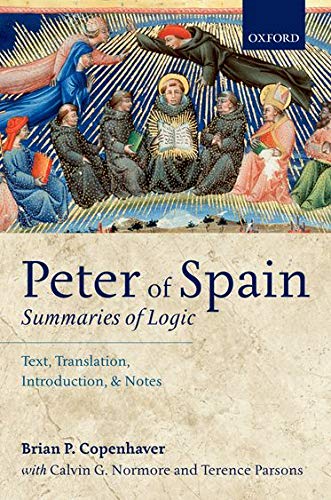
For nearly four centuries, when logic was the heart of what we now call the “undergraduate curriculum,” Peter of Spain’s Summaries of Logic (c. 1230) was the basis for teaching that subject. Because Peter’s students were teenagers, he wrote simply and organized his book carefully. Since no book about logic was read by more people until the twentieth century, the Summaries has extensively and profoundly influenced the distinctly Western way of speaking formally and writing formal prose by constructing well-formed sentences, making valid arguments, and refuting and defending arguments in debate. Some books, like the Authorized Version of the English Bible and the collected plays of Shakespeare, have been more influential in the Anglophone world than Peter’s Summaries–but not many. This new English translation, based on an update of the Latin text of Lambertus De Rijk, comes with an extensive introduction that deals with authorship, dating, and the place of the Summaries in thedevelopment of logic, before providing a chapter-by-chapter analysis of Peter’s book, followed by an analysis of his system from the point of view of modern logic. The Latin text is presented on facing pages with the English translation, accompanied by notes, and the book includes a full bibliography.
User’s Reviews
Editorial Reviews: Review “… one of the most exciting contributions to the history of medieval logic in recent years, not because it presents any dramatic discoveries, but because it introduces an important work to a public wider than that of dedicated scholars able to read Latin… Future generations of students and scholars will undoubtedly be grateful to Copenhaver, Normore and Parsons for this splendid publication.” –Notre Dame Philosophical Reviews Online “…this is a welcome treatment of a classic text that has long deserved such an outstanding edition, translation, and commentary.” — Journal of the History of Philosophy About the Author Brian P. Copenhaver, Distinguished Professor and Udvar-Hazy Chair of Philosophy and History at UCLA, teaches medieval and early modern philosophy. He has written extensively about magic, astrology, the Hermetica, Cabala and their foundations in Neoplatonic, Aristotelian and scholastic philosophy; natural philosophy; scepticism; Averroism; philosophical translation; modern Italian philosophy; historiography; the classical tradition in philosophy; Lorenzo Valla; Marsilio Ficino; Giovanni Pico della Mirandola; Lorenzo de’ Medici; Polydore Vergil; Tommaso Campanella; Isaac Newton; Henry More; and Benedetto Croce. He was elected to the American Academy of Arts and Sciences and has held Fulbright, ACLS, Guggenheim and Getty fellowships.Calvin G. Normore is Professor of Philosophy at UCLA, and at McGill University.Terence Parsons is Professor of Philosophy and Linguistics at UCLA. He is the author of Nonexistent Objects (Yale University Press, 1980), Events in the Semantics of English (MIT Press, 1990), and Indeterminate Identity (OUP, 2000).
Reviews from Amazon users which were colected at the time this book was published on the website:
⭐This is an English translation with facing Latin text of Peter of Spain’s Summulae logicales, which was widely read and commented on at medieval universities. A huge number of medieval Latin treatises exist, many which have never been edited and most which do not have authoritative translations and commentaries. I assert that translating and commenting on these works is much more productive than writing essays in thinly circulated Festschriften, which is where so much scholarship exists. And there are many topics in medieval philosophy that would benefit from being studied by linguists and logicians who do not know Latin comfortably enough to read standalone Latin texts. For example, Abelard’s Dialectica has been edited by De Rijk but has not been translated. There have been good translations done by Normann Kreztmann
⭐, Eleonore Stump
⭐, and John Magee
⭐. But there remain many works by first rank authors that have not been translated, for example in the Oxford school of physics and logic, Thomas Bradwardine, “De incipit et desinit”, John Dumbleton’s “Summa Logica et Philosophiae Naturalis”, and Richard Swineshead’s “Liber calculationum”.
⭐A monument
⭐
Keywords
Free Download Peter of Spain: Summaries of Logic: Text, Translation, Introduction, and Notes 1st Edition in PDF format
Peter of Spain: Summaries of Logic: Text, Translation, Introduction, and Notes 1st Edition PDF Free Download
Download Peter of Spain: Summaries of Logic: Text, Translation, Introduction, and Notes 1st Edition 2014 PDF Free
Peter of Spain: Summaries of Logic: Text, Translation, Introduction, and Notes 1st Edition 2014 PDF Free Download
Download Peter of Spain: Summaries of Logic: Text, Translation, Introduction, and Notes 1st Edition PDF
Free Download Ebook Peter of Spain: Summaries of Logic: Text, Translation, Introduction, and Notes 1st Edition