

Ebook Info
- Published: 2012
- Number of pages: 618 pages
- Format: PDF
- File Size: 12.53 MB
- Authors: xxWilliam H. F. Altmanxx
Description
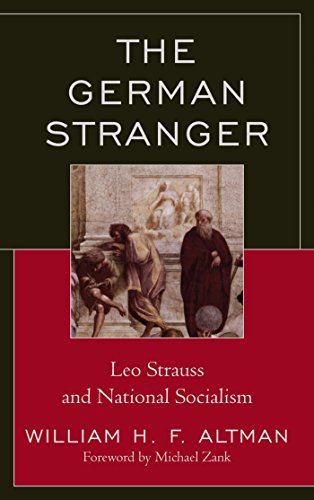
Leo Strauss’s connection with Martin Heidegger and Carl Schmitt suggests a troubling proximity to National Socialism but a serious critique of Strauss must begin with F. H. Jacobi. While writing his dissertation on this apparently Christian opponent of the Enlightenment, Strauss discovered the tactical principles that would characterize his lifework: writing between the lines, a faith-based critique of rationalism, the deliberate secularization of religious language for irreligious purposes, and an “all or nothing” antagonism to middling solutions. Especially the latter is distinctive of his Zionist writings in the 1920s where Strauss engaged in an ongoing polemic against Cultural Zionism, attacking it first from an orthodox, and then from an atheist’s perspective. In his last Zionist article (1929), Strauss mentions “the Machiavellian Zionism of a Nordau that would not fear to use the traditional hope for a Messiah as dynamite.” By the time of his “change of orientation,” National Socialism was being led by a nihilistic “Messiah” while Strauss had already radicalized Schmitt’s “political theology” and Heidegger’s deconstruction of the ontological Tradition. Central to Strauss’s advance beyond the smartest Nazis is his “Second Cave” in which he claimed modern thought is imprisoned: only by escaping Revelation can we recover “natural ignorance.” By using pseudo-Platonic imagery to illustrate what anti-Semites called “Jewification,” Strauss attempted to annihilate the common ground, celebrated by Hermann Cohen, between Judaism and Platonism. Unlike those who attacked Plato for devaluing nature at the expense of the transcendent Idea, the émigré Strauss effectively employed a new “Plato” who was no more a Platonist than Nietzsche or Heidegger had been. Central to Strauss’s “Platonic political philosophy” is the mysterious protagonist of Plato’s Laws whom Strauss accurately recognized as the kind of Socrates whose fear of death would have caused him to flee the hemlock. Any reader who recognizes the unbridgeable gap between the real Socrates and Plato’s Athenian Stranger will understand why “the German Stranger” is the principal theoretician of an atheistic re-enactment of religion, of which genus National Socialism is an ultra-modern species.
User’s Reviews
Reviews from Amazon users which were colected at the time this book was published on the website:
⭐I highly recommend Will Altman’s tome on Leo Strauss, not because I agree with his every argument regarding Strauss but because of the amazing scholarship on display in TGS. Altman has read Strauss’ original works in German, for instance, and relies on works like Strauss’ dissertation, for instance, to make his case early on. His attention to footnotes and his scrupulous reading of texts are probably the key to the work of this astute intellectual detective. These features make clear his debt to Strauss, which Altman acknowledges openly near the end of the book–a debt that anyone familiar with Strauss’ works and critiques contained therein sees throughout his treatment of Strauss’ “esoteric” teaching. Anyone who is a motivated defender of Strauss will need to be prepared to match Altman’s scholarship and provide counter-arguments–if he wants to learn something along the way, that is. As one who has studied with Strauss’ students and has read most of Strauss’ books, I found Altman’s tone a bit too polemical at times: he is not at his best when he seeks to draw a straight line between Strauss’ secret teaching and Sarah Palin’s political advisors, for instance. Additionally, I found some of his arguments reminiscent of some of Strauss’ own students, particularly Stanley Rosen, on the Straussian project as an “act of will”: in fact, Altman’s defense of Plato against Strauss’s “anti-platonic” Platonism needs to be seen (for Strauss defenders) through Rosen’s defense of the possibility of philosophy. If Altman’s book inspires a new generation of Straussians to take up the original sources of Strauss’ inspiration, namely, the Greeks and the Bible, to forge counter-arguments, then it will have served that higher purpose that I believe the author intends. It is this form of liberalism in Strauss’ exoteric teaching that has kept me coming back to his books over the years. Altman’s critique fundamentally has not shaken my “faith” because I believe that Strauss as a teacher was always open to argument, from whatever corner: he was, in the one time I had a chance to visit with him, not only a man of intense intellect but a spirited defender of serious politics. And it is on this final point I would make the case that the best defense of Strauss lies in an understanding of Aristotle and Israel.
⭐A highly important contribution to the Straussian debate.
Keywords
Free Download The German Stranger: Leo Strauss and National Socialism in PDF format
The German Stranger: Leo Strauss and National Socialism PDF Free Download
Download The German Stranger: Leo Strauss and National Socialism 2012 PDF Free
The German Stranger: Leo Strauss and National Socialism 2012 PDF Free Download
Download The German Stranger: Leo Strauss and National Socialism PDF
Free Download Ebook The German Stranger: Leo Strauss and National Socialism