

Ebook Info
- Published: 2017
- Number of pages: 270 pages
- Format: PDF
- File Size: 2.58 MB
- Authors: Tim Rogan
Description
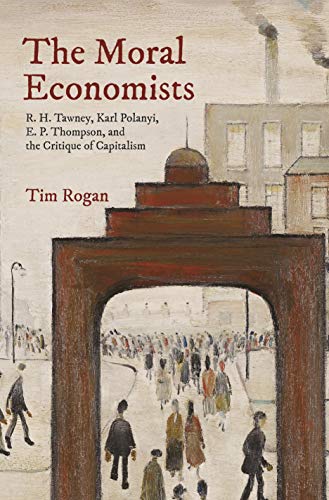
A fresh look at how three important twentieth-century British thinkers viewed capitalism through a moral rather than material lensWhat’s wrong with capitalism? Answers to that question today focus on material inequality. Led by economists and conducted in utilitarian terms, the critique of capitalism in the twenty-first century is primarily concerned with disparities in income and wealth. It was not always so. The Moral Economists reconstructs another critical tradition, developed across the twentieth century in Britain, in which material deprivation was less important than moral or spiritual desolation.Tim Rogan focuses on three of the twentieth century’s most influential critics of capitalism—R. H. Tawney, Karl Polanyi, and E. P. Thompson. Making arguments about the relationships between economics and ethics in modernity, their works commanded wide readerships, shaped research agendas, and influenced public opinion. Rejecting the social philosophy of laissez-faire but fearing authoritarianism, these writers sought out forms of social solidarity closer than individualism admitted but freer than collectivism allowed. They discovered such solidarities while teaching economics, history, and literature to workers in the north of England and elsewhere. They wrote histories of capitalism to make these solidarities articulate. They used makeshift languages of “tradition” and “custom” to describe them until Thompson patented the idea of the “moral economy.” Their program began as a way of theorizing everything economics left out, but in challenging utilitarian orthodoxy in economics from the outside, they anticipated the work of later innovators inside economics.Examining the moral cornerstones of a twentieth-century critique of capitalism, The Moral Economists explains why this critique fell into disuse, and how it might be reformulated for the twenty-first century.
User’s Reviews
Reviews from Amazon users which were colected at the time this book was published on the website:
⭐Brilliant. Helpful in understanding what each economist was saying, how they complement each other, and perceived limitations of their arguments.
⭐The topic sounds more interesting than the book turned out to be. The author got so caught up in the inside game of who said what about whom and what was the pedigree of each. The book spent too little time on the ideas the main economists who seemed the focus of the book.
⭐”The Moral Economists’ is a dreadful slog, unnecessarily dense because of its lack of competent editing, as well as the author’s apparent reluctance to assert his own ideas or his need to prove that he has read everything ever already written on his subjects and thus avoid claiming some thought as his own.This is a academic research, not a book to be read for learning about its purported subjects, and certainly not for pleasure. I was eager to find, purchase and read this book after seeing it referred to in an article that included discussion of economics from a perspective other than that which dominates modern capitalist-based (utilitarian) thought.My criticism as ‘academic research’ is that the author’s intent is painfully obviously to prove to others in his field of research that he has done his research of what has come before him. ‘The Moral Economists’ is a short book, with four relatively short chapters, but at least two of the chapters have well over 200 chapter notes, which have to be turned to at the back of the book (a terrible convention in academics, requiring the reader to flip back and forth ad search for the note, and then back to the text, etc.). There are paragraphs here in which every sentence has an chapter notation. The problem with this for those of us not obsessed with proven that we’re equal to other academics who want/need to prove that they’re fully aware of and account for others’ work, is that the author of this book (and similar writing) are thus constrained in their content AND in how they write. There is virtually no flow of ideas or thoughts or narrative.Additionally, I was disappointed and then very annoyed to find that the author has a TERRIBLE habit of squeezing 6 pages of information into 30. He consistently repeats himself, taking at least three consecutive paragraphs to state information or, upon the rare occasion in which he expresses an original thought, make an assertion.I waded through the first chapter and into the second, having put on my chest-high waders and arming myself with two machetes to carve a path through the muck and jungle. But, there was no let-up. The author may be a good or very good academic. But this book make a very bright shining case for Amazon to create a category of ‘Books’ that clearly labels academic research.It’s too bad that this subject was not better explored, or – my responsibility – that I didn’t find a book that does a better job of introducing and informing on the topic of economics from a perspective that challenged (and maybe still does) assumptions that underlie utilitarian capitalism.Fortunately, I was within the window for returning the book, losing only the cost of shipping for the experience of reading a couple chapters of ‘The Moral Economists’.
⭐The book is undoubtedly an academic book and anyone expecting something other than that will be disappointed. However, I happen to like academic history!For me, it had a good number of ‘gosh’ moments. First, the idea that there is something called ‘moral economy’ which emerges as solidarities within commercial societies is an important one. The author traces this idea through Tawney, Polanyi and Thompson, praising the latter for his ‘ground up’ use of social data.Second, the author’s suggestion that the solidarities studied by his three chosen authors now seem out of date and provincial (e.g. workers in the potteries) in a world dominated by globalist conceptions of society is fascinating. More could perhaps be made of this, but the take-away point that solidarities arise in capitalism is striking. I wonder – will one perhaps emerge amongst gig economy workers?One thing that the author might consider is whether neoliberalism is just too sophisticated an individualistic system for solidarities to emerge. That is, whether or not the utilitarians have learnt a thing or two about how to run the show, and whether or not utilitarians have a social technology which really does defeat moral economy.
⭐This is both a very insightful book and highly frustrating. The insights are about each of the thinkers mentioned and the basis of their critique of capitalism, either a theological or humanist idea of humanity. The conclusion takes off into a different realm of modern authors like Sen. The frustration is that the chapters about Tawney, Polanyi and Thompson have so much contextual detail that it is hard to find the key points. I might have expected a life summary of each of them at the beginning of each Chapter to set the context and then widen the historical account.
⭐Buen libro. Muy interesante.
⭐
Keywords
Free Download The Moral Economists: R. H. Tawney, Karl Polanyi, E. P. Thompson, and the Critique of Capitalism in PDF format
The Moral Economists: R. H. Tawney, Karl Polanyi, E. P. Thompson, and the Critique of Capitalism PDF Free Download
Download The Moral Economists: R. H. Tawney, Karl Polanyi, E. P. Thompson, and the Critique of Capitalism 2017 PDF Free
The Moral Economists: R. H. Tawney, Karl Polanyi, E. P. Thompson, and the Critique of Capitalism 2017 PDF Free Download
Download The Moral Economists: R. H. Tawney, Karl Polanyi, E. P. Thompson, and the Critique of Capitalism PDF
Free Download Ebook The Moral Economists: R. H. Tawney, Karl Polanyi, E. P. Thompson, and the Critique of Capitalism