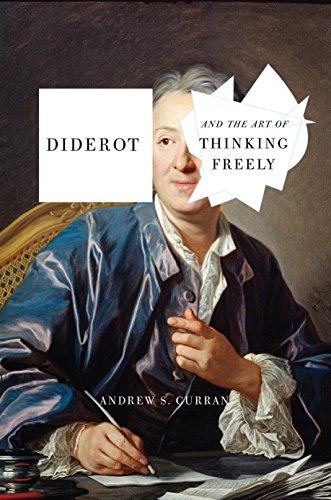
Ebook Info
- Published: 2019
- Number of pages: 529 pages
- Format: PDF
- File Size: 33.55 MB
- Authors: Andrew S. Curran
Description
Best Book of the Year – Kirkus ReviewsA spirited biography of the prophetic and sympathetic philosopher who helped build the foundations of the modern world.Denis Diderot is often associated with the decades-long battle to bring the world’s first comprehensive Encyclopédie into existence. But his most daring writing took place in the shadows. Thrown into prison for his atheism in 1749, Diderot decided to reserve his best books for posterity–for us, in fact. In the astonishing cache of unpublished writings left behind after his death, Diderot challenged virtually all of his century’s accepted truths, from the sanctity of monarchy, to the racial justification of the slave trade, to the norms of human sexuality. One of Diderot’s most attentive readers during his lifetime was Catherine the Great, who not only supported him financially, but invited him to St. Petersburg to talk about the possibility of democratizing the Russian empire.In this thematically organized biography, Andrew S. Curran vividly describes Diderot’s tormented relationship with Rousseau, his curious correspondence with Voltaire, his passionate affairs, and his often iconoclastic stands on art, theater, morality, politics, and religion. But what this book brings out most brilliantly is how the writer’s personal turmoil was an essential part of his genius and his ability to flout taboos, dogma, and convention.
User’s Reviews
Reviews from Amazon users which were colected at the time this book was published on the website:
⭐This is a largely descriptive book on one of the Enlightenment’s greatest avatars, Diderot. It follows how his thought evolved, particularly through the writings he published, but also what he left unpublished in an enormous cache that has been dribbling out posthumously. Unfortunately, for all its enjoyment as a reading experience, I did not feel by the end that I understand what his life and work meant. He was a brilliant polymath, a lover of life, and a kind of early modern Socratic thinker who questioned everything, especially religious dogma: he was openly atheist, skeptical, self aware.Diderot started out as a member of the emerging middle class. His father was an expert artisan of surgical instruments and cutlery in a provincial city, Langres. Of exceptional intelligence and well connected, Diderot seemed destined for the clergy, like his uncle, a Bishop. This would have been a lucrative and secure life, but after much training including top schools in Paris, he was denied promotion, but honestly was also reluctant to give up sex. His decision to go his own way alienated him from his extended family for the rest of his life.Highly educated, Diderot quickly found work as a translator, while beginning to write in a variety of genres. His writings brought him to the attention of conservative censors, who wanted to suppress his apparently atheist-leaning philosophical dialogues. Soon, he was thrown into prison, which he defied and then seemed broken in spirit, begging for release and promising good behavior. This drove much of his writing underground, particularly on religious subjects. As a result, he left an enormous amount of texts unpublished, which he bequeathed to his conservative daughter and a few others; about half of them were not found until after WWII.The book is oddly structured. Part I is a quick and immensely enjoyable biography, which is written in a fluid style that is very fun, mostly about what he published in his lifetime. Part II is broken down by topic – love, sex, art, ethics, biology – and is much less engaging; it flits over the surface of the topics predominantly in his unpublished works instead of embedding his ideas more deeply into Diderot’s times and offering more detailed assessments of how his writing influenced both contemporaries and later generations. I got to the end of the book and felt frustrated that I got so little idea of what he actually accomplished.Diderot was the principal editor and author of the Encyclopedia, a secular compendium of all available knowledge. Curran stresses that it was viewed as a highly subversive undertaking, stopped intermittently by censors and under constant threat from Versailles. He got around this by embedding many of his controversial thoughts in long essays, with a subtle system of cross-referencing them, so that committed readers could find nuggets of information that would teach them how to be freethinkers. Nonetheless, after decades of labor that cost him many of his best years, the printer took it upon himself to edit out a number of the most controversial passages and essays. Diderot was incensed but, Curran argues, he still essentially accomplished his ambition. Admittedly, I do wonder how Curran might prove that Diderot instilled “freethinking”.The other stuff is much less clear to me. Curran’s writing becomes more vague in the second half, making it kind of a mishmash in my reading, adding a further tidbit here about his life and long descriptions of the contents of his writings, including his novels. In his interpretations, Curran offers up an intellectual portrait of sorts, but it was far too speculative for me. For example, in the section on biology, Curran sees Diderot as a direct precursor to Darwinism, in that the study of life was separated from scriptural precepts, hence purely materialistic and mechanistic. What I wonder is how, if at all, he influenced working biologists; Curran offers nothing concrete to back up his claims. (I know it’s hard to judge the “real impact” of ideas, but that was the purpose of the book, or so I thought.) Diderot’s “ethics” is even more convoluted, as are the speculations about sex and love. Though long married, Diderot had a number of mistresses, both intellectual and physical; his attitudes toward physical fulfillment, the purpose of marriage, and the intensity of love should, in Currans’ view, be relevant today.This is a fun, almost breezy read, much of it narrative. I had expected more analysis, some thesis more specific than that Diderot trained us to think freely. The level of the writing is undergraduate or even advanced high school. Recommended as a basic intro.
⭐I learned a lot about one of the greatest thinkers and I guy who loved life and enjoyes it Fully. i fully reccomend.
⭐When he died in 1784, 32 volumes of his unpublished manuscripts and 3,000 books were sent to his friend and benefactor, Catherine the Great, ruler of Russia. He was famous for his 25 years of work on the first great encyclopedia, for which he wrote 7,000 articles, and solicited and edited thousands more. But he deliberately withheld his other writings, after imprisonment for his atheism, until his death. These works would have great influence on the 19th century. He “has now become the most relevant of Enlightenment philosophers.” (7)He trained for the priesthood and became “the most prominent atheist of his era.” “Far more than Voltaire,” Curran writes, “Diderot was the face of an increasingly vocal and skeptical opposition to all received ideas … subjecting religion, politics, contemporary mores … to withering criticism.” Diderot said the role of the philosopher is to “trample underfoot prejudice, tradition, antiquity, shared covenants, authority — everything that controls the mind of the common herd.” (8) Rousseau called him an “astonishing, universal genius.” Rousseau and Diderot were great friends until they became enemies.The huge encyclopedia was “designed to pass on the temptation and method of intellectual freedom to a huge audience.” (102) It was published from 1751 to 1772 in 28 volumes. Diderot was the only editor-writer to stay with it throughout relentless attacks by conservatives, monarch and church authorities who railed against the “spiritual quicksand” of “encyclopedism.” (145) In 1757, as the 7th volume appeared, the king issued a decree that anyone guilty of writings that “attack religion, undermine our authority, trouble the order of our state, will be sentenced to death.” (150) The encyclopedia was periodically banned and burned.A hero of the Enlightenment, new to me, the wealthy aristocrat Chevalier Louis de Jaucourt, devoted himself to saving the Encyclopedia when it was threatened by king and pope, exhausted his fortune and wrote over 17,000 articles for Diderot. One of his articles denounced slavery as no one had ever done in France. (168)In his 25 years of work on the encyclopedia, Diderot “had carried the ideas of the Enlightenment forward in a way that no person, not Voltaire, and certainly not Rousseau, had done before.” (175) Diderot and Voltaire and other French philosophers absorbed the “new philosophy” produced by the English thinkers Bacon, Locke, Newton.A man adopts a materialist, atheist worldview and has the inner resources to pursue arduously a great purpose, to obtain and share knowledge, and strength of character to persist courageously in face of life-threatening opposition, demonstrating, in the words of Lionel Trilling, “the moral obligation to be intelligent.” Isn’t this a decisive answer to the question “If God does not exist, is virtue possible?” — a question Diderot explored in his withheld masterpiece RAMEAU’S NEPHEW (1761-1781). This book astonished Goethe in 1803.Diderot was “the single most important French interpreter of the remarkable political experiment taking place on the other side of the Atlantic” — the American Revolution. (369)Diderot wrote prolifically for the rest of his life on many subjects, withholding publication, believing posterity would benefit and preserve his legacy. Curran has written several books on Diderot’s work, and give a good review of these works in this book.
⭐Diderot was a very brave man who well and truly thought outside the box. We are now surrounded by celebrities that are just clones, the herd, following a few “leaders”. Read this book and be transported to a time when the superstitious old thinking was being challenged. This book is a wonderful romp through his amazing life.
⭐The exhaustive amount of detail – with much repetition – diminishes the impact of what is important to know!
⭐Me rappeler certaines règles d’éthique que épistolaireTediously boring and the redundancy is deliberate.
⭐Too bad I did not return this book in time.
Keywords
Free Download Diderot and the Art of Thinking Freely in PDF format
Diderot and the Art of Thinking Freely PDF Free Download
Download Diderot and the Art of Thinking Freely 2019 PDF Free
Diderot and the Art of Thinking Freely 2019 PDF Free Download
Download Diderot and the Art of Thinking Freely PDF
Free Download Ebook Diderot and the Art of Thinking Freely