

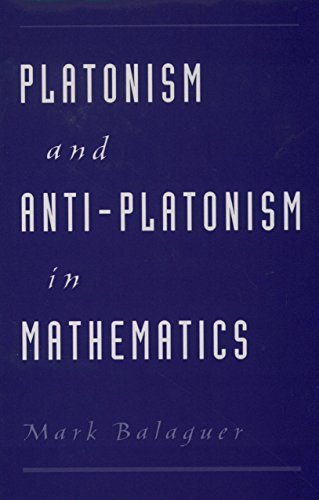
Ebook Info
- Published: 1998
- Number of pages: 222 pages
- Format: PDF
- File Size: 13.76 MB
- Authors: Mark Balaguer
Description
In this highly absorbing work, Balaguer demonstrates that no good arguments exist either for or against mathematical platonism-for example, the view that abstract mathematical objects do exist and that mathematical theories are descriptions of such objects. Balaguer does this by establishing that both platonism and anti-platonism are justifiable views. Introducing a form of platonism, called “full-blooded platonism,” that solves all problems traditionally associated with the view, he proceeds to defend anti-platonism (in particular, mathematical fictionalism) against various attacks-most notably the Quine-Putnam indispensability attack. He concludes by arguing that it is not simply that we do not currently have any good arguments for or against platonism but that we could never have such an argument. This lucid and accessible book breaks new ground in its area of engagement and makes vital reading for both specialists and all those intrigued by the philosophy of mathematics, or metaphysics in general.
User’s Reviews
Reviews from Amazon users which were colected at the time this book was published on the website:
⭐This is a remarkably forceful and ambitious book but a veryworthy read nonetheless. Balaguer is clearer in his arguments than about any other contemporary philosopher I have read on the subject! He does however make a few discernable mistakes and shows a surprising lack of depth is some of his tangential examinations as pointed by some of his reviewers (I am thinking of Colyvan and Zalta whose review of this book can be found on the web). Also, out of breath as I was, by the time I finished this book, I cannot say I feel persuaded by its thesis with respect to the indescernability between Fictionalism and Platonism. This is mostly because he means to accomplish it through a nominalization of Quantum Mechanics which I find not just blatantly flawed but ultimately indefensible (but I will address why I think so in a review of Hatry Field’s book on Fictionalism since my qualms start with his own approach to this program. With David Malament I doubt QM can be nominalized or fictionalized.). Still Balaguer’s notion of Full-Bloodied Platonism, the peculiar point-of-view he develops and embraces in this work is extremely interesting and challenging: it comes down to the notion that all “broadly possible” mathematical structures exist. This happens to be, though Balaguer seems anaware of it, a thesis currently arrived at by physical cosmologists speculating about the “Multiverse” (see Mark Tegmark’s recent Scientific American article on “Parallel Worlds”)! When different lines of speculation arrive at the same concepts there is some hint of historical consensus one tends to suspect a metaphysical corner where we are all about to get stuck for a while! On the other hand I cannot help to remark how simplistic and misleading is the language in which philosophers insist in carrying their arguments! An example from the beginning is the characterization of an abstract object as one that exists “non-spaciotemporaly”. Though he ends up debating some of the obvious problems with thisdistinction Balaguer never addresses today’s scientific consensus that space-time itself is an abstract object of some sort (except if you ask Julian Barbour and his Leibnitzian crowd), either Riemann space or Multiverse, so one may naturally ask why should it be a previledged reference for existence (among such objetcs)? On this matter I take a a more radical view than Balaguer, which I would call “Full-Bodied Platonism”, by arguing that all that exists are abstract mathematical objects (but NOT all mathematical objects need exist)! That is what he calls spaciotemporal existents (that includes us, at least the ones among us who cartesianly think they exist) whose existence is merely contingent on our participation in the true (eternal and necessary) existence of such abstractions. (But wait! Isn’t that what Plato thought?)
⭐To my mind, the author was trying to prove two things:a) that he is smarter than Kurt Godel, and anyone else who has thought about the problem, andb) that the correct answer to Platonism vs Fictionalism is “who knows or cares?”I was unconvinced by the former and underwhelmed by the latter. On internalising the latter, I was unable to finish the book. Perhaps the rest is better, or perhaps I was expecting something else. Or perhaps, being not even as smart as Godel, I am just not clever enough. Who knows, who cares?
⭐A wonderful and great book indeed! The arguments are best explained by Mark Balaguer himself and he does it in a highly eloquent way. A book which is worth reading it! Even twice!
Keywords
Free Download Platonism and Anti-Platonism in Mathematics in PDF format
Platonism and Anti-Platonism in Mathematics PDF Free Download
Download Platonism and Anti-Platonism in Mathematics 1998 PDF Free
Platonism and Anti-Platonism in Mathematics 1998 PDF Free Download
Download Platonism and Anti-Platonism in Mathematics PDF
Free Download Ebook Platonism and Anti-Platonism in Mathematics