

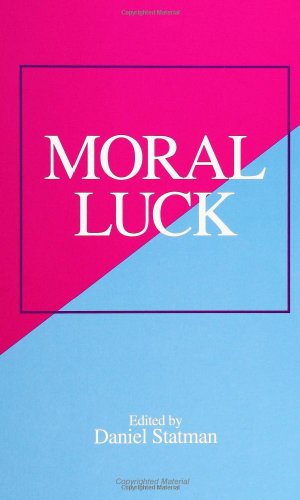
Ebook Info
- Published: 1993
- Number of pages: 258 pages
- Format: PDF
- File Size: 10.87 MB
- Authors: Daniel Statman
Description
Luck plays a part in determining our judgments and in causing us to question our notions of morality. Should a successful murderer be punished more severely than an unsuccessful one? Should a person be praised for his fine moral character which was a consequence of his good luck in being born into a certain kind of family, in particular historical circumstances? These questions and other ideas are discussed in this book by leading philosophers including: Bernard Williams, Thomas Nagel, Martha C. Nussbaum, Don Levi, Judith Andre, Henning Jensen, Nicholas Rescher, Norvin Richards, Steven Sverdlik, Judith Jarvis Thomson, Michael J. Zimmerman, and Margaret U. Walker. The reader is stimulated to reflect on his or her basic notions of morality, especially those of responsibility, agency, and justification.
User’s Reviews
Editorial Reviews: Review “This is a topic of immense importance. It is hard to believe that more has not been done in this area. It is both important in its own right and also important in assessing the plausibility of Kantian ethics.” ― Gregory Mellema, Calvin College About the Author Daniel Statman teaches in the Department of Philosophy at Bar-Ilan University in Israel.
Reviews from Amazon users which were colected at the time this book was published on the website:
⭐Statman has collected an interesting series of papers on moral luck. With an excellent introduction by Statman and postscript by Williams
⭐
Keywords
Free Download Moral Luck (SUNY Series in Ethical Theory) in PDF format
Moral Luck (SUNY Series in Ethical Theory) PDF Free Download
Download Moral Luck (SUNY Series in Ethical Theory) 1993 PDF Free
Moral Luck (SUNY Series in Ethical Theory) 1993 PDF Free Download
Download Moral Luck (SUNY Series in Ethical Theory) PDF
Free Download Ebook Moral Luck (SUNY Series in Ethical Theory)