

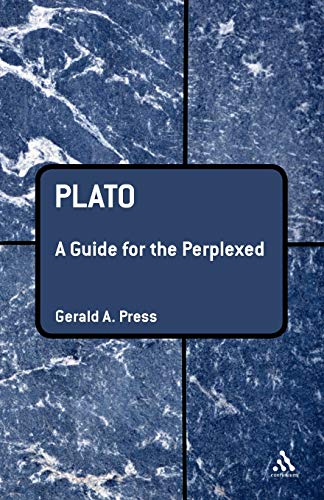
Ebook Info
- Published: 2007
- Number of pages: 250 pages
- Format: PDF
- File Size: 0.87 MB
- Authors: Gerald A. Press
Description
It is widely agreed that Plato laid the foundations for the whole history of western thought and, well over 2000 years later, his work is still studied by every student of philosophy. Yet his thought and writings continue to evoke perplexity in readers; and perplexity (aporia) is itself a characteristic of many of his writings, a recurrent motif of his thought, and apparently an important stage one must pass through along the path to wisdom that Plato presents.Plato: A Guide for the Perplexed is a clear and thorough account of Plato’s philosophy, his major works and ideas, providing an ideal guide to the important and complex thought of this key philosopher. The book offers a detailed review of all the major dialogues and explores the particular perplexities of the dialogue form. Geared towards the specific requirements of students who need to reach a sound understanding of Plato’s thought, the book also provides a cogent and reliable survey of the whole history of Platonic interpretation and his far-reaching influence. This is the ideal companion to the study of this most influential and challenging of philosophers.
User’s Reviews
Editorial Reviews: Review “[The book] is comprehensive, full of useful advice for anyone teaching Plato at any level. Press gives us the information we need to have at our fingertips, but his suggestions only increase the excitement of reading the dialogues themselves.” – Debra Nails, Professor of Philosophy, Michigan State University, USA”It appears that things have changed in Plato scholarship during the quarter century that has elapsed since I was trained as an undergraduate in philosophy and classical languages and, consequently, a book that I cannot recommend enough is Gerald A. Press, Plato: A Guide for the Perplexed.” – Peter Wright, Teaching for Inclusion: Difficult Dialogues (Blog), July 25, 2008 (Peter Wright)”a book such as Press’s is very timely. It works out in detail the implications of Plato’s use of the dialogue as a literary form, and suggests ways of reading the dialogues in the light of this, recognising such things as the mixture of truth and fiction, the use of irony and the use of myth”The international journal of the platonic tradition, 2009 (A. H. Lesser)“It appears that things have changed in Plato scholarship during the quarter century that has elapsed since I was trained as an undergraduate in philosophy and classical languages and, consequently, a book that I cannot recommend enough is Gerald A. Press, Plato: A Guide for the Perplexed.” – Peter Wright, Teaching for Inclusion: Difficult Dialogues (Blog), July 25, 2008 (Sanford Lakoff)”a book such as Press’s is very timely. It works out in detail the implications of Plato’s use of the dialogue as a literary form, and suggests ways of reading the dialogues in the light of this, recognising such things as the mixture of truth and fiction, the use of irony and the use of myth”The international journal of the platonic tradition, 2009 (Sanford Lakoff) About the Author Gerald A. Press is Professor of Philosophy at Hunter College and CUNY Graduate Center, USA.
Reviews from Amazon users which were colected at the time this book was published on the website:
⭐This is a very good book, appropriately titled a “guide” rather than an “introduction.” Although it has an introductory character and generally avoids (or explains) technical terms, etc., it tends to assume familiarity with Plato’s dialogues and to some extent their historical and intellectual context and background. I can imagine someone who’s read a few “early” dialogues (with interest) profiting from this book, but it probably wouldn’t be my first suggestion to someone unfamiliar with Plato.I put “early” in quotes because Press considers the traditional “developmental” approach to Plato interpretation (e.g. Vlastos) mistaken. He doesn’t provide much detail, but after a decent, brief history of interpretation he says the “developmental” approach, built on stylometry, was undone by computerized stylometry (though he acknowledges it supports a late group). The other major approach he discounts is the “esoteric” (e.g. Tubingen, the “unwritten doctrines”). His approach is “dramatic” (apparently influenced by Sayre’s Plato’s Literary Garden), central to which are contextualism (historical, cultural, regarding characters and setting), organicism (all parts of a dialogue are integral parts of a complex whole), and holism (all dialogues are interrelated parts of an integrated corpus). Press prefers to view the dialogues arranged by dramatic date, beginning with Parmenides and ending with Phaedo.I’m not convinced the traditionalists have been as thoroughly refuted as Press seems to believe, and in addition to the Seventh Letter he dismisses The Laws as spurious without much explanation. A reasonable case could possibly be made for this, but his arguments seem a bit weaker if The Laws is genuine. There are also disadvantages as well as advantages to viewing the dialogues arranged by dramatic date (e.g. it suppresses the close relationships between Parmenides, Theaetetus, Sophist and Politicus; and detailed stylometry aside, there seem to be similarities of composition, content and approach in the traditional groupings, for whatever reasons, which merit consideration).Regardless, Press makes a very reasonable and compelling case that context, characters, scene, action, digressions, allusions and correspondences with history, stories and myths are highly relevant to interpretation, and that the dramatic and philosophical are inextricably interwoven in Plato. He also makes a reasonable case that the Platonic corpus forms a whole which is important to interpretation of individual dialogues. Although attempts have often been made to extract the philosophy from the drama (e.g. translations that delete interlocutors’ names), he’s convincing in arguing that this can only hinder our understanding of the dialogues.Press sees Platonic interpretation as typically either dogmatic (presenting systematic doctrines) or skeptical (suggesting knowledge isn’t possible). In contrast to both, he sees Plato as a great dramatist – a master of irony, paradox, authorial anonymity, use of myths, play, and an array of other literary devices – which he uses to “enact” his open-ended philosophy, causing the reader to be deeply engaged in it. This is a more pleasurable approach to philosophy than reading a treatise, and it draws us in both emotionally and intellectually, giving us impetus to think through the questions rather than merely assenting to or disagreeing with presented statements. We’re also shown the correspondences or lack thereof between statements and actions of the characters in the dialogues. This attracts us to Socrates, the hero of the dramas and a type of the philosopher. It attracts us to his way of life and his ideas, and so to philosophy as represented by him. At the same time we’re repelled by the unpleasant characters, and so disinclined towards their behavior and ideas (sophistry, political demagoguery and self-seeking). Being neither dogmatic nor skeptical, Press argues that this open-ended philosophy has persistent themes constituting (in part) Plato’s philosophical vision.He considers that, for Plato, philosophy is an activity rather than a set of doctrines, and that “the examination of propositions and arguments is not a philosophical end in itself, but a means of character formation.” Plato “seeks to inculcate orientations, attitudes and practices, not specific beliefs,” meaning philosophy for Plato is “provisional rather than final.” It “has a wider scope than modern conceptions of philosophy, but it is also different in its orientation. Its central questions are moral, ethical and political, rather than questions of logic, epistemology and metaphysics.” The suggestion that epistemology is not a central question for Plato is debatable. In light of that statement it might be no surprise that Press tends to focus on the “earlier” dialogues, but the tendency isn’t excessive and he certainly doesn’t ignore Platonic epistemology.Press says that Plato doesn’t offer propositional, or discursive, knowledge, but a vision, which is like a theory (e.g. of evolution) which is synoptic rather than propositional, and synthetic rather than analytical. This vision is “complete in a moment,” i.e. intuitive. A fundamental part of it is Plato’s two-level conception of reality (e.g. Forms vs. things), but rigid propositions don’t serve the vision. It’s seen in general principles expressed consistently throughout the dialogues (the body-soul composite, the primary importance of caring for the soul). Philosophy is a way of life, and one of joint enquiry through dialectic. Critical to dialectic, besides being social, is its frequently resulting in aporia (lack of resolution or failure to reach conclusion), which has both “therapeutic and pedagogical value.” Realizing one has an incorrect belief, held unreflectively, is a disturbing but important step towards knowledge.Press recommends reading each dialogue at least three times: a logical reading first, then a dramatic and literary reading, then an integrative one. He illustrates this approach with a selection from Meno. Needless to say, there’s some controversial material here, but that seems to be true of virtually anything written about Plato. The book is very well-written, thought-provoking and valuable. It also has a very good brief glossary of Greek terms, good, brief summaries of the dialogues (actually nineteen of the twenty-four or so Press considers genuine), and a good bibliography and suggestions for further reading. I recommend it pretty highly, but suggest also reading Platonic introductions or overviews by interpreters with other approaches (e.g. Taylor [qualified due to an implausible view of the “Socratic problem”], Grube, Melling, Rowe, Vlastos; also Allan Bloom’s essay on Republic, which may be considered “esoteric” but has much in common with Press’ approach).
⭐
Keywords
Free Download Plato: A Guide for the Perplexed (Guides for the Perplexed) in PDF format
Plato: A Guide for the Perplexed (Guides for the Perplexed) PDF Free Download
Download Plato: A Guide for the Perplexed (Guides for the Perplexed) 2007 PDF Free
Plato: A Guide for the Perplexed (Guides for the Perplexed) 2007 PDF Free Download
Download Plato: A Guide for the Perplexed (Guides for the Perplexed) PDF
Free Download Ebook Plato: A Guide for the Perplexed (Guides for the Perplexed)