

Ebook Info
- Published: 2014
- Number of pages: 792 pages
- Format: PDF
- File Size: 8.49 MB
- Authors: Eric Poisson
Description
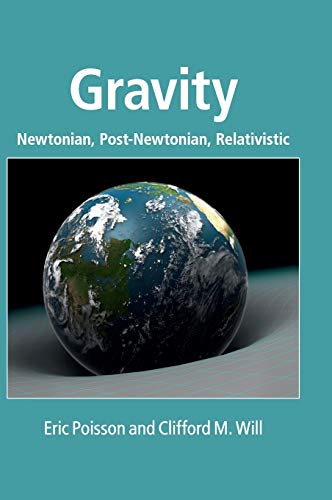
This textbook explores approximate solutions to general relativity and their consequences. It offers a unique presentation of Einstein’s theory by developing powerful methods that can be applied to astrophysical systems. Beginning with a uniquely thorough treatment of Newtonian gravity, the book develops post-Newtonian and post-Minkowskian approximation methods to obtain weak-field solutions to the Einstein field equations. The book explores the motion of self-gravitating bodies, the physics of gravitational waves, and the impact of radiative losses on gravitating systems. It concludes with a brief overview of alternative theories of gravity. Ideal for graduate courses on general relativity and relativistic astrophysics, the book examines real-life applications, such as planetary motion around the Sun, the timing of binary pulsars, and gravitational waves emitted by binary black holes. Text boxes explore related topics and provide historical context, and over 100 exercises present challenging tests of the material covered in the main text.
User’s Reviews
Editorial Reviews: Review “This remarkable book gives a superb pedagogical treatment of topics that are crucial for modern astrophysics and gravitational-wave science, but (sadly) are generally omitted from textbooks on general relativity, or treated much too briefly. With enthusiasm, I recommend this book to all astrophysicists, gravitational physicists, and students of these subjects.” Kip S. Thorne, California Institute of Technology”This book is likely to become the bedside reading of all students and working scientists interested in Newtonian and Einsteinian gravity. Pedagogically written using fully modern notation, the book contains an extensive description of the post-Newtonian approximation, and is replete with useful results on gravitational waves and the motion of bodies under gravity.” Luc Blanchet, Institut d’Astrophysique de Paris”I know of no other text that compares with this compendium of tricks for calculating observables in the large fraction of the universe that is not near an event horizon. Eric Poisson and Clifford Will, two world-renowned leaders in the field, have produced the ideal manual for anyone who wishes to do calculations relevant to current experiments or upcoming gravitational-wave observations. … The clear, unified presentation in Gravity is a must-read for anyone wishing to absorb the material efficiently. … a great textbook for a special-topics graduate course after the introductory relativity course, a crucial study aid for anyone learning about astrophysical relativity and gravitational waves, and a lifelong reference for career researchers.” Benjamin Owen, Physics Today Book Description A unique graduate textbook that develops powerful approximation methods and their applications to real-life astrophysical systems. About the Author Eric Poisson is Professor of Physics at the University of Guelph. He is a Fellow of the American Physical Society and serves on the editorial boards of Physical Review Letters and Classical and Quantum Gravity.Clifford M. Will is Distinguished Professor of Physics at the University of Florida and J. S. McDonnell Professor Emeritus at Washington University in St Louis. He is a member of the US National Academy of Sciences, and Editor-in-Chief of Classical and Quantum Gravity. He is well known for his ability to bring science to broad audiences. Read more
Reviews from Amazon users which were colected at the time this book was published on the website:
⭐Clifford Will: ” distinguished professor of physics at the University of Florida will receive the 2019 Albert Einstein Medal from the Albert Einstein Society, being recognized for his contributions to physics and to theory of General Relativity, including the post-Newtonian expansions of the Einstein field equations and their confrontation with experiments.”A recent acquisition and a joy to peruse. Pedagogic, lucidly written, ‘boxes’ for enrichment and excellent exercises of varying degrees of difficulty. An exposition of gravity in all its manifestations: Newtonian, Post-Newtonian, Relativistic. An invaluable textbook of utility for students, professors and researchers.(1) Your background should be the equivalent of a solid fourth year undergraduate student of physics.(2) You get thorough review of Newtonian gravity, orbital mechanics and a modernization of outlook for today’s student. Read: “Equation #1.98 (compact form of Euler and continuity equations) is independent from, and indeed more fundamental than, the Einstein field equations.” (page 26). Read: “There is no measurable way to determine the true position of the center of mass.” (page 48). Boxed material offers more, for example, regarding tidal deformation analogy to single harmonic oscillator driven by external force (page 124).(3) Up to date applications for astrophysics (Caveat/Preface: no cosmology) and a review of tensor analysis plus a variety of mathematical techniques utilized throughout the discourse. Read: “Einstein’s original Principle of Equivalence formulation is not an equivalence, but a tautology.” (page 221).(4) Pay attention to end of chapter exercises (example: page 285, # 5.2, which pertains to accelerated charges, delightful !). Attention paid to the problem-sets procures skill needed to follow all subsequent developments. Chapters one through five (to page 285) will be in the nature of review (now, I surmise that this material, much of chapter one and two, is foreign to many a reader: built-in assumptions such as linear superposition and the equality of inertial mass density and passive gravitational mass density plus an extensive discussion of tidal deformations). Internal structure of white dwarf stars is described (section 2.2.5, pages 81-88 ). Revel in the description (and a summary of) foundations of Newtonian gravity.(5) My favorite chapters: (third) orbital dynamics, celestial mechanics, Kepler, Lagrange; (sixth) Landau-Lifshitz formulation along with Green’s functions (Box # 6.5, Green’s function for wave equation). Chapter ten: clock synchronization, spinning bodies, precession ! Chapter eight: Maxwell-like formulation of post-Newtonian theory, beautiful ! (Box #8.1). Couched between my favorites, we are treated to expositions of fluid dynamics, Euler equations, conservation laws and isolated bodies.(6) Gravitational Waves, this topic in two chapters, read especially: “Why 45 degrees? ” (page 550). Final chapter: alternative theories, that discussion rounding out an exemplary textbook. In my review I have neglected much: experimental developments: One example “…in 0.1% agreement with the relativistic prediction.” (page 486). But, I am still assimilating the substance of this tome’s unique accomplishment.So, with unbridled enthusiasm I recommend this textbook to all students, professors, researchers.
⭐This book contains a complete pedagogical account of the modern Landau-Lifshitz based approach to post-Minkowskian and post-Newtonian theory, as given for general relativity. It is well written with thorough and illuminating discussion of the issues, as required and welcomed for a subject material that is complex and easy to trip up in if not properly briefed. Poisson and Will are principal developers in this field, so who better to learn from.My one beef is with the quality of the book binding from Cambridge University Press, which may be OK for a cheap paperback but not a quality hardcover academic book. It has literally fallen apart in my hands after months of use, so now I have to buy another copy and treat it with kid gloves, gluing the unsupported paper block spline to the inside of the hard cover before using. But this has nothing to do with the superb content.
⭐Writing this book must have been an extraordinary challenge. If all the details are included then the book must have bulged to thrice its size. The authors have cut corners at the right places so as to cover this advanced aspect of general relativity for the readers. Currently, there is no better book on post-Newtonian theory than this one.
⭐This book is at a high level, but offers a wealth of information not found in other single sources. It belongs on the shelf of anyone seriously interested in Gravitation. I was particularly impressed with the coverage of Newtonian gravitation as a foundation for the remainder of the book.
⭐With the recent disscoveries of dark matter and dark energy gravity has become an important topic in physics. This advanced textbook explores approximate solutions to general relativity and their consequences. It is recommended reading for physicists with advanced degrees.
⭐Great book. A masterpiece. Extremely useful too, e.g. for looking up the post-newtonian equations of motion.
⭐Fantastic text leading up to the recent discovery of gravitational waves! A must read for students and professionals alike!
⭐i love this book. well written and clear descriptions of the equations.
⭐excellent
Keywords
Free Download Gravity: Newtonian, Post-Newtonian, Relativistic 1st Edition in PDF format
Gravity: Newtonian, Post-Newtonian, Relativistic 1st Edition PDF Free Download
Download Gravity: Newtonian, Post-Newtonian, Relativistic 1st Edition 2014 PDF Free
Gravity: Newtonian, Post-Newtonian, Relativistic 1st Edition 2014 PDF Free Download
Download Gravity: Newtonian, Post-Newtonian, Relativistic 1st Edition PDF
Free Download Ebook Gravity: Newtonian, Post-Newtonian, Relativistic 1st Edition