

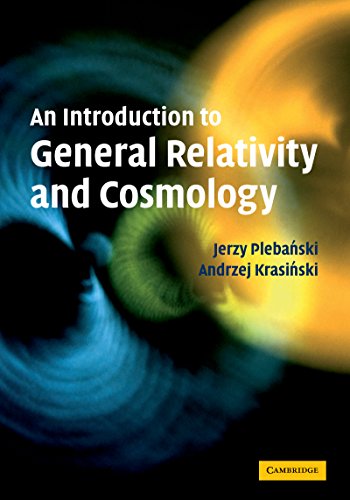
Ebook Info
- Published: 2006
- Number of pages: 558 pages
- Format: PDF
- File Size: 3.06 MB
- Authors: Jerzy Plebanski
Description
General relativity is a cornerstone of modern physics, and is of major importance in its applications to cosmology. Plebanski and Krasinski are experts in the field and in this book they provide a thorough introduction to general relativity, guiding the reader through complete derivations of the most important results. Providing coverage from a unique viewpoint, geometrical, physical and astrophysical properties of inhomogeneous cosmological models are all systematically and clearly presented, allowing the reader to follow and verify all derivations. For advanced undergraduates and graduates in physics and astronomy, this textbook will enable students to develop expertise in the mathematical techniques necessary to study general relativity.
User’s Reviews
Reviews from Amazon users which were colected at the time this book was published on the website:
⭐This is a difficult book to review. First note: this text is not an “introduction.” Second note, this is not as much a textbook as it is a monograph (had it been marketed as such, I believe it would be better known).The back-cover reads that it serves as “a textbook for advanced undergraduates and graduates,” however I would not recommend this textbook to an undergraduate student. Now, allowing for those reservations, there is much here of value, especially, for researchers ! Let us take a tour:(1) We note: the metric utilized is (+,-,-,-), opposite to many introductions, a student will need to re-adjust accordingly. Special relativity will not be reviewed in the text. A student needs to know relevant aspects of special relativity as summarized in Misner, Thorne and Wheeler’s Gravitation (1973, 2017). For the purpose of summarizing special relativity Plebanski refers to the text by Trautmann and Kopczynski, Spacetime and Gravitation (1992). Trautmann and Kopczynski is a rather terse and advanced exposition.(2) Mathematics is presented in a “top-down” approach. That is, the discussion begins with manifolds and then proceeds to ‘add structure’ as we go forward. I recommend (at a minimum) knowing parts of track one of Misner, Thorne, Wheeler. Robert Wald’s General Relativity can also be recommended for reviewing mathematical preliminaries (his chapter two and chapter three).(3) Initial chapters (one to seven) comprise the ‘introductory’ aspects of this monograph. If prerequisites assumed, this comprises a seventy page survey of mathematical material: Wedge product for forms here (page 41, although forms have not yet been defined). A discussion of signature (+,-,-,-) is useful (page 50). Discussion of ‘interval’ in four-dimensional spacetime is noteworthy (page 61). Gauss-Codazzi equations presented (page 68; compare this to Wald, page 258), followed by an all-too brief encounter with Petrov classification (also, pages 113-122 are too brief, yet, essential for Petrov classification by spinors ).(4) If a student has succeeded in assimilating these 70 pages of ‘introduction,’ the remainder of the book offers nuggets of wisdom. I highlight chapter eight: Symmetries and Killing Vector Fields. We read: “the number of linearly independent Killing vector fields can be larger than the dimension of the manifold.” (page 79). Spherical symmetric form given a rapid-fire derivation (page 84 ). Chapter nine consists of a total of five pages: methods to calculate curvature quickly, that is brief ! One returns to Misner, Thorne, and Wheeler for more (Gravitation, chapter 14).(5) The remainder of this book consists of advanced material (at least, advanced to my way of thinking).A reconsideration of Petrov classification utilizing spinors occupies chapter eleven (of nine pages). This is essential material with 15 exercises devoted to verification of equations (page 122). Consult Robert Wald, chapter thirteen or John Stewart for additional material discussed at a more leisurely pace.(6) Finally, Einstein equations (chapter twelve). First note: Equation #12.21, index positions do not match between the two sides of the equation ! (page 131). Read: “The Einstein equations had for many years been rumored to be very difficult, almost too difficult to find any exact solutions. This opinion lingers until today and is even repeated in some publications, although it ceased to have any basis decades ago,” and “finding a solution for a simple situation does not really help in looking for more general solutions.” (page 145).(a) Read: “For brevity, we have omitted several instructive analogies of the linearized Einstein equations to Maxwell’s equations…” (page 156). That omission is unfortunate and as a remedy of sorts reference is made to Stephani’s (excellent) 1990 text.(b) Read: “there is no general criterion that would allow one to distinguish between a true singularity from a singularity introduced artificially together with the coordinate system (page 191).(c) Read: “Other observationally meaningful quantities are specific flux, intensity of radiation, specific intensity…while being useful for observations, these quantities do not really involve relativity in their definitions and properties, and are handled by routine mathematics.” (chapter sixteen). The monograph references the beautiful review article by Ellis, 1971: Relativistic Cosmology.(7) Chapters 16, 17, 18, and 19 are headlined Relativistic Cosmology (Parts 1, 2, 3, 4). Advanced they are, but fascinating. Read: “if we wish to stick with the tradition that physics is an empirical science, inflation can not be called a physical theory.” (page 286, Section #17.9, written by Andrzej Krasinski).(8) Kerr solution concludes the book. Read: “The Kerr metric was discovered rather accidentally…”(page 438). For the story as told by Roy Kerr I refer to: The New Zealand Listener (25 September 2004).This final chapter 20 (sixty pages) is a useful exposition. Penrose process mentioned (page 486), but the section of Newtonian analogues is brief (page 493).(9) There are exercises. These conclude each chapter. Some are simple: “show that the geodesics on a 2-dimensional sphere are great circles.” (problem #2, page 72, hint provided). Others are more involved: “verify that the tensors E and H, and the vector-field u, determine the Weyl tensor.” (#9, page 72).Helpful hints are usually provided. Topics omitted include: gravitational waves and experimental tests.(10) Concluding: This is not really a first or second course in General Relativity. It is more a potpourri of advanced topics. This is not really an introduction for undergraduates. But, with sufficient background, there is much of interest. When utilized as a reference for advanced topics, it is quite useful.
⭐A master piece from an important scientist!
⭐This book written by Andrzej Krasinski and Jerzy Plebanski is a true masterpiece indeed.I have adopted it for my General Relativity graduate course. Unfortunately I was able to cover only the selected topics during the one semester course. Among the selecta from this rich and wonderful masterpiece, which is in my opinion of rather SPECIAL PHYSICAL IMPORTANCE,is the one based on Professor Krasinski’s 1978 article published in ANNALS OF PHYSICS, Ellipsoidal Space-Times, Sources of the Kerr Metric.
⭐Fantastic book. Going into details of relativity not normally seen in texts
⭐This is an advanced textbook on general relativity and cosmology, yet it’s very pedagogic. Being a newbie to the general relativity I find this book an excellent choice to develop my understanding of this beautiful physical theory.
Keywords
Free Download An Introduction to General Relativity and Cosmology in PDF format
An Introduction to General Relativity and Cosmology PDF Free Download
Download An Introduction to General Relativity and Cosmology 2006 PDF Free
An Introduction to General Relativity and Cosmology 2006 PDF Free Download
Download An Introduction to General Relativity and Cosmology PDF
Free Download Ebook An Introduction to General Relativity and Cosmology