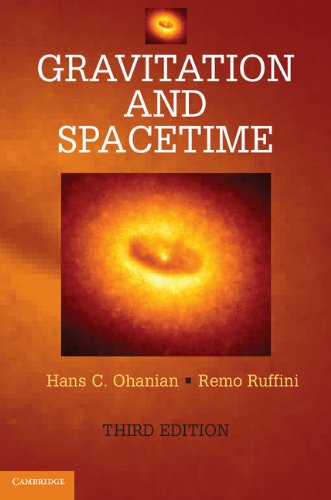
Ebook Info
- Published: 2013
- Number of pages: 545 pages
- Format: PDF
- File Size: 6.55 MB
- Authors: Hans C. Ohanian
Description
The third edition of this classic textbook is a quantitative introduction for advanced undergraduates and graduate students. It gently guides students from Newton’s gravitational theory to special relativity, and then to the relativistic theory of gravitation. General relativity is approached from several perspectives: as a theory constructed by analogy with Maxwell’s electrodynamics, as a relativistic generalization of Newton’s theory, and as a theory of curved spacetime. The authors provide a concise overview of the important concepts and formulas, coupled with the experimental results underpinning the latest research in the field. Numerous exercises in Newtonian gravitational theory and Maxwell’s equations help students master essential concepts for advanced work in general relativity, while detailed spacetime diagrams encourage them to think in terms of four-dimensional geometry. Featuring comprehensive reviews of recent experimental and observational data, the text concludes with chapters on cosmology and the physics of the Big Bang and inflation.
User’s Reviews
Reviews from Amazon users which were colected at the time this book was published on the website:
⭐Of the over 30 texts we review in our ClassPros professional text/course evaluation groups, this volume has become THE favorite for first year grad texts, and in the top 5 for advanced undergrad texts on relativity.The approach of the authors is very unusual. Most texts either take relativity just as Einstein did, with curved spacetime tensors and his field equation, OR gradually build to pre-quantum using electromagnetic analogies instead. This is the one text that travels to the beat of it’s own drum: first, it takes the much simpler, more intuitive, and more in tune with current experimental methods “assume there was no Einstein” approach of deriving relativity from Maxwell (extending electromagnetic functional analogies to relativistic spacetime and gravitation) as well as experimental results that Einstein somehow anticipated with “blind genius.” Next, it REPEATS those initial 5 chapters by going through the whole derivation again in ANOTHER 4 chapters, this time using Einstein’s logic and methodology, albeit peppered with a ton of current validation examples!This is a lot like the “wax on – wax off” method of teaching programming, by the time you’re done you REALLY get it, or, you commit suicide. If you’re an undergrad attempting this text, make SURE you’ve taken linear algebra, several advanced astronomy and physics classes, ODEs and PDEs, a course on tensors, and at least a Maxwell orienting electromagnetics course. While the text is clearly written, the notation is maddeningly grad level, using triple integrals for 3 and 4D spacetime integration without the integral signs. If you’re not used to this notation, you’ll have to keep going back to the keys at the beginning of the book to translate the equations.I mention the astronomy classes, because whereas many books on relativity give “examples” that are inherently mathematical, these authors use many more real astronomical examples, making it necessary for you to be able to visualize the mass of the sun, galaxies, planets, etc. as well as speed, distances, etc. Tiny little controversies like dark matter make the discussions even more challenging in that context.For a book that “only” comes out with new editions once every 15 to 20 years (!!! not a typo) compared to the “racket” of publishers who come out with a new edition (eg. operating systems or software) every 6 months, I probably don’t have to tell you that this edition is a MUST if you’ve been using 1994! What’s changed? Everything, because now we’ve got the web! The authors have removed almost their entire bib/notes and references, and refer you to the web. They also do the same for ongoing research.The space generated by that change is well used with many more up to date experimental results charts, photos of experiments, alternate derivations of formulae, etc. Granted, the gravitational constant has only changed by digits to the right of 6.6 since 1895, but there IS a 2006 update! More to the point, inflationary models, Lagrange field equations, new geometric interpretations of gravity, new updates on Hulse-Taylor and gravitational radiation, Fermi coordinates, new coverage of neutron stars, and very recent discoveries of baryon acoustic oscillations with new measurements of cosmic background radiation including speculation and theories about the flatness puzzle. Few of these were “hot” topics 20 years ago!With the caveat that the authors PACK a lot into each paragraph, and you need to really be up on tensors and advanced matrices/ integration for 4D, this is still an amazing and unique text, especially for pre-quantum grad students who want the very latest approach to astrophysics. Hundreds of current experiments are detailed, and references to web resources are given to keep those up do date… maybe for the next 20 years? Highly recommended. I probably don’t need to say this for a text of this quality, but the errors are at a minimum given the time for feed back since E2. I say it anyway given the terrible errors we are seeing today in texts rushed to print– this IS NOT one of those!Library Picks reviews only for the benefit of Amazon shoppers and has nothing to do with Amazon, the authors, manufacturers or publishers of the items we review. We always buy the items we review for the sake of objectivity, and although we search for gems, are not shy about trashing an item if it’s a waste of time or money for Amazon shoppers. If the reviewer identifies herself, her job or her field, it is only as a point of reference to help you gauge the background and any biases.
⭐This is not a comment on the subject content ( I’m still on Chapter 1), but it is just a shame that US publishers insist on low quality just to save on printing costs. Many of the figures and pictures are just awful! Especially in Chapter 4 (compare to the 2nd edition, where the pictures in Ch.4 are in color). I suspect this book is printed in colour and high quality in Europe. I know this is typical with other books where an initially excellent high quality textbook in brilliant colours is ruined when published and sold in the USA.
⭐This is the second book I’ve read by Ohanian. His writing is highly technical and usually written at a more difficult level than comparable books (see his Electrodynamics book compared to Griffiths.) What really makes his books great is the interspersed explanations between bouts of mathematics. Particularly in the first few chapters, he goes through great lengths to explain the experiments that have confirmed the theories discussed. Ultimately this book does a great job of providing mechanical and conceptual explanations of the concepts discussed.Also, I think his problems are pretty fair and self-contained.
⭐Cheap glued binding. Pages fall out. Might as well be a paperback.
⭐This is for the kindle edition only. The text itself is wonderful but the kindle editions contain too many mistakes, especially many misplaced/wrong equations. I eventually ordered the print version. What a waste of money!
⭐Good revision of a classical
⭐Excellent treatment of a difficult subject. Well motivated presentation.
Keywords
Free Download Gravitation and Spacetime 3rd Edition in PDF format
Gravitation and Spacetime 3rd Edition PDF Free Download
Download Gravitation and Spacetime 3rd Edition 2013 PDF Free
Gravitation and Spacetime 3rd Edition 2013 PDF Free Download
Download Gravitation and Spacetime 3rd Edition PDF
Free Download Ebook Gravitation and Spacetime 3rd Edition