

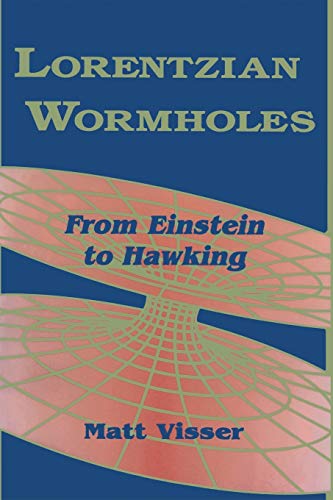
Ebook Info
- Published: 1996
- Number of pages: 437 pages
- Format: PDF
- File Size: 14.42 MB
- Authors: Matt Visser
Description
From H.G. Wells to Star Trek, audiences have been captivated by the notions of time travel, time warps, space warps, and wornholes. But science fiction is not the only realm where these concepts thrive. An active group of general relativists and quantum field theorists has produced a considerable body of serious (thought admittedly speculative) mathematical and physical analyses of the wormhole system. Now, with this fascinating book, readers can explore in depth the science behind the science fiction. Drawing on pivotal work by Einstein, Wheeler, Morris, Thorne, Hawking, and others, Matt Visser charts the development and current state of Lorentzian wormhole physics. Dr. Visser shows that by pushing established physical theories to their limits, it is possible to deduce the physical properties of such exotica as wormholes and time travel. The physical framework he uses is derived from one of the major research frontiers of modern theoretical physics: quantum gravity-the intersection of classical Einstein gravity and quantum field theory. Physicists, students of general relativity, cosmology, quantum physics, or any interested reader with a background in physics wil find this a provocative introduction to an exciting and active topic of ongoing research.
User’s Reviews
Reviews from Amazon users which were colected at the time this book was published on the website:
⭐Wormholes, and rotating black holes…my personal favorites!
⭐It’s perfect and unique textbook in its field of general relativity. Recommanded for all who are interested in up-to-date stage of traversable wormhole studies.
⭐Matt Visser: “The question we will like to ask and answer in here is whether all the consequences of this universal character of gravity have already been fully explored.” (arXiv: gr-qc 1805.05583.v1). A beautiful essay ! Co-Winner 2018 First Prize Essay of the Gravity Research Foundation: “Gravity’s Universality.”Kip Thorne: “Unfortunately, despite considerable effort, theoretical physicists have not yet deduced definitely whether the laws of physics permit such wormholes to exist and stay open, though indications are pessimistic.” (2017, page 69, Modern Classical Physics).Matt Visser has written an unusual monograph. Prerequisites for understanding are perusal of ‘Track One’ of Misner, Thorne and Wheeler’s Gravitation, and Ryder’s Quantum Field Theory text. After which, turn to the article: “Wormholes in Spacetime and Their Use For Interstellar Travel: A Tool For Teaching General Relativity” (Morris and Thorne,1988, American Journal of Physics). Happily, Visser reminds the reader that: “understanding the vast phenomenological success of QFT in describing elementary particle physics is not necessary to understanding this monograph.” (page 37). Six-parts: background, history, renaissance, time-travel, quantum effects and reprise. Now more:(A) Dimensional analysis gets one off and running. Chapter four (pages 39-42) describes the geometrized units. If new, confusing or perplexing, then a review of dimensional analysis is in order. As examples: pages 188 and 189.(B) Exercises are strategically placed throughout the book and are essential for going forward through the text. Some are easy (the author labels them as such), some difficult, some are “tedious.” How to proceed ? Complete the “easy” exercises upon first encounter, then return to the more involved exercises as your understanding unfolds. Let us read what Matt Visser has to say:(1) “…a naive application of general relativistic ideas seems to predict internal structure for elementary particles…in violent conflict with the experimental situation” (page 49). Complete exercises # 1, 2 & 3 (page 49, labelled “easy” ).(2) “…it is surprisingly difficult to even get agreement as to what sort of process would constitute a true change in topology.” (page 63). Topology (not topology ‘change’) in various guises met again throughout the text: “Topology change in classical general relativity is not merely an energetically forbidden process, rather it is a kinematically forbidden process.” (page 71). Thus, chapter six, SpaceTime Foam, needs to be assimilated ! Especially: Theorems (see pages 64-67). Read the “research problem” regards “Planck mass.”(3) Casimir Energy: “…an awful lot of gibbering nonsense has been written about zero-point-energy. Proceed at your own risk.” (page 83).(4) Read Morris and Thorne (1988 paper), after which chapter eleven will be palatable. Invaluable asset: inequalities. As with dimensional analysis, a thorough understanding of inequalities is often eschewed in traditional coursework ! Think about it ! In any event, if you provide intermediate steps in manipulations (say, from pages 103 to 109) then all will fall into place.(5) Thin Shell Formalism, chapter 14: “major tool to analyze traversable wormholes without spherical symmetry.” Next chapter applies this formalism to Wormholes. So, study chapters 14 and 15 as a unit !If you are inclined for more, read Eric Poisson’s excellent chapter three in A Relativist’s Toolkit (2004).(6) Two types of “time machine” defined (page 206). Read: “diseased boundary conditions lead to diseased physics.” and “it is sometimes claimed that Godel solution proves the existence of time travel as a real physical phenomenon. I view such claims as gross over enthusiasm.” (pages 218 and 219). Finally: “a rule of thumb seems to be that closed timelike curves are associated with sufficiently rapid rotation.”(7) I highlight this remark: “it is the metric that has to be smooth, this does not mean the components of the metric have to be smooth.” (page 240). Complete an exercise asking you to “prove” equation #18.46 (page 241). Excellent pedagogy !(8) Topology (again) is chapter 19. Read: “the ordinary notion of spacetime as a Hausdorff differential manifold is clearly inadequate to the task”–the task of accommodating time travel effects.You meet “interpretations of quantum mechanics.” (pages 258-262).(9) Casimir (again ! ): A discussion of chronology protection conjecture. Consult Birrell and Davies (1982).(10) The final part: quantum effects ( the best part of the monograph, also more technical). Read here of: fluctuations, Van Vleck determinants: “essentially a measure of the tidal focusing of geodesic flows” and inequalities ! (page 306), then, Wheeler-Dewitt equation. Before attempting this material, understand the formalism of “WKB-approximation.” Read: “If the reader feels at this stage that the situation is still rather murky and confusing, well, congratulations, welcome to research.”(11) An excellent bibliography directs the reader to research articles and textbooks (fifteen pages). Note: item #292 (page 392). Visser has written an unusual monograph. What one gets out of it depends heavily upon one’s background. There are parts that can be understood by an advanced undergraduate student, but, it seems to best serve as a pointer to possibilities in “research.” Visser dispels many myths and that is good ! The author injects his humor and opinions into the discourse. That is also good ! A final quote: “The experimental data take precedence over theoretical musings.” (page 287).Have fun with this book ! At a minimum, complete the easy exercises !
⭐Some of the words in this book have appeared in movies and science fiction stories, but in this book they take on a mathematical/scientific meaning, thanks to the efforts of the author. Although the concepts in the book are still far-removed from experimental verification, one must credit the author with writing of a book that may be standard reading in centuries to come. When reading the book, one can only hope that its ideas, or some similar to them, will eventually allow humans to traverse time and space routinely. The reader will need a strong background in general relativity and quantum field theory to really appreciate the book, but after reading it will obtain a solid understanding of what might be calle, in the words of the author, “non-boring” physics.After a brief overview of general relativity and quantum field theory, the author devotes the first part of the book to the history of wormhole physics. I was surprised to learn that the study of wormholes goes as far back as 1916 in paper by the physicist L.Flamm. But it was the desire of A. Einstein and N. Rosen to build a geometrical model of an elementary particle that is finite and singularity-free that set the tone for the research that continues to this day. Their ideas are reviewed in detail, and the author shows that viewing elementary particles as they did predicts they have internal structure, contrary to experiment. The contributions of J.A. Wheeler, namely his interest in topological issues in general relativity, and his geon/spacetime foam ideas are discussed also. The role of wormhole physics in developing a quantum theory of gravity, via the quantization of weak field gravity and the subsequent appearance of gravitons is treated also. The author lists the things that be done with quantized linearized gravity and gives references for research that counters the idea of spacetime foam. “Back-of-the-envelope” calculations are given for the importance of quantum fluctuations in the gravitational field at Planckian scales. A very interesting, and critical discussion is given of topology changes of spacetime via quantum fluctuations. The author states (but does not prove) various theorems regarding the topology of spacetime if a Lorentz metric is put on it. These results are pretty restrictive in limiting the existence of certain topology changes, but as the author remarks, one can abandon the idea of spacetime being everywhere-Lorentzian if one gives up the strong equivalence principle, an idea he clearly is not comfortable with. Given his remarks, it is interesting to ask whether quantum fluctuations could force a violation of the strong equivalence principle. The author does consider the role of quantum tunneling in changing spacetime topology, but concludes that it is not a meaningful question. However, he does devote a brief paragraph to the consideration of an energy-dependent effective topology which is the one of relevance to physics. Based on the “quantum claustrophobia” effect arising from the tendency of a particle to avoid small regions (i.e Heisenberg uncertainty), some regions of spacetime may thus not be visible from a quantum point of view. The author gives one example of this, but this idea has far-reaching consequences: not just for physics but for mathematics. If viewed from a quantum perspective, many of the usual mathematical structures in topology and other areas of mathematics are changed considerably. One can then perform a kind of interpolation between “quantum” and “classical” mathematical constructions.The author switches to more modern developments in part 3, with the idea of a traversable wormhole due to M. S. Morris and K.S. Thorne leading off the discussion. These wormholes are shown to violate the weak, strong, and dominant energy conditions, implying the existence of negative energy density near the throat of the wormhole. The existence of this energy will remind the reader of the Casimir effect, and the author does discuss this effect in detail. In addition, the thin shell formalism is discussed as a tool to analyze traversable wormholes without spherical geometry. Global techniques and the topological censorship are used to give a mathematically precise definition of a traversable wormhole, although the censorship theorem is not proven.Part 4 attempts to remove the idea of time travel from pure fantasy science fiction and give it more of a scientific foundation. The author is convincing in his efforts, via his thorough analysis of causality conditions in spacetime, and the explicit constructions of simple time machines, which in the author’s words are a consequence of general relativity being “infested” with geometries that produce them. The van Stockum, Godel, Kerr, and Gott tiem machines are discussed in detail, and the author shows explicitly how to construct time machines via wormholes. He also addresses the problems that arise in the actual construction of these time machines, such as the possibility of a non-Hausdorff topology, the problem of unique histories (Novikov conjecture), the breakdown of unitarity in the quantum realm, and the Hawking chronology protection conjecture.Section 5 is an overview of the quantum field theory needed for a study of wormhole physics. The author shows that time- and space-orientable spacetimes are incompatible with the Standard model. He discusses in detail the result that the ANEC condition can be violated by scale anomalies. Readers will have to have a very detailed knowledge of quantum field theory in curved spacetime to follow the discussion. The calculation of van Vleck determinants, familiar as Green function techniques, are done also. The stress-energy tensor is calculated explictly for traversable wormhole spacetimes. The Wheeler-DeWitt minisuperspace formalism is used to shed light on the quantum aspects of Lorentzian wormholes, and the Wheeler-DeWitt equation for Einstein gravity on minisuperspace is solved exactly.The last part of the book is more of a send off to the reader and an encouragement for further reading on the issues in the book A list of research problems in given for the ambitious and curious reader.
Keywords
Free Download Lorentzian Wormholes: From Einstein to Hawking (AIP Series in Computational and Applied Mathematical Physics) 1996th Edition in PDF format
Lorentzian Wormholes: From Einstein to Hawking (AIP Series in Computational and Applied Mathematical Physics) 1996th Edition PDF Free Download
Download Lorentzian Wormholes: From Einstein to Hawking (AIP Series in Computational and Applied Mathematical Physics) 1996th Edition 1996 PDF Free
Lorentzian Wormholes: From Einstein to Hawking (AIP Series in Computational and Applied Mathematical Physics) 1996th Edition 1996 PDF Free Download
Download Lorentzian Wormholes: From Einstein to Hawking (AIP Series in Computational and Applied Mathematical Physics) 1996th Edition PDF
Free Download Ebook Lorentzian Wormholes: From Einstein to Hawking (AIP Series in Computational and Applied Mathematical Physics) 1996th Edition