

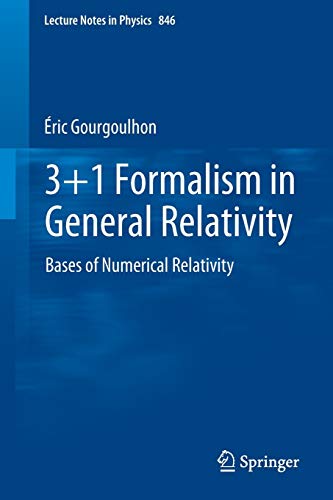
Ebook Info
- Published: 2012
- Number of pages: 311 pages
- Format: PDF
- File Size: 4.36 MB
- Authors: Éric Gourgoulhon
Description
This graduate-level, course-based text is devoted to the 3+1 formalism of general relativity, which also constitutes the theoretical foundations of numerical relativity. The book starts by establishing the mathematical background (differential geometry, hypersurfaces embedded in space-time, foliation of space-time by a family of space-like hypersurfaces), and then turns to the 3+1 decomposition of the Einstein equations, giving rise to the Cauchy problem with constraints, which constitutes the core of 3+1 formalism. The ADM Hamiltonian formulation of general relativity is also introduced at this stage. Finally, the decomposition of the matter and electromagnetic field equations is presented, focusing on the astrophysically relevant cases of a perfect fluid and a perfect conductor (ideal magnetohydrodynamics). The second part of the book introduces more advanced topics: the conformal transformation of the 3-metric on each hypersurface and the corresponding rewriting of the 3+1 Einstein equations, the Isenberg-Wilson-Mathews approximation to general relativity, global quantities associated with asymptotic flatness (ADM mass, linear and angular momentum) and with symmetries (Komar mass and angular momentum). In the last part, the initial data problem is studied, the choice of spacetime coordinates within the 3+1 framework is discussed and various schemes for the time integration of the 3+1 Einstein equations are reviewed. The prerequisites are those of a basic general relativity course with calculations and derivations presented in detail, making this text complete and self-contained. Numerical techniques are not covered in this book.
User’s Reviews
Editorial Reviews: Review From the reviews:“The monograph originating from lectures is devoted to the 3+1 formalism in general relativity. It starts with three chapters on basic differential geometry, the geometry of single hypersurfaces embedded in space-time, and the foliation of space-time by a family of spacelike hypersurfaces. … With the attempt to make the text self-consistent and complete, the calculations are … detailed such that the book is well suitable for undergraduate and graduate students.” (Horst-Heino von Borzeszkowski, Zentralblatt MATH, Vol. 1254, 2013)“This book is written for advanced students and researchers who wish to learn the mathematical foundations of various approaches that have been proposed to solve initial value problems (with constraints) for the Einstein equations numerically. … Even for experts it may be useful, as it includes an extensive bibliography up to 2011.” (Hans-Peter Künzle, Mathematical Reviews, January, 2013) From the Back Cover This graduate-level, course-based text is devoted to the 3+1 formalism of general relativity, which also constitutes the theoretical foundations of numerical relativity. The book starts by establishing the mathematical background (differential geometry, hypersurfaces embedded in space-time, foliation of space-time by a family of space-like hypersurfaces), and then turns to the 3+1 decomposition of the Einstein equations, giving rise to the Cauchy problem with constraints, which constitutes the core of 3+1 formalism. The ADM Hamiltonian formulation of general relativity is also introduced at this stage. Finally, the decomposition of the matter and electromagnetic field equations is presented, focusing on the astrophysically relevant cases of a perfect fluid and a perfect conductor (ideal magnetohydrodynamics). The second part of the book introduces more advanced topics: the conformal transformation of the 3-metric on each hypersurface and the corresponding rewriting of the 3+1 Einstein equations, the Isenberg-Wilson-Mathews approximation to general relativity, global quantities associated with asymptotic flatness (ADM mass, linear and angular momentum) and with symmetries (Komar mass and angular momentum). In the last part, the initial data problem is studied, the choice of spacetime coordinates within the 3+1 framework is discussed and various schemes for the time integration of the 3+1 Einstein equations are reviewed. The prerequisites are those of a basic general relativity course with calculations and derivations presented in detail, making this text complete and self-contained. Numerical techniques are not covered in this book.
Reviews from Amazon users which were colected at the time this book was published on the website:
⭐Excellent short book. Great derivations, very logical presentation. A great way to quickly get up to speed on 3+1 formulation of GR and be ready to read the literature and start working on simulations.
⭐Everything OK !
⭐Cet ouvrage constitue une référence pour celui qui veut aborder le formalisme 3+1.Pour en profiter, il est cependant nécessaire d’avoir de bonnes bases en relativité générale.Le niveau doctorat est recommandé.L’auteur explique de façon claire et rigoureuse le formalisme mathématique utilisé, tout en détaillant la démonstration de nombreux résultats.Je conseillerais fortement cet ouvrage à tout étudiant ou chercheur souhaitant se lancer dans cette thématique.
⭐
Keywords
Free Download 3+1 Formalism in General Relativity: Bases of Numerical Relativity (Lecture Notes in Physics, Vol. 846) 1st Edition in PDF format
3+1 Formalism in General Relativity: Bases of Numerical Relativity (Lecture Notes in Physics, Vol. 846) 1st Edition PDF Free Download
Download 3+1 Formalism in General Relativity: Bases of Numerical Relativity (Lecture Notes in Physics, Vol. 846) 1st Edition 2012 PDF Free
3+1 Formalism in General Relativity: Bases of Numerical Relativity (Lecture Notes in Physics, Vol. 846) 1st Edition 2012 PDF Free Download
Download 3+1 Formalism in General Relativity: Bases of Numerical Relativity (Lecture Notes in Physics, Vol. 846) 1st Edition PDF
Free Download Ebook 3+1 Formalism in General Relativity: Bases of Numerical Relativity (Lecture Notes in Physics, Vol. 846) 1st Edition