Ebook Info
- Published: 2014
- Number of pages: 299 pages
- Format: PDF
- File Size: 1.81 MB
- Authors: Yvonne Choquet-Bruhat
Description
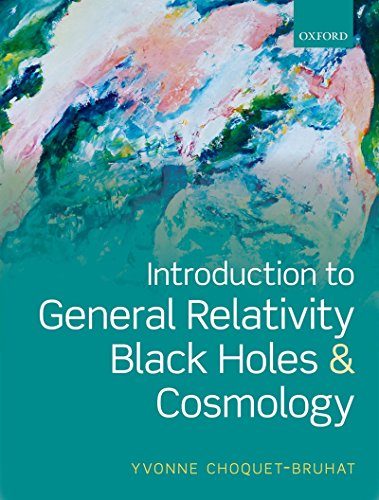
General Relativity is a beautiful geometric theory, simple in its mathematical formulation but leading to numerous consequences with striking physical interpretations: gravitational waves, black holes, cosmological models, and so on.This introductory textbook is written for mathematics students interested in physics and physics students interested in exact mathematical formulations (or for anyone with a scientific mind who is curious to know more of the world we live in), recent remarkable experimental and observational results which confirm the theory are clearly described and no specialised physics knowledge is required. The mathematical level of Part A is aimed at undergraduate students and could be the basis for acourse on General Relativity. Part B is more advanced, but still does not require sophisticated mathematics.Based on Yvonne Choquet-Bruhat’s more advanced text, General Relativity and the Einstein Equations, the aim of this book is to give with precision, but as simply as possible, the foundations and main consequences of General Relativity. The first five chapters from General Relativity and the Einstein Equations have been updated with new sections and chapters on black holes, gravitational waves, singularities, and the Reissner-Nordström and interior Schwarzchild solutions.The rigour behind this book will provide readers with the perfect preparation to follow the great mathematical progress in the actual development, as well as the ability to model, the latest astrophysical and cosmological observations. The book presents basic General Relativity and provides a basis for understanding and using the fundamental theory.
User’s Reviews
Reviews from Amazon users which were colected at the time this book was published on the website:
⭐Another text for which I am inclined to rate five stars. Unfortunately, the text suffers, being too concise and condensed to serve as a genuine introduction. That noted, the material presented is done so in a manner made most clear. Although emphatically not for the uninitiated, the book does manage to convey depth and breadth. Examples: A discussion of Yang-Mills Fields offers compact interlude, yet too advanced for a beginner (pages 52-53) ! A remark, “The geometric equations found by Einstein…are the very simple ones…” (page 70), is a subjective view which an expert appreciates more so than a novice !(1) Margin-notes accompany the primary text material, these margin notes add pedagogic usefulness to the text.We read: ” It is possible that all fundamental particles have zero rest- mass, and that the positive rest-mass of the particles that appear to us…is only an interaction energy.” (page 48). Margin-Note #10 should be heeded for assimilation of section #2.5, Electromagnetic Field and Maxwell Equations in Minkowski Spacetime. Margin-Note #11 refers to the text of Misner, Thorne and Wheeler (page 40), however, that textbook is not found among the reference list ! (pages 267-272).(2) There are useful remarks: Remark # 1.5.1, “We adopt ‘mostly plus’ MTW convention. Some authors adopt the opposite, but, they give equivalent geometrical results…surprisingly this is not true of non-orientable manifolds.” (page 13).(3) The exercises sprinkled throughout are in many instances provided with hints or solutions. There are nice problems: Einstein cylinder, De-Sitter and Anti-De Sitter spacetimes (pages 95-98), following which are solutions. A few problems are trivial (examples: #3.9.2 and #3.9.3, geometrized units and dimensional analysis, page 66-67). A few are simple: exercise #6.31, page 137, is offered a computational solution (page 150-151). Others are only slightly more involved: exercise #7.92 (page 170, utilizing Taylor series and inequalities. Not all exercises are simple: exercise #4.92 (page 94) !Note: exercise #1.41, page 10, has an unfortunate typo in the second term on the right-hand side of the equal sign.In any event, the exercises and their solutions provide enrichment alongside immediate testable understanding.Peruse the author’s earlier book: “Problems and Solutions in Mathematical Physics” to get further acquainted with the style (published 1967).(4) A minor quibble: Only a paragraph devoted to thermodynamics of Black Holes, that discussion should be amplified (page 149). Otherwise, an interesting chapter six devoted to Black Holes. The mathematical review in the first chapter will elude most novices, but for those with sufficient background it presents a nice compendium. Read “The physically realistic problem is to link the abstract reference frames with a concrete observable one.”(5) Chapter two: Special Relativity, too condensed for a novice, but lucid if one possesses requisite background (happily, no “ict”). Read: “The Lorentz contraction and dilation are not intrinsic to the phenomena.” (page 40) and “There is no intrinsic splitting between gravity and inertial type forces, nevertheless gravity is a physical reality that can not be assimilated with the old notion of Inertia.” (page 62).(6) Einstein’s equations, presented fourth chapter, represents thoughtful discussion of WKB approximation applied to study of nonlinear effects. Advanced topics are treated in the final three chapters of the text: Cauchy problem, relativistic fluids, kinetic theory.(7) More awaits the student between these covers. Careful reading will be rewarded. Were one to browse its simpler content, absent mathematical compass, it would still be possible to profit from the text. Read: “Lagrangians, arising from energies, play a fundamental role in physics. The Lagrangian formulation of the Einstein equations stands apart, being unrelated to a point wise, intrinsically defined, gravitational energy.” (page 91). To gain maximum utility from the content, a student (mathematics or physics) needs minimum preparation equivalent to a four-year degree (to assimilate chapters two through seven) or, higher-level coursework (to assimilate the final chapters). Chapter one stands apart as mathematical review (of 35 pages), yet the solved problems are helpful in assessing gaps in such background (page 29 is challenging).
⭐Outstanding ! Mathematically rigorous (yet quite accessible). Very affordable too.The first seven chapters provide an excellent (graduate level) coverage of the main GR topics.Part B covers more advanced (less accessible) topics.Previous to attempting to digest this book, I’d recommend going thru an intro book (such as the excellent Ta-Pei-Cheng’s book)
⭐Very interesting studybook on GR by a theoretical physicist who has spend a lifetime of research on fundaments of mathematical physics.
⭐Wonderfully explained by one of the very originators of Mathematical Relativity. Lots of exercises with hints to some of them help develop your familiarity with the topics.
⭐satisfied
⭐I reviewed a review copy of this book. I was expecting more of a general text on the subject. This is not really the case. In the promotion text (here on Amazon) it says”This introductory textbook is written for mathematics students interested in physics and physics students interested in exact mathematical formulations (or for anyone with a scientific mind who is curious to know more of the world we live in)”Take this VERY, VERY seriously. Unless you are well versed in manifolds, tensors and tensor fields, and a variety of higher (beyond diff eq) math, then this book won’t mean much to you . I was going to give you a taste by writing the third sentence from the book proper (not the preface or forward), but I can’t because the Amazon text editor can’t do the math symbols required. The third sentence.That all being said, the few parts that were not based in fundamental math were very interesting. However, I found the grammar and word choice a little odd, even allowing for my limited (comparatively) understanding of the math involved.Make no mistake, this is a text book for the mathematical underpinnings of General Relativity. However, I did find that the discussion of black holes was very limited (one chapter, plus a chapter Scharzschild spacetime). Likewise, cosmology got a single chapter out of ten total chapters and I found that the cosmology section was very limited. Specifically it was limited to a very basic mathematical relationship to Relativity and didn’t mention much about cosmology beyond that relationship. So to me, the title was somewhat misleading.With all that being said, I’m sure this is a fine book, for what it is. I’m just not qualified to discuss it at that mathematical level.
⭐Y. Choquet-Bruhat es una científica con un gran conocimiento de Geometría Diferencial y una técnica en exposición clara y rigurosa. Esas dos cualidades hacen que el libro valga la pena.The book is great (at least for someone who’s familiar with the author’s other books). I my opinion physical intuition and mathematical rigor is more or less balanced in this book, which is not an easy task to achieve.However, the printing quality is TERRIBLE! The whole book seems to be printed from an ink-jet printer (cf. the attached photo): the letters have fuzzy edges and it looks like the ink is seeping through the paper. I guess that’s why this book is “cheap” (i.e. below 30 euros), but I honestly think OUP can strike a better balance between price and quality.P.S. according to the copyright page, the book is printed by “Clays Ltd, St Ives plc”
⭐OK
⭐Nice introduction to the essential concepts of GR.
Keywords
Free Download Introduction to General Relativity, Black Holes, and Cosmology 1st Edition in PDF format
Introduction to General Relativity, Black Holes, and Cosmology 1st Edition PDF Free Download
Download Introduction to General Relativity, Black Holes, and Cosmology 1st Edition 2014 PDF Free
Introduction to General Relativity, Black Holes, and Cosmology 1st Edition 2014 PDF Free Download
Download Introduction to General Relativity, Black Holes, and Cosmology 1st Edition PDF
Free Download Ebook Introduction to General Relativity, Black Holes, and Cosmology 1st Edition