

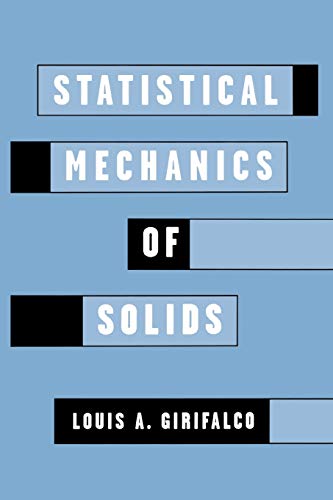
Ebook Info
- Published: 2003
- Number of pages: 544 pages
- Format: PDF
- File Size: 25.39 MB
- Authors: Louis A. Girifalco
Description
This monograph, suitable for use as an advanced text, presents the statistical mechanics of solids from the perspective of the material properties of the solid state. The statistical mechanics are developed as a tool for understanding properties and each chapter includes useful exercises to illustrate the topics covered. Topics discussed include the theory of the harmonic crystal, the theory of free electrons in metal and semiconductors, electron transport, alloy ordering, surfaces and polymers.
User’s Reviews
Editorial Reviews: About the Author Louis A. Girifalco is Professor of Materials Science at the University of Pennsylvania.
Reviews from Amazon users which were colected at the time this book was published on the website:
⭐This remarkable book is addressed to scientists interested in the properties of solids from the point of view of materials science. Statistical mechanics is applied to a broad set of topics of interest in this field and the book has the virtue of filling an existing gap. An earlier book on this subject was published by L. A. Girifalco thirty years ago (Statistical Physics of Materials, 1973). The present book updates the material and adds also a substantial body of novel topics that have vigorously grown and matured meanwhile.The book grew out of a course that the author has been teaching at the University of Pennsylvania. The broad experience of L. A. Girifalco, acquired after many years of research in materials science applying the techniques of statistical mechanics (metallic and graphitic materials, defects in solids and diffusion represent some of the subjects investigated by the author) has provided him with the best background to make a wise selection of topics of importance and broad interest. In addition the contact with the students has allowed the author to optimize the pedagogical aspects. So this book is highly recommended for graduate courses, and students will find it extremely useful to get a comprehensive and updated overview of the field.The first three chapters (approximately one fifth of the book) introduce the basic concepts of thermodynamics and statistical mechanics. This part is needed to make the volume self-contained. Even more, those three chapters, where the fundamental concepts are presented clearly at an accessible mathematical level, could form the core of a short course on basic statistical mechanics for physicists, chemists or engineers. The thermal properties of crystals arising from the vibration of the atoms are treated in Chapters 4 and 5, focusing on harmonic and anharmonic effects, respectively. The equilibrium and transport properties of electrons in metals and semiconductors are considered in Chapters 6 and 7, taking as a basis the free electron model. Classic examples of cooperative phenomena, as order-disorder transitions in alloys and magnetism, are treated in Chapters 8 and 9. The theory of phase equilibria and phase transformations is presented in Chapter 10. Sublimation, melting and the formation of solid solutions in alloys are some of the subjects considered. Critical exponents characterising how of physical properties vary with temperature near a phase transition are presented in Chapter 11, with its explanation by renormalization group theory. The surface of solid bodies is the region of contact with the outer medium and controls many technological properties of the solids. The statistical mechanics of surface and interface effects is treated in Chapter 12, focusing on adsorption, adhesion and segregation. The theory of the random motion of a particle through space, treated in Chapter 13, has a variety of uses: important applications to molecular and atomic diffusion and to the statistics of long chain molecules can be highlighted. In fact, linear polymer chains are treated in Chapter 14. The last two chapters of the book then develop the statistical mechanics of point defects (vacancies and interstitials in solids, substitutional impurities in dilute alloys) and diffusion of point defects. The book also contains several useful mathematical appendixes.In conclusion this book presents a comprehensive and original treatment of the statistical mechanics of solids that will be useful not only to graduate students and teachers, but also to any beginner or experienced scientist interested in this subject.
⭐This is an excellent, well-tested textbook on statistical mechanics for materials scientists and engineers, both graduate students and practitioners who need a refresher on how to apply useful theoretical methods,such as mean-field models of phase transitions,to the analysis of experimental data or, perhaps, want to learn something about new developments in statistical mechanics which are not often covered in materials science and engineering courses, such as critical exponents and the renormalization group. You might wonder why there is a need for yet another textbook on statistical mechanics. Well, this is a book primarily for those interested in understanding or estimating the properties of solids, rather than dwelling on the foundations of statistical mechanics, and there is not another book quite like it. It uses simple mathematics and makes much, fruitful use of simple methods like mean-field theory and simple ways of making improvements thereto. It begins with three brilliantly explained, succinctly written chapters intoducing, or reviewing, the basic principles of thermodynamics and statistical mechanics, and then proceeds to cover their applications to a wide range of topics in the materials science of metals, semiconductors, and polymers. Some applications include bulk thermodynamic properties, surfaces, transport properties of electrons, phonons, and atoms,as well as phase transitions. There are eight appendices where helpful mathematical and methodological details are covered so that the expository prose in the main chapters does not get bogged down in unnecessary details. There are some useful topics covered in this book which are not easily found in other texts: for example, there are three chapters with a careful exposition of the foundations, and some applications, of the thermodynamics and kinetics of lattice defects, a topic of much importance for materials scientists and engineers; the useful and versatile Girifalco-Good method for estimating energies of interfacial adhesion is described; and the Kirkwood second-moment method for going beyond the mean-field approximation in order-disorder is derived and utilized to introduce the Landau theory of phase transitions. These are a few examples of useful topics for materials scientists not readily found elsewhere. There are also illuminating exercises at the end of each chapter. Professor Girifalco is a gifted pedagogical writer, and he has polished much of this material in his courses in the Department of Materials Science and Engineering at the University of Pennsylvania. I myself has used several chapters of this book as reference material for an advanced graduate seminar in the modeling of phase transitions in materials, and they were very successful. I highly recommend this book.
Keywords
Free Download Statistical Mechanics of Solids (Monographs on the Physics and Chemistry of Materials, 58) 1st Edition in PDF format
Statistical Mechanics of Solids (Monographs on the Physics and Chemistry of Materials, 58) 1st Edition PDF Free Download
Download Statistical Mechanics of Solids (Monographs on the Physics and Chemistry of Materials, 58) 1st Edition 2003 PDF Free
Statistical Mechanics of Solids (Monographs on the Physics and Chemistry of Materials, 58) 1st Edition 2003 PDF Free Download
Download Statistical Mechanics of Solids (Monographs on the Physics and Chemistry of Materials, 58) 1st Edition PDF
Free Download Ebook Statistical Mechanics of Solids (Monographs on the Physics and Chemistry of Materials, 58) 1st Edition