

Ebook Info
- Published: 2010
- Number of pages: 424 pages
- Format: PDF
- File Size: 3.72 MB
- Authors: Lori Meeks
Description
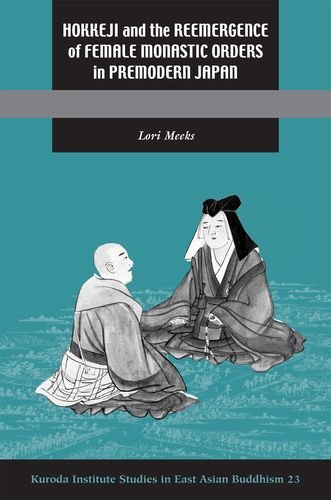
Winner of the 2012 John Whitney Hall Prize. Hokkeji, an ancient Nara temple that once stood at the apex of a state convent network established by Queen-Consort Kōmyō (701-760), possesses a history that in some ways is bigger than itself. Its development is emblematic of larger patterns in the history of female monasticism in Japan. In Hokkeji and the Reemergence of Female Monastic Orders in Premodern Japan, Lori Meeks explores the revival of Japan’s most famous convent, an institution that had endured some four hundred years of decline following its establishment. With the help of the Ritsu (Vinaya)-revivalist priest Eison (1201-1290), privately professed women who had taken up residence at Hokkeji succeeded in reestablishing a nuns’ ordination lineage in Japan. Through the lens of Hokkeji, Meeks considers a broad range of issues surrounding women’s engagement with Buddhism during a time when their status within the tradition was undergoing significant change. The thirteenth century brought women greater opportunities for ordination and institutional leadership, but it also saw the spread of increasingly androcentric Buddhist doctrine. Hokkeji explores these contradictions. In addition to addressing the socio-cultural, economic, and ritual life of the convent, Hokkeji examines how women interpreted, used, and “talked past” canonical Buddhist doctrines, which posited women’s bodies as unfit for buddhahood and the salvation of women to be unattainable without the mediation of male priests. Texts associated with Hokkeji, Meeks argues, suggest that nuns there pursued a spiritual life untroubled by the so-called soteriological obstacles of womanhood. With little concern for the alleged karmic defilements of their gender, the female community at Hokkeji practiced Buddhism in ways resembling male priests: they performed regular liturgies, offered memorial and other priestly services to local lay believers, and promoted their temple as a center for devotional practice. What distinguished Hokkeji nuns from their male counterparts was that many of their daily practices focused on the veneration of a female deity, their founder Queen-Consort Kōmyō, whom they regarded as a manifestation of the bodhisattva Kannon. Hokkeji rejects the commonly accepted notion that women simply internalized orthodox Buddhist discourses meant to discourage female practice and offers new perspectives on the religious lives of women in premodern Japan. Its attention to the relationship between doctrine and socio-cultural practice produces a fuller view of Buddhism as it was practiced on the ground, outside the rarefied world of Buddhist scholasticism.
User’s Reviews
Editorial Reviews: Review “Well written and well edited, this book is a landmark in scholarship on Japanese Buddhism, women and Buddhism, and the history of monastic institutions.” –Fabio Rambelli, Harvard Journal of Asiatic Studies “This meticulously researched volume documents how women in Japanese Buddhist orders negotiated the constraints of their presumed inferiority, barriers to Buddhist education, and obstacles to full ordination.” –Karma Lekshe Tsomo, Journal of the Economic and Social History of the Orient”This study will become a standard reference on the topic of women in medieval Japanese Buddhism for years to come.” –James C. Dobbins, Religious Studies Review”Meeks eschews the notion of female monastic life as being either repressed or for that matter, liberated; instead, she . . . explains how [women’s] performance of religion differed greatly from what one might assume based on doctrinal assertions about female salvation.” –Tom Conlan, The Journal of Asian Studies”[Hokkeji] may be the best book on Buddhism in pre-modern Japan published in recent years. . . . To my knowledge, no other book so successfully reveals the actual intersections of monastery, court, and society in Kamakura Japan.” –Miriam Levering, Monumenta Nipponica From the Back Cover “This book makes major contributions to at least three key topics: women and Buddhism, mainstream Buddhism in premodern Japan, and religious institutions as settings for cultural and religious life. It is the first study to provide readers with a detailed and comprehensive overview of a single specific religious site and the women who lived there. Although the number of works that deal with women and Buddhism continues to grow (testifying to the on-going interest in this topic), none to my knowledge have yet attempted such a sustained analysis of a female religious order. While the so-called new Buddhism of the Kamakura period attracts the most attention from scholars, this study demonstrates the importance of the mainstream religious centers of Nara (and Kyoto) for our understanding of religions in premodern Japan.–William M. Bodiford, University of California, Los Angeles “This is one of the best books on Japanese Buddhism I have read in recent years. There are a number of books and collections of essays that deal with the relationship between women and Buddhism, but Lori Meeks’ study of Hokkeji surpasses anything else I have seen. While earlier studies have frequently focused on the lives or works of a particular person, Meeks draws on a broad range of sources, both primary and secondary, to reveal some of the presuppositions underlying these earlier studies. In doing so, she gives us a much clearer vision of how medieval women related to Buddhism. Her book should appeal to a wide variety of readers, including those interested in Buddhism, Japanese history, Japanese literature, and gender, and will establish her as a leading figure in the field of women and Buddhism and Japanese Buddhist history.”–Paul Groner, University of Virginia About the Author Lori Meeks is Associate Professor of Religion and East Asian Languages and Cultures at the University of Southern California in Los Angeles. She is also Co-Director of USC’s new Center for Japanese Religions and Culture (CJRC). Read more
Reviews from Amazon users which were colected at the time this book was published on the website:
⭐If you study Buddhism to any serious degree, it doesn’t take long until you realize that for much of its history its doctrines have been slanted with a deeply androcentric or even misogynist set of discourses. The unspoken assumption then has usually been that if it was written down, it was believed–that both men and women automatically internalized those attitudes found articulated in Buddhist texts. One brilliant thing among many that Lori Meeks accomplishes in this brilliant study is to riddle such an assumption to pieces.On a more specialized level, if one looks into Kamakura Buddhism with any tenacity one will soon become familiar with Eison’s Shingon Ritsu movement and with the story of how Eison kindly condescended to help out a group of well-intentioned but non-legit women practitioners at Hokkeji temple and ordain them properly as nuns. Through judicious and extensive investigative work with primary sources, Meeks flips the perspective on this old story and we start to get some sense of what an alliance with Eison and his movement did to further their own goals and intentions. How did they see the relationship, and what was in it for them?If all this book did was make these two important points, that would be enough in and of itself, but in the process the highly detailed and richly complex world of religious belief and practice at this particular time and place is painstakingly brought to life from a variety of angles in these pages. Hokkeji’s shifting fortunes as a pilgrimage destination involving relics and faith in a deified empress, the evolving religious vocations of court ladies and their role in Hokkeji’s revival, the nuts-and-bolts financial aspects of the revival and the socioeconomic dynamics of Hokkeji’s plural class makeup, the nuns’ varied and busy ritual calendar and more are all reconstructed vividly along with a properly cautious and nuanced analysis of the gender dynamics actually operating in religious writings by the nuns of Hokkeji themselves and the Shingon Ritsu monks acquainted with them.”Hokkeji and the Reemergence of Female Monastic Orders in Premodern Japan” then is an accurate if dull title for a deeply interesting and illuminating landmark study in Japanese Buddhist history.
⭐Great book. The author addresses complicated and seemingly obscure topics in an interesting way that makes them very relevant. If you’re interested in Japanese Buddhism, or Women’s studies, this book is a vital new addition to the field.
Keywords
Free Download Hokkeji and the Reemergence of Female Monastic Orders in Premodern Japan (Kuroda Studies in East Asian Buddhism) in PDF format
Hokkeji and the Reemergence of Female Monastic Orders in Premodern Japan (Kuroda Studies in East Asian Buddhism) PDF Free Download
Download Hokkeji and the Reemergence of Female Monastic Orders in Premodern Japan (Kuroda Studies in East Asian Buddhism) 2010 PDF Free
Hokkeji and the Reemergence of Female Monastic Orders in Premodern Japan (Kuroda Studies in East Asian Buddhism) 2010 PDF Free Download
Download Hokkeji and the Reemergence of Female Monastic Orders in Premodern Japan (Kuroda Studies in East Asian Buddhism) PDF
Free Download Ebook Hokkeji and the Reemergence of Female Monastic Orders in Premodern Japan (Kuroda Studies in East Asian Buddhism)