Ebook Info
- Published: 2020
- Number of pages: 976 pages
- Format: PDF
- File Size: 15.83 MB
- Authors: Martine Robbeets
Description
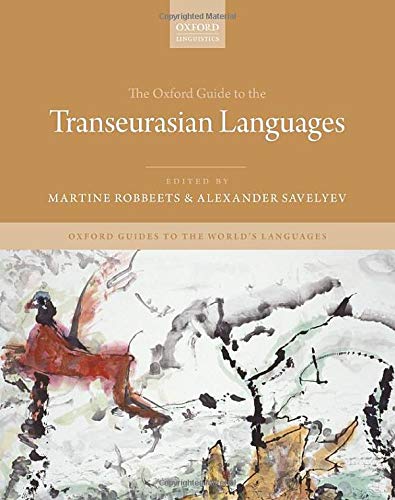
The Oxford Guide to the Transeurasian Languages provides a comprehensive account of the Transeurasian languages, and is the first major reference work in the field since 1965. The term ‘Transeurasian’ refers to a large group of geographically adjacent languages that includes five uncontroversial linguistic families: Japonic, Koreanic, Tungusic, Mongolic, and Turkic. The historical connection between these languages, however, constitutes one of the most debated issues in historical comparative linguistics. In the present book, a team of leading international scholars in the field take a balanced approach to this controversy, integrating different theoretical frameworks, combining both functional and formal linguistics, and showing that genealogical and areal approaches are in fact compatible with one another. The volume is divided into five parts. Part I deals with the historical sources and periodization of the Transeurasian languages and their classification and typology. In Part II, chapters provide individual structural overviews of the Transeurasian languages and the linguistic subgroups that they belong to, while Part III explores Transeurasian phonology, morphology, syntax, lexis, and semantics from a comparative perspective. Part IV offers a range of areal and genealogical explanations for the correlations observed in the preceding parts. Finally, Part V combines archaeological, genetic, and anthropological perspectives on the identity of speakers of Transeurasian languages. The Oxford Guide to the Transeurasian Languages will be an indispensable resource for specialists in Japonic, Koreanic, Tungusic, Mongolic, and Turkic languages and for anyone with an interest in Transeurasian and comparative linguistics more broadly.
User’s Reviews
Editorial Reviews: Review “Comprising nearly 50 entries, this volume covers diverse features of these languages relevant for understanding their intertwined histories. It draws together specialists representing multiple areas of expertise from within and outside linguistics. Rather than supporting one definitive conclusion, the contributors offer differing opinions on whether some or all of these languages are genealogically related. … The meticulous phonological and grammatical descriptions of individual languages or families are superb.” — E. J. Vajda, CHOICE”The book is surely destined to become a standard reference for any scholar working on some of the areas it covers, whether or not they are interested in the overarching Transeurasian hypothesis.” — Linguist List About the Author Martine Robbeets, Research Group Leader, Max Planck Institute for the Science of Human History, Jena,Alexander Savelyev, Postdoctoral Researcher, Max Planck Institute for the Science of Human History, JenaMartine Robbeets is Research Group Leader at the Max Planck Institute for the Science of Human History in Jena and Honorary Professor in Transeurasian Linguistics at the University of Mainz. She currently leads the eurasia3angle research project, which explores the dispersal of the Transeurasian languages and is funded by the European Research Council. Her publications include Is Japanese related to Korean, Tungusic, Mongolic and Turkic? (Harrassowitz, 2005), Diachrony of Verb Morphology: Japanese and the Transeurasian Languages (De Gruyter, 2015), and several edited volumes.Alexander Savelyev is a postdoctoral researcher at the Max Planck Institute for the Science of Human History in Jena. He obtained his PhD from the Institute of Linguistics of the Russian Academy of Sciences in 2015 and joined the eurasia3angle research project in 2016. He currently works on cultural reconstruction of the Proto-Turkic language and its Transeurasian connections, and on verifying the internal structure of the Turkic language family. His other research interests include historical grammar and dialectology of Chuvash, language contact in the Volga-Kama Basin, and documentation of Siberian Turkic languages.
Reviews from Amazon users which were colected at the time this book was published on the website:
⭐I want to put this tiny piece of thought about the book as a person who is not romantically enticed to languages having a superior genetic relationship (or not be a result of borrowings) as a precondition to see work that tries to develop a unified model of approaching the functional parts of languages that show similar characteristics in various aspects. This book is an outstanding work for those who desire to get involved with Transeurasian languages, namely Japonic, Koreanic, Mongolic, Tungusic, and Turkic. The book is a collection of articles that could instead be used for reference than a cover to cover reading; the amount of knowledge is worthy of appraisal, especially regarding the extended range of cited work developed initially without any comparative concerns but very consistently represented here. Such content and well-laid tables make this a treasured piece to keep in the library. There are a few abbreviation mistakes or collisions. Although many people are motivated against this book as if it is the latest of the devil’s word, it has enormous value as a reference for people that want to benefit from the functional implications of the inspected grammatical structures. The book does not disappoint with its scope, quality, and quantity! Congratulations to everyone involved with this project!
⭐Not found.
⭐Not found.
⭐Not found.
Keywords
Free Download The Oxford Guide to the Transeurasian Languages (Oxford Guides to the World’s Languages) in PDF format
The Oxford Guide to the Transeurasian Languages (Oxford Guides to the World’s Languages) PDF Free Download
Download The Oxford Guide to the Transeurasian Languages (Oxford Guides to the World’s Languages) 2020 PDF Free
The Oxford Guide to the Transeurasian Languages (Oxford Guides to the World’s Languages) 2020 PDF Free Download
Download The Oxford Guide to the Transeurasian Languages (Oxford Guides to the World’s Languages) PDF
Free Download Ebook The Oxford Guide to the Transeurasian Languages (Oxford Guides to the World’s Languages)