

Ebook Info
- Published: 2009
- Number of pages: 456 pages
- Format: PDF
- File Size: 1.96 MB
- Authors: Tony Bennett
Description
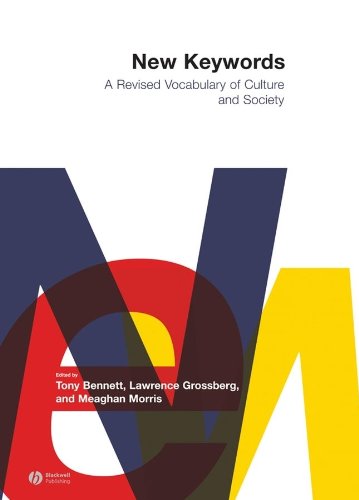
Over 25 years ago, Raymond Williams’ Keywords: A Vocabulary of Culture and Society set the standard for how we understand and use the language of culture and society. Now, three luminaries in the field of cultural studies have assembled a volume that builds on and updates Williams’ classic, reflecting the transformation in culture and society since its publication. New Keywords: A Revised Vocabulary of Culture and Society is a state-of-the-art reference for students, teachers and culture vultures everywhere. Assembles a stellar team of internationally renowned and interdisciplinary social thinkers and theorists Showcases 142 signed entries – from art, commodity, and fundamentalism to youth, utopia, the virtual, and the West – that capture the practices, institutions, and debates of contemporary society Builds on and updates Raymond Williams’s classic Keywords: A Vocabulary of Culture and Society, by reflecting the transformation in culture and society over the last 25 years Includes a bibliographic resource to guide research and cross-referencing The book is supported by a website: www.blackwellpublishing.com/newkeywords.
User’s Reviews
Reviews from Amazon users which were colected at the time this book was published on the website:
⭐Very very good condition, like a new one!
⭐This volume is an update of Raymond Williams’
⭐published in 1985. The original volume was designed to provide “one-stop shopping” for definitions of social science terms used to discuss “culture and society.” The authors have followed three strategies in their update: expanding definitions of the keywords to include conceptual analysis since 1985; adding new keywords which have become important during this time; and removing key words that have declined in importance. The result is a list of 142 keywords, each with an extended discussion of its history and meaning.The book’s value as a reference is a fair matter for debate. In some ways it may be superseded by the type and quantity of information on the web. But there are also advantages to a standard source, at least as a reference point. One additional advantage is its usefulness in building word lists or “content dictionaries” for automated analysis of text collections (see
⭐). The extensive cross-referencing of relationships between keywords and the common vocabulary used in their definitions have a consistency that reduces the amount of work needed to create content dictionary categories with crisp boundaries.I recommend the book for researchers conducting content and text analysis of social and cultural themes.
⭐If you are a communication or sociology major, this book is a must have. I used it all throughout college and it was very useful in my focus studies.
⭐This book, which was required for an introduction to graduate studies course I recently took, is nothing more than a specialized, and random, encyclopedia. The other reviews hail this volume as a “comprehensive resource” for multiple areas of study. The problem is, the definitions of each term are too broad to be useful to specialists and too random and/or inaccessible for people merely interested in these topics. Most of the terms are all so unrelated that I just don’t see the point of owning this book. If you need a definition for “globalism” and “materialism,” buying this book would be useless. There are plenty of free resources online which also define such terms, and often more comprehensively than this broad overview.I can see why such a volume was viable when it was first printed in the 70’s, but why it was reprinted in 2005 is beyond me. This seems to be an intellectual artifact with very little use in the 21st century.
⭐decent price. I used this book for a class. The price was cheaper than what the school book store wanted for it.
⭐View the Contents of this book to see how it fits as a re-newed model:Acknowledgements AbbreviationsIntroductionAesthetics, Alternative, Art, AudienceBehaviour, Biology, Body, Bureaucracy,Canon, Capitalism, Celebrity, Citizenship, City, Civilization, Class, Colonialism, Commodity, Communication, Community, Conservatism, Consumption, Copy, Country, CultureDeconstruction, Democracy, Desire, Development, Diaspora, Difference, Disability, Discipline, Discourse,Economy, Education, Elite, Emotion, Empirical, Environment / ecology, Equality, Ethnicity, Everyday, Evolution, ExperienceFamily, Fashion, Feminism, Fetish, Freedom, Fundamentalism,Gay and Lesbian, Gender, Generation, Gene/genetic, Globalization, GovernmentHeritage, History, Holocaust, Home, Human, Human RightsIdeology, Identity, Image, Indigenous, Individual, Industry, Information, IntellectualJustice, Knowledge, LiberalismManagement, Marginal, Market, Mass, Materialism, Media, MemoryMobility, Modern, Movements, MulticulturalismNarrative, Nation, Nature, Network, NormalObjectivity, Orientalism, OtherParticipation, Person, Place, Policy, Political correctness Popular, Pornography, Postcolonialism, Postmodernism, PovertyPower, Pragmatism, Private, Public, Queer,Race, Radical, Reason, Reform/revolution, Relativism Representation, Resistance, Risk,Science, Self, Sexuality, Sign, Socialism, Society, Sovereignty,Space, Spectacle, State,Taste, Technology, Text, Theory, Therapy, Time, Tolerance, Tourism, Unconscious, Utopia, Value, Virtual, Welfare, West, theWork, Writing, Youth,About the Book:Over 25 years ago, Raymond Williams’ Keywords: A Vocabulary of Culture and Society set the standard for how we understand and use the language of culture and society. Now, three luminaries in the field of cultural studies have assembled a volume that builds on and updates Williams’ classic, reflecting the transformation in culture and society since its publication. New Keywords: A Revised Vocabulary of Culture and Society is a state-of-the-art reference for students, teachers and culture vultures everywhere.
⭐The editors, Tony Bennett, Lawrence Grossberg and Meaghan Morris are well known academics and scholars in cultural studies. The New Keywords is a comprehensive resource for everyone furthering their studies in cultural and literary theory. In addition, students involved in anthropology, sociology and philosophy may find it very useful.
⭐This newly expanded version of Raymond Willaims’ original addresses a host of newly important keywords in addition to the previous selection, and does so with insight, elan, and relevance. It is an interesting read, even if you’re not in need of the sources and shades of meanings of the words included. Among my favorites for words that have been pivotol in discussions of culture and society, are aesthetics, art, ideology, civilization, conservatism, liberalism, education, family, fundamentalism, justice, multiculturalism, objectivity, pragmatism, race, relativism, theory, science, pragmatism, gender, race, and value–just a sample of words needed to discuss issues with deeper understanding than a dictionary provides–even some technical dictionaries. And the discussion is benefitted from the expansion of contributors and the consistency across entries. The entries on aesthetics and pragamtism are particular notable.
Keywords
Free Download New Keywords: A Revised Vocabulary of Culture and Society 1st Edition in PDF format
New Keywords: A Revised Vocabulary of Culture and Society 1st Edition PDF Free Download
Download New Keywords: A Revised Vocabulary of Culture and Society 1st Edition 2009 PDF Free
New Keywords: A Revised Vocabulary of Culture and Society 1st Edition 2009 PDF Free Download
Download New Keywords: A Revised Vocabulary of Culture and Society 1st Edition PDF
Free Download Ebook New Keywords: A Revised Vocabulary of Culture and Society 1st Edition