

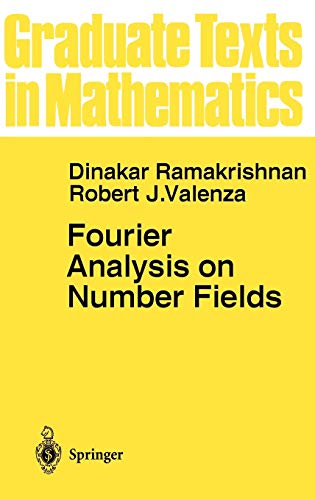
Ebook Info
- Published: 1999
- Number of pages: 376 pages
- Format: PDF
- File Size: 6.67 MB
- Authors: Dinakar Ramakrishnan
Description
A modern approach to number theory through a blending of complementary algebraic and analytic perspectives, emphasising harmonic analysis on topological groups. The main goal is to cover John Tates visionary thesis, giving virtually all of the necessary analytic details and topological preliminaries — technical prerequisites that are often foreign to the typical, more algebraically inclined number theorist. While most of the existing treatments of Tates thesis are somewhat terse and less than complete, the intent here is to be more leisurely, more comprehensive, and more comprehensible. While the choice of objects and methods is naturally guided by specific mathematical goals, the approach is by no means narrow. In fact, the subject matter at hand is germane not only to budding number theorists, but also to students of harmonic analysis or the representation theory of Lie groups. The text addresses students who have taken a year of graduate-level course in algebra, analysis, and topology. Moreover, the work will act as a good reference for working mathematicians interested in any of these fields.
User’s Reviews
Reviews from Amazon users which were colected at the time this book was published on the website:
⭐I first read this book when I was a senior in undergrad, and I loved it… Granted, at the time I could really only understand the first three chapters, but it was this book that made me want to go into analytic number theory. As things turned out, I wound up going into representation theory for quantum groups… But still, the first three chapters of this book (together with the excellent exercises) are what made me fall in love with abstract harmonic analysis.As for the later chapters… There’s not a whole lot of options when it comes to studying field theory from an analyst’s perspective. I’m not terribly good with algebra, so I like having an exposition that’s written only assuming a non-specialist’s knowledge of algebra.Finally, I like how the book has a very clear goal in mind: understand Tate’s thesis. The authors do a good job of summarizing why Tate’s thesis is important at the beginning, and they connect back to it throughout. Learning from this book, you never stop and question, “Why do we care about this?”
⭐I agree very much on what Stephen Miller said. This textbook is a very execellent introductory textbook to modern number theory. It does not require any particular math background besides elementary undergraduate maths so that it is suitable to new graduate students. The exercises are very nice and helpful. The level is a little bit challenging. I ever taught courses based on this book twice and both students and I benefit a lot.For the contents, the textbook provides a thourough treatment on basics of modern NT such as local fields, adeles, ideles, Fourier inverse formula etc. Moreover, I think the textbook might be the best source so far I know for on Tate’s thesis as a textbook. It is a perfect starting book for readers who are interested on automorphic forms. Also, just as Miller said, it is also a good reference book to mathematicians with various background, not just merely number theorists.So I recommend this textbook strongly.Song Wang, the Morningside Center of Mathematics, AMSS, CAS, China.
⭐I don’t agree with the previous reviewer about the value of thisbook – I think that with several minor exceptions there is nothing in this book which could justify its publication.Of course, as it is clear to every expert, there is nothingreally new in this book; but sometimes one can rewrite oldthings in such a way that a new book is justified.With the material of this book I know much better expositionsof every chapter of it (including harmonic analysis, number theory and Tate-Iwasawa method) in other sourses.There are also some mistakes and errors (for example,the Poisson summation formula is not proven),some of which may cause the readerthink that there were mistakes on the original works.This text could have appeared online as lecture notes,but the publication of it by Springer confirm the well known fact of degradation of their mathematical series.D. Ziegler
⭐Not found.
⭐Not found.
Keywords
Free Download Fourier Analysis on Number Fields (Graduate Texts in Mathematics, 186) 1999th Edition in PDF format
Fourier Analysis on Number Fields (Graduate Texts in Mathematics, 186) 1999th Edition PDF Free Download
Download Fourier Analysis on Number Fields (Graduate Texts in Mathematics, 186) 1999th Edition 1999 PDF Free
Fourier Analysis on Number Fields (Graduate Texts in Mathematics, 186) 1999th Edition 1999 PDF Free Download
Download Fourier Analysis on Number Fields (Graduate Texts in Mathematics, 186) 1999th Edition PDF
Free Download Ebook Fourier Analysis on Number Fields (Graduate Texts in Mathematics, 186) 1999th Edition