

Ebook Info
- Published: 2015
- Number of pages: 304 pages
- Format: PDF
- File Size: 1.94 MB
- Authors: Giancarlo Bernacchi
Description
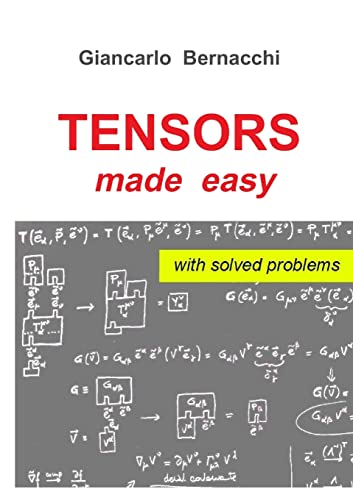
— New MARCH 2021 REVISED RELEASE — A friendly and non-formal approach to a subject of abstract mathematics that has important applications in physics, especially in General Relativity, but also in other fields. The purpose of the book is mainly didactic and requires some mathematical background (differential calculus, partial derivatives included).
User’s Reviews
Reviews from Amazon users which were colected at the time this book was published on the website:
⭐I’ve meant to write a review for this book for a while now, but didn’t get around to doing it until now. I’m currently about to enter physics graduate school and I’ve been trying to understand tensors for a long time now. I’ve looked at dozens of sources that claim to teach the necessary mathematics to understand general relativity, but I’ve always come out disappointed until now. In short, this book is an introductory masterpiece for anyone who seeks to understand tensors. This together with the fact that the book comes with problems and solutions to them means that it is hands down the ideal book for self-study.The biggest strength of this book is the level at which the material is presented and the order in which it is presented. It never feels like you are missing vital details or like it is oversimplifying. At the same time you don’t get bogged down in so many details that you lose understanding. If you manage to work through it you will gain great insight into tensors. This insight will help you understand all those other books that before might have been incomprehensible, and therefore your mastery of the mathematics surrounding relativity will grow exponentially.This book isn’t without its flaws, but its pros far outweigh any of them. One reviewer for example mentioned that it uses “broken English,” but this is in fact misleading. Yes, sometimes the English is a bit incorrect, but it’s still completely understandable. The most common mistake I saw was the author using words ending in “-ing” instead of “-ed” or vice versa. Any English speaker would have no trouble understanding what he meant. I believe the reason for the mistakes is that it’s a translation from Italian. (Also, note I actually have the previous edition. This means that at least some of these errors might have already been corrected in the newer edition.)In any case, this book is a gem, and the author’s systematic step-by-step build up of tensors starting with vectors and covectors is at just the right level for an introduction. And his model for visualizing vectors, covectors, and tensors is not bad either. His model basically reminded me of how Lego blocks connect together. It’s especially useful for beginners. If you continue using the book eventually you won’t need the visuals, but you can still refer to them to clarify stuff. It’s quite a useful model that he presents. It reminds me of Penrose’s diagrammatic tensor notation, but simpler.I think that a good supplement for section 4.6 of this book, which is the section on contravariant and covariant tensors, is chapter 4 of the book A Student’s Guide to Vectors and Tensors. It’s not necessary to do this, but visually it will lead you to a geometric understanding of what it means for something to be covariant or contravariant. I think if you want to become an expert it’s well worth it to read the chapter just before or right after that section 4.6. That book by itself, although highly rated, I think has problems, because it refers to rank-2 tensors as matrices, which can potentially be confusing. However, that chapter is still worth reading as a supplement. It is worth noting that the reason for this is that it is common for physicists to refer to the components of a tensor as the actual tensor. In any case, this book deals with this wonderfully. The book starts out by not following this traditional by-components formalism, and I believe it is one of the reasons why it is so understandable. However, as you progress through the book the author shows both the more rigorous formalism and the by-components formalism. This by extension gives the reader the ability to understand and access a greater number of sources including more traditional ones, and helps when learning about Penrose’s abstract index notation, which is the modern formalism used by relativists.Finally, the only section I thought was hard to read was half of section 5.5 talking about curvature. This is partially in page 101 and partially in page 102. This is about a page of material, so not that much and it’s not that big of a deal. If you go through it carefully enough you can get the meaning probably, but I was in a bit of a rush. In any case I would supplement that section with section 3.3 Curvature from the book A First Course in Loop Quantum Gravity. If you do this, then you will have no problems at all even if you skip that second half of section 5.5 that I mentioned.I suggest that anyone trying to read this book to have at least taken some Vector Calculus. Linear algebra is useful, but is arguably not completely necessary. As long as you know what matrices are, what linear independence is, and basically what vector spaces and linear transformations are, then you will be fine for the most part. Though it’s always useful to know more than what you need, because the more familiar you are with certain concepts the easier to get greater insight on them. With enough dedication and willingness to think about the concepts and review them in your head, I think you will be surprised at the amazing insights you will discover.This book despite its possible flaws doesn’t deserve anything less than 4 stars, but considering how terrible the rest of the literature on tensors can be and considering how incredibly helpful (and inexpensive!) this book is for understanding all those other sources, this book deserves the whole 5 stars in my opinion. Furthermore, considering how one review just uses one sentence to say that it’s in broken English, but I already explained why that is not really the case and that no understanding is lost by any spelling mistakes, then this is an unfair review. Another reviewer just says in one sentence that they don’t understand it, but they don’t explain what they are having trouble with at all. And finally, the third bad review of the book also uses only one sentence and the reviewer just says that they took two years of calculus MANY YEARS AGO. The fact that they don’t understand might be self-explanatory in this case, at least partially.Therefore, considering how poorly the book has been rated, and unfairly so in my opinion, this just further supports why I have given the book the full 5 stars.Note: For those interested in learning even more differential geometry, I suggest the book Differential Forms and The Geometry of General Relativity. It’s not about tensors exactly, but you will understand the connection between differential forms and tensors, and you will learn enough about that language so that you can feel comfortable tackling any text in either the language of differential forms or the language of tensors. Trust me, the sheer pleasure of learning some of the same concepts in a different setting makes it worth the read. For example, the definition of what a geodesic is might seem to differ in these two books, but figuring out how they actually are the same can help you build a solid understanding of the mathematics. Therefore, at the very least I suggest reading the half of the book on differential forms. And after reading all that for those interested in learning group theory, more differential geometry, or quantum gravity I suggest the book GAUGE FIELDS, KNOTS AND GRAVITY.
⭐My edition is labeled the 4th. The definition of a vector in section 1.1 needs to be rewritten and expanded. The writing soon gets much better. The author uses the duality condtion and Kronecker symbol to explain the relationship between basis vectors and covectors. (pages 7-14) The solved problems 2 and 3 at the end of the book beautifully demonstrate this relationship. The T-Mosaic graphic metaphor beautifully illustrates what a tensor is how it is formed (Pages 14-24) Problem 5 nicely demonstrates how a tensor is built from the components of vectors. The book builds on this foundation in the first thirty pages to review the distance , gradient tensors, and covariant derivatives needed for general relativity. The books assumes basic skills in trigonometry, linear algebra, and partial differential equations. If you have read, “Collier’s A Most Incomprehensible Thing”, Bernacchi’s book will provide you more insight into the math of the tensors. Bernacchi’s book with the many solved problems is a wonderfull example of text written for self learners. Please read a few pages at a time. You will have to match each concept with the solved problem in the back. I think a better title for the book would be “Tensors Made Easier”. It will take some time but it is worth the beauty of this math is worth the effort. Addendum: On second reading I have identified a few typos. They are usually obvious. The discussion of symmetry, T-mosiac patterns, and 24 distinct inner products (page 35) needs to be expanded.
⭐First the good: The solved problems are excellent for self learning and understanding what can appear abstract.However, there are several bad points: The book need editing by a native English speaker who knows the subject. There are several (? typo) mistakes in the solutions, which usually correct by the final line. The text is hard to understand at times, because it reads like an Italian speaking English as a second language. Some abbreviations were very confusing to me until I used an Italian dictionary, e.g. “e” means “and” in Italian and “ecc.” is “etc.” There are also some sentences that are totally untranslated. Finally , there is no index in the book, which makes searching for difficult.
⭐Tensors Made Easy is an excellent text with problems at the end of the text that are solved with explanations. I appreciated the explanation of tensors having a basis. Most texts simply start discussing the components of a tensor (or tensors) without mentioning the basis of the tensors. Beware that after the text leaves the easier material of vectors and covectors and begins explaining tensors in general the reader will still be challenged. You have to read it carefully. The t-mosaic technique helps with keeping track of computations with indicies, yet the text does not use them extensively when discussing material leading up to the Einstein tensor. The problems at the end of the text are very helpful and thorough.
⭐No joke, I have been studying (or trying to study) tensors and tensor calculus for over a year. I have used a handful of other books, Tensors Analysis on manifolds, Applications of Tensor Analysis, Tensor Calculus made simple, etc. I’ve also used several online resources.In one week of seriously reading and taking notes from this book, I have learned more from this book than from all other resources over a year. Definitely need a strong linear algebra background, and also a strong calculus background. Other than that, this book gives you everything you need, not just to do the problems, but have the intuition that comes from a deeper grasp of the concepts.
⭐I have a shelf full of books on tensors. The most thorough beyond doubt is Schaum’s Outline “Tensor Calculus”, though it’s very dry. Peter Collier’s “A most incomprehensible thing” includes a friendly and succinct description of tensors, just sufficient to provide a useful handle on general relativity (which after all is why most of us are interested in tensor calculus).Having now read Bernacchi’s book, I finally “get” tensors. The combination of written equations with the visual “t-mosaic” representation helps. For example the t-mosaic representation makes clear whether the result is a tensor, vector, or scaler.There are two serious drawbacks:• The Italian English is a major problem• There’s no index, which is quite extraordinaryThe worked examples were generally good. When I got stuck on the text, going to the problems got me going again. Other reviewers have complained that the examples were gathered together at the back of the book. This wasn’t an issue for me, though an indication of the chapter a problem related to would be helpful.A couple of issues with the content:• I’m not sure I’ve got to the bottom of inner and outer products, homogeneous and heterogenous, scaler and vector products• Bernacchi’s treatment of curvature is disappointing. Extrinsic curvature is irrelevant to tensors in general, and cosmology in particular. It’s only intrinsic curvature that matters. It would be far better if the discussions and derivations were driven entirely from the intrinsic perspective. A discussion on Einstein’s field equations in 2-space (Minkowski space) and in 3-space (x0, x1, and x2) would have been illuminating.I may be wrong, but I believe the book is self-published. This would explain the major drawback of the book: the appalling English (which was often incomprehensible) and the massive number of unnecessary spelling errors. Having worked with translators, I suspect that Bernacchi’s English reflects a difficulty in writing in his own language. A publisher would have addressed these issues, as well as the missing index.In summary, a useful book, let down by poor English and spelling.
⭐Terrible and extremely non-didactic. The author throws a huge amount of theory in the reader without examples (all the solved problems about all the subjects only appear in the end of the book), its basically just equations with explanations of their terms and further mathematical theorems. The “mosaic” approach they use to explain vectors, covectors and tensors is just useless, not making any sense for a serious PhD student. There are no indications on which problem belongs to each chapter and the solutions are right below the statement of the problem, not giving the reader a chance to try to solve it by him/herself. Would never buy it again.
⭐A slightly different approach to Tensors and one that works. Easy to read – cover to cover in 2 days. English is a bit strange in places but perfectly allowable in an advanced maths text.
⭐I bought this book to do a review of the basics of tensors and study them more deeply because I want to learn general relativity.If you are new to tensors, then this book is a good choice for you.I don’t give 5 stars because I think that the solved problems shouldn’t be localized on the end of the book but just right after the chapters.
⭐Prompt service, easy to read volume, highly recommended
Keywords
Free Download TENSORS made easy with SOLVED PROBLEMS in PDF format
TENSORS made easy with SOLVED PROBLEMS PDF Free Download
Download TENSORS made easy with SOLVED PROBLEMS 2015 PDF Free
TENSORS made easy with SOLVED PROBLEMS 2015 PDF Free Download
Download TENSORS made easy with SOLVED PROBLEMS PDF
Free Download Ebook TENSORS made easy with SOLVED PROBLEMS