Ebook Info
- Published: 2010
- Number of pages: 252 pages
- Format: PDF
- File Size: 1.11 MB
- Authors: Richard J. Lipton
Description
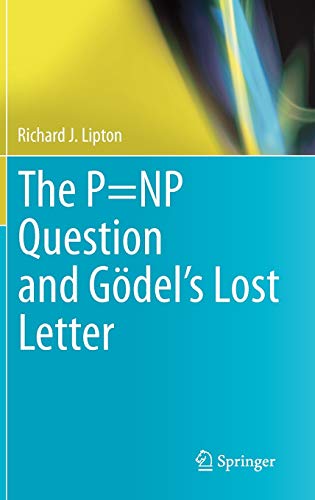
? DoesP=NP. In just ?ve symbols Dick Karp –in 1972–captured one of the deepest and most important questions of all time. When he ?rst wrote his famous paper, I think it’s fair to say he did not know the depth and importance of his question. Now over three decades later, we know P=NP is central to our understanding of compu- tion, it is a very hard problem, and its resolution will have potentially tremendous consequences. This book is a collection of some of the most popular posts from my blog― Godel ¨ Lost Letter andP=NP―which I started in early 2009. The main thrust of the blog, especially when I started, was to explore various aspects of computational complexity around the famousP=NP question. As I published posts I branched out and covered additional material, sometimes a timely event, sometimes a fun idea, sometimes a new result, and sometimes an old result. I have always tried to make the posts readable by a wide audience, and I believe I have succeeded in doing this.
User’s Reviews
Editorial Reviews: Review “This book is a thoroughly enjoyable read because of the great balance between anecdotes, presentations of ‘nice’ problems and algorithms and their solutions and proofs, ‘hard mathematics,’ and musings on how to approach mathematical problems. After having read the book, most readers with a background in complexity theory will most likely be unable to resist immediately working on at least one of the many open problems presented in the book.” (Till Tantau, Mathematical Reviews, October, 2015)“This book … collects and edits the highlights from Lipton’s ongoing blog, rounded out by cross-references and a useful index and bibliography. … the book offers a different experience and a framed portrait of the state of the art. … Summing Up: Recommended. All levels/libraries.” (D. V. Feldman, Choice, Vol. 48 (9), May, 2011)“The P=NP question is certainly one of the most important problems in mathematics and computer science (CS). What makes this book unique and delightful is that it gives proper weight to the question rather than the technicalities. Each chapter is based on one of Lipton’s blog posts, and readers can jump from chapter to chapter to find his beautifully written thoughts and insights. … In fact, anyone who is highly motivated by this interesting subject that relates science with reality should read it.” (Hector Zenil, ACM Computing Reviews, March, 2011)“This book collects some entries of the author’s blog on Gödel’s lost letter and P = NP … . It is an enjoyable and lively introduction to some impressive achievements in the field of complexity theory.” (Thierry Coquand, Zentralblatt MATH, Vol. 1215, 2011) From the Back Cover The P=NP question is one of the great problems of science, which has intrigued computer scientists and mathematicians for decades. Despite the abundant research in theoretical computer science regarding the P=NP question, it has not been solved. The P=NP Question and Gödel’s Lost Letter covers historical developments (including the Gödel’s Lost letter), the importance of P=NP and the future of P=NP. This guide is also based on a new blog by the author, located at http://rjlipton.wordpress.com. Jin-Yi Cai, a professor in computer science at the University of Wisconsin remarks ‘I think it is the single most interesting web blog I have seen on related topics. He has a great insight and wit and beautiful way to see things and explain them.’ Richard DeMillo, a professor in computer science at Georgia Tech remarks, ‘This is a much needed treatment of great open problem computing.’The P=NP Question and Gödel’s Lost Letter is designed for advanced level students and researchers in computer science, and mathematics as a secondary text and reference book. Computer programmers, software developers and IT professionals working in the related industry of computer science theory, will also find this guide a valuable asset. About the Author Richard Lipton is the Storey Professor of Computer Science at Georgia Institute of Technology. Previously he held faculty positions at Yale University, the University of California at Berkeley, and Princeton University. His research is focused primarily, but not exclusively, on theory of computation. He has made seminal contributions to many areas of computing from software engineering and program testing, to computer security and cryptography, to DNA and molecular computation, and to other areas of computer science. He is a member of The National Academy of Engineering, an ACM Fellow, and a Guggenheim fellow. Read more
Reviews from Amazon users which were colected at the time this book was published on the website:
⭐There are two ways to evaluate this book: by itself, as a book, or in comparison to the blog from which it is derived.AS A BOOK ITSELFIf you have had some exposure to computer science concepts, at least to the extent that you have heard about the P/NP question, or at least heard the names Godel or Turing, then this book is for you. You can be a current student or someone who has once studied it and have since moved on to other fields but are still curious about the nature of reality. If this describes you, this is one of the best books you can get. It is simultaneously philosophical, personable, and precise. The clarity of thought is almost blinding. For example, he explains how the answer to P/NP need not be a simple yes or no, and how different kinds of answers will affect different kinds of people in different ways. The personal stories that start each chapter are always a delight and are always a great introduction to the topic of the post. Some relevant comments from blog posts are also summarized. It is a great book.COMPARISON TO BLOGThere are advantages and disadvantages. The advantages of the book over the blog is that it is much easier to flip through or browse. The disadvantages are that you obviously can’t do a search for a keyword or click on a link for related reading. But the biggest difference is the lack of pictures. I know it sounds silly but the photos of the people he describes really add to the blog posts. I am guessing that almost surely the reason there are no pictures in the book is for copyright reasons. Lipton describes how he tried very hard to include a particular Far Side cartoon either in the book or on his blog and simply could not obtain the rights. It is unfortunate. There are still occasional typos in the book, but they are rare and innocuous, like a duplicated word or something (“the the”). But the references to other posts have been replaced with references to correct chapter numbers. In an ideal world, if you could print in color each of the blog posts and format it nicely in a good hardbound cover like this one, that would be perfect. But perfection is not an option. Because of that, this book is almost perfect, but probably as good as it is legally possible to get.Plus, there is a certain timelessness to having a book you can pick up and look over again. And reading many chapters in a row gives you new insights not just into the interesting questions of complexity, but also into how to best present an argument or be careful in your logic or find or fix flaws in your thinking. It is kind of hard to read many blog posts in a row. But in a book form, it is more natural. And though it discusses complexity, the embedded lessons are much broader, and work more by building up on themselves over time than belonging to any single blog post.BOTTOM LINESo: if you are comparing this to other books, then you should buy this one, without a doubt. If you are comparing it to the blog, then it depends on whether you will actually read the earlier blog posts there. If you do, fine. But if you are like me and you tend to read only recent blog posts in general, and not so much on the older ones, you will enjoy this book, as you can more leisurely browse it occasionally, and always with pleasure.
⭐This is the entertaining and challenging book that followers of the “Lost Letter” blog have been waiting for. Lipton is a master theoretician who has made fundamental contributions to the famous “P=NP” problem of theoretical computer science. He is a prolific researcher and collaborator, but it is his teaching and writing skills that are on display in this book. Interweaving a masterful exposition of deep and complex mathematics with engaging — and at times inspiring — stories about the scientists who have created the field, this book is the one to which teachers will point their students as THE entry point to a difficult and competitive field.There is a reason that Lipton’s blog is among the most popular at WordPress.com and attracts hundreds of comments from amateurs and experts alike. Highly recommended.
⭐This book is just a collection of articles published on the author’s blog.You can even take the titles of paragraphs and google his blog to read the articles.You will learn very little of computational complexity or anything else, because the book is oriented towards people that are inside of this field. Even that the prose is excellent and the author simplifies and humanizes lots of things, making the book very engaging.So my advice is:- if you know about computational complexity, read the articles on the author’s blog and save trees.- if you are new to the field, just get another book.
⭐The P=NP Question and Godel’s Lost Letter is simply an outstanding book. It is a beautiful composition of some of the best entries from Prof. Richard Lipton’s blog […]. Prof. Lipton’s style of writing makes his blog, and consequently this book, very unique.The underlying theme in the book is about Computer Science’s most central question, is P=NP? This is a theoretical question that has received significant attention over past several decades, owing to its far reaching consequences.What makes the book unique and delightful is that there is something in it for everyone: ranging from people who actively think about the P vs. NP question, to even non computer scientists.Every chapter in the book starts with an introduction of a mathematician or computer scientist, then mentions a personal anecdote or tidbit (that you will not find anywhere else), then goes on to describe some fundamental work of the person. This is then followed by Prof. Lipton’s own thoughts and insights into the problem, or some variant of it, some new results and ideas, and finally the chapter concludes with open problems (which are sometimes general and sometimes specific).Personally, my favorite part is the initial section of each chapter that talks about a past or current researcher, and usually mentions a story or interesting fact or encounter with this person, from Prof. Lipton’s personal experience. This part of each chapter is very light reading. Further, it seems that from Prof. Lipton’s vast experiences and several decades of being at the forefront of Mathematics and Computer Science research, he has countless such stories and anecdotes to share.My second favorite part of the book is Prof. Lipton’s own thoughts on the problem. This provides an excellent insight into the working of a top notch researcher. Sometimes these are accompanied by general advice or specific suggestions, or personal opinion and sometimes not. However, I have found any/each chapter is a great learning experience even if I am not specifically interested in the problem. On numerous occasions, reading his blog entry (which are chapters in the book) on a problem I do not intend to think about, has given me insights into other problems (in research or even otherwise).Overall I strongly recommend getting this book. The book makes you feel like you are personally interacting with the author as well as others mentioned in it. It is a wonderful journey through years of mathematics+computer science, a vast ocean of personal anecdotes, insights into the working of various researchers, and the state-of-the-art on several central research problems. The book really is a gem!I was suggested to add the disclaimer that I was Prof. Lipton’s PhD student. My opinion may be biased but I think this book is a great buy!
Keywords
Free Download The P=NP Question and Gödel’s Lost Letter 2010th Edition in PDF format
The P=NP Question and Gödel’s Lost Letter 2010th Edition PDF Free Download
Download The P=NP Question and Gödel’s Lost Letter 2010th Edition 2010 PDF Free
The P=NP Question and Gödel’s Lost Letter 2010th Edition 2010 PDF Free Download
Download The P=NP Question and Gödel’s Lost Letter 2010th Edition PDF
Free Download Ebook The P=NP Question and Gödel’s Lost Letter 2010th Edition