Ebook Info
- Published: 2006
- Number of pages: 224 pages
- Format: PDF
- File Size: 14.92 MB
- Authors: Piergiorgio Odifreddi
Description
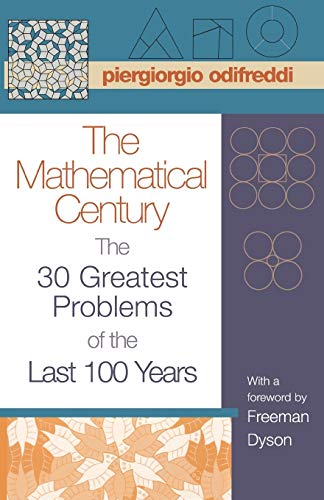
The twentieth century was a time of unprecedented development in mathematics, as well as in all sciences: more theorems were proved and results found in a hundred years than in all of previous history. In The Mathematical Century, Piergiorgio Odifreddi distills this unwieldy mass of knowledge into a fascinating and authoritative overview of the subject. He concentrates on thirty highlights of pure and applied mathematics. Each tells the story of an exciting problem, from its historical origins to its modern solution, in lively prose free of technical details. Odifreddi opens by discussing the four main philosophical foundations of mathematics of the nineteenth century and ends by describing the four most important open mathematical problems of the twenty-first century. In presenting the thirty problems at the heart of the book he devotes equal attention to pure and applied mathematics, with applications ranging from physics and computer science to biology and economics. Special attention is dedicated to the famous “23 problems” outlined by David Hilbert in his address to the International Congress of Mathematicians in 1900 as a research program for the new century, and to the work of the winners of the Fields Medal, the equivalent of a Nobel prize in mathematics. This eminently readable book will be treasured not only by students and their teachers but also by all those who seek to make sense of the elusive macrocosm of twentieth-century mathematics.
User’s Reviews
Editorial Reviews: Review “Odifreddi’s overview is of course a personal one, but it is hard to argue with either his choices or his organization. This is a perfect handle on an otherwise bewildering proliferation of ideas.”—Ben Longstaff, New Scientist”Odifreddi clearly and concisely describes important 20th-century developments in pure and applied mathematics. . . . Unlike similar volumes, this book keeps descriptions general and contains a short section on the philosophical foundations of mathematics to help non-mathematicians easily navigate the material.” ― Library Journal”This is an astonishingly readable, succinct, and wonderful account of twentieth-century mathematics! It is a great book for mathematics majors, students in liberal-arts courses in mathematics, and the general public. I am amazed at how easily the author has set out the achievements in a broad array of mathematical fields. The writing appears effortless.”—Paul Campbell, Mathematics Magazine”Piergiogio Odifreddi’s book successfully portrays the major developments in 20th century mathematics by an examination of the mathematical problems that have gained prominence during the past 100 years. . . . [T]he literary style is such that the contents are made accessible to a very wide readership, but with no hint of oversimplification.”—P.N. Ruane, MathDL”Odifreddi . . . has an engaging and effective style and a knack for compact but comprehensible summaries, making his presentation seem effortless. The Mathematical Century can be dabbled in, read through, or perhaps even used as a quick reference.”—Danny Yee, Danny Reviews Review “The Mathematical Century is both popular and scholarly. Piergiorgio Odifreddi clearly and accurately covers many important mathematical problems and the contributions that leading mathematicians have made to their solutions. Offering a personal but very balanced perspective, his book is one that amateur and professional alike can learn from.”―Sir Michael Atiyah, Fields Medalist 1966, and former President of the Royal Society”Piergiorgio Odifreddi has done a superb job, telling the story of twentieth-century mathematics in one short and readable volume.”―Freeman Dyson, Institute for Advanced Study, Princeton”Odifreddi’s book successfully portrays the major developments in 20th century mathematics by an examination of the mathematical problems that have gained prominence during the past 100 years. . . . [It] comes very near to being that intangible entity―a history of modern mathematics. Moreover, the literary style is such that the contents are made accessible to a very wide readership, but with no hint of oversimplification.”―P.N. Ruane, MAA Online From the Inside Flap “”The Mathematical Century is both popular and scholarly. Piergiorgio Odifreddi clearly and accurately covers many important mathematical problems and the contributions that leading mathematicians have made to their solutions. Offering a personal but very balanced perspective, his book is one that amateur and professional alike can learn from.”–Sir Michael Atiyah, Fields Medalist 1966, and former President of the Royal Society”Piergiorgio Odifreddi has done a superb job, telling the story of twentieth-century mathematics in one short and readable volume.”– Freeman Dyson, Institute for Advanced Study, Princeton From the Back Cover “The Mathematical Century is both popular and scholarly. Piergiorgio Odifreddi clearly and accurately covers many important mathematical problems and the contributions that leading mathematicians have made to their solutions. Offering a personal but very balanced perspective, his book is one that amateur and professional alike can learn from.”–Sir Michael Atiyah, Fields Medalist 1966, and former President of the Royal Society”Piergiorgio Odifreddi has done a superb job, telling the story of twentieth-century mathematics in one short and readable volume.”–Freeman Dyson, Institute for Advanced Study, Princeton”Odifreddi’s book successfully portrays the major developments in 20th century mathematics by an examination of the mathematical problems that have gained prominence during the past 100 years. . . . [It] comes very near to being that intangible entity–a history of modern mathematics. Moreover, the literary style is such that the contents are made accessible to a very wide readership, but with no hint of oversimplification.”–P.N. Ruane, MAA Online About the Author Piergiorgio Odifreddi is Professor of Mathematical Logic at the University of Turin and has been a visiting professor at Cornell University for many years. He is the author of the textbook Classical Recursion Theory. He is also a regular contributor to the Italian daily La Repubblica. Freeman Dyson, Professor Emeritus of Physics at the Institute for Advanced Study, is the author of several books, including Disturbing the Universe. Read more
Reviews from Amazon users which were colected at the time this book was published on the website:
⭐The author takes a superficial smorgasbord approach which is a totalwaste of time to anyone at all familiar with the recent history of mathand absolutely unenlightening to anyone who isn’t. Hecovers many areas in which he is not trained – and it shows -laughably in some cases [e.g. referring to the “moonlighting”conjecture].The only decent thing in the book is the foreward written byDyson- and it’s a shame he didn’t go on to write the wholething. Thanks for nothing P.U.Press.
⭐The Mathematical Century, by Piergiorgio Odifreddi, subtitled The 30 Greatest Problems of the Last 100 Years, is what I would call the best book of its kind that I have ever read. The meaning of the phrase “of its kind” comes from one simple fact, quite obvious if you would see a page or two, that this is a very technical, mathematics-oriented book. It is not like the average storybook of fictional characters going through an archetypal journey, but it does tell the story of how these 30 problems have been analyzed by real mathematicians and solved over the years. Considering the sheer size and original complexity of some of these ideas and problems, Odifreddi does an excellent job of explaining, although you may need to stop and really think abstract for a few minutes. For those of you who enjoy abstract thinking, interesting ideas, or just mathematical concepts, this book is a rare treat. Since this quality of a book is often a self-judging trait, a sample of the book is necessary. In this passage, Odifreddi’s way of presenting and narrating the history of the problems and their very concept is captivating:”One of the great achievements of nineteenth-century mathematics was the classification of the 2-dimensional surfaces from the topological point of view, that is, by regarding them as rubber sheets that can be deformed at will provided they are not torn apart. From this abstract point of view, an inflated ball and a deflated one are the same surface, even if …” (Odifreddi, 78) For each problem presented, there are about six pages about its origin, nature, history, attempts at solving, and, for all but the open problems (ones yet to be answered), the solution. The problems include many old questions of geometry, algebra, calculus, and number theory while several more modern ones as well. An interesting factor of many of these problems is how much computers show up in this storyline, as tools that themselves prove too incapable to display or solve some problems in full completeness. To me, this was a little surprising, considering I usually see computers able to do just about anything that programmers tell them to do. Often, these problems are solved with what seems at first the most irrelevant equation or concept that happens to tie in exactly to complete the puzzle. All of this Odifreddi packs efficiently into short sections whose length compares to pamphlets, keeping this brief but informative rather than something of a textbook. With the style of light reading, even the depth of these questions keeps reading this from being overly involved. In addition, the capacity this book has for stimulating abstract thinking far outweighs anything else. To begin with, the very nature of many of the ideas presented begs for abstraction, like presenting a geometric surface that intersects itself and thus cannot have constructed model to represent it. Take note that in this 180 page book there are thirty problems and even more concepts, the greater half of those could use some abstraction. A critical backbone in this abstraction capacity comes from the fact that this is not science fiction, this deals with real mathematical and physical concepts that exist, whether or not we care to notice, with proof and some given trends. The inability to dismiss these abstract concepts, in my opinion, makes them all the better and more interesting. Overall, this is not a book that I would recommend to buy without flipping through it and reading a page or two. After doing that, if The Mathematical Century suits your liking, it should be a great book to read. One nice property for people like me who sometimes wish to read in a random order is the effective ease of doing that in this book. Few, if any, sections of this book require any reading of the pages before it, which will be relieving to readers who might dislike or completely not understand one part but love the rest. Personally, I would rate this book as a five out of five for those of you who like this type of material, although those who lack an interest in such a subject as this would probably give this book a low rating.
⭐This is a survey for the layperson of some of the most important mathematical advances of the twentieth century, grouped into categories of pure math, applied math, and computer math. Although it is not possible for the layperson to truly understand any of this material, the author nonetheless does a reasonably good job of presenting it in an interesting and not-too-technical way. I would recommend this book to anyone who is curious about what mathematicians are up to and the kinds of discoveries they have made. Some are quite counter-intuitive and definitely stranger than fiction!The last chapter presents major unsolved problems for the 21st century, and is a little out of date in that the Poincare Conjecture was proved in 2002 by Grigori Perelman based on work by Richard Hamilton. This is quite an interesting story in its own right and is well presented by Szpiro’s book “Poincare’s Prize…”, which I also recommend.
⭐How does one discuss the culture of mathematics in the twentieth century in a meaningful way, of interest to a broad spectrum of readers, addressing the major advances and approaches to problems? This is a very difficult task, and at an important level becomes somewhat subjective, however one chooses to approach it. There is no question that mathematics has blossomed in the twentieth century, as a result of fragmenting into numerous specializations. Odifreddi chooses 30 strands to follow in the evolution of this technical field that is at once “the queen of the sciences”, and also distressingly abstract. I think that he has succeeded remarkably well, by tracing a historical path that often starts in roots prior to the twentieth century, that everyone can relate to, and then pursuing the path in the directions identified as important by mathematicians, as indicated by, say, solutions to the problems Hilbert posed or awarding of the Fields medal or Wolf prize. He could have carried out a development into many more than 30 strands, but his approach clearly gives a flavor of the incredible technical importance of mathematics to science and engineering (although his choices focus on mathematics), the evolution of modern mathematics, and its technical depth. Like any culture, as outsiders, the layperson may see much that is strange and even repulsive about mathematics. The book gives an objective view of this culture. From my perspective, this book is extremely interesting in giving a big picture that seems to show us some of the beauty, wonder and importance of mathematics, as well as a field that, by virtue of specialization and fragmentation, has often gone in obscure and esoteric directions. I highly recommend this book, to a broad readership. It would be difficult to imagine producing a better overview, in such few pages, that could communicate so much of the culture of mathematics in the twentieth century.
⭐Mind blowing account of mathematical brains
⭐I thoroughly enjoyed this book. It is a fast blast through cutting edge math at a very high level. Some readers may want more in the way of explanation while others might be overwhelmed by the subject matter that is, admittedly, glossed over, but I found it to be a refreshing compromise between these extremes.
Keywords
Free Download The Mathematical Century: The 30 Greatest Problems of the Last 100 Years in PDF format
The Mathematical Century: The 30 Greatest Problems of the Last 100 Years PDF Free Download
Download The Mathematical Century: The 30 Greatest Problems of the Last 100 Years 2006 PDF Free
The Mathematical Century: The 30 Greatest Problems of the Last 100 Years 2006 PDF Free Download
Download The Mathematical Century: The 30 Greatest Problems of the Last 100 Years PDF
Free Download Ebook The Mathematical Century: The 30 Greatest Problems of the Last 100 Years