

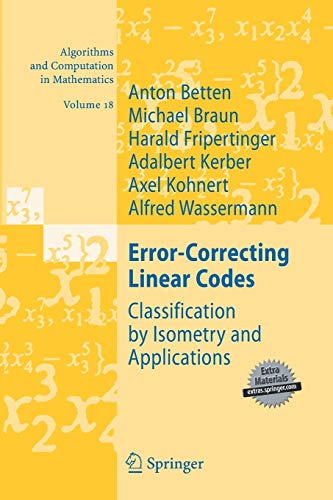
Ebook Info
- Published: 2006
- Number of pages: 827 pages
- Format: PDF
- File Size: 6.76 MB
- Authors: Anton Betten
Description
This text offers an introduction to error-correcting linear codes for researchers and graduate students in mathematics, computer science and engineering. The book differs from other standard texts in its emphasis on the classification of codes by means of isometry classes. The relevant algebraic are developed rigorously. Cyclic codes are discussed in great detail. In the last four chapters these isometry classes are enumerated, and representatives are constructed algorithmically.
User’s Reviews
Editorial Reviews: Review From the reviews:”The theory of error-correcting codes is a … new addition to the list of mathematical disciplines. … This book contains 51 figures and 102 tables. … The book provides access to all results at a level which is proper for graduate students of mathematics and computer science as well as for researchers.” (Zlatko Varbanov, Zentralblatt MATH, Vol. 1102 (4), 2007)”This is a thorough treatment of the theory of error-correcting codes. … This book is remarkable because of the enormous amount of material presented (in a very lucid style), but also because of the great variety of mathematical disciplines used … . A beautiful book on applied mathematics!” (H. Mitsch, Monatshefte für Mathematik, Vol. 151 (3), 2007)”The main object of the book under review is an error-correcting linear code. … a motivated reader can profit much from studying this monograph, which contains rich material in one of the rapidly developing areas. … The presentation of material is reader-friendly, arguments are clear and concise, numerous exercises are original and stimulating … . To sum up, the book under review can be strongly recommended to anyone interested in the topic.” (Boris È. Kunyavskii, Mathematical Reviews, Issue 2008 h) From the Back Cover This text offers a thorough introduction to the mathematical concepts behind the theory of error-correcting linear codes. Care is taken to introduce the necessary algebraic concepts, for instance the theory of finite fields, the polynomial rings over such fields and the ubiquitous concept of group actions that allows the classification of codes by isometry. The book provides in-depth coverage of important topics like cyclic codes and the coding theory used in compact disc players. The final four chapters cover advanced and algorithmic topics like the classification of linear codes by isometry, the enumeration of isometry classes, random generation of codes, the use of lattice basis reduction to compute minimum distances, the explicit construction of codes with given parameters, as well as the systematic evaluation of representatives of all isometry classes of codes. Up until now, these advanced topics have only been covered in research papers. The present book provides access to these results at a level which is suitable for graduate students of mathematics, computer science and engineering as well as for researchers.
Reviews from Amazon users which were colected at the time this book was published on the website:
⭐Not found.
⭐Not found.
⭐Not found.
⭐Not found.
⭐Not found.
⭐Not found.
Keywords
Free Download Error-Correcting Linear Codes: Classification by Isometry and Applications (Algorithms and Computation in Mathematics, 18) 2006th Edition in PDF format
Error-Correcting Linear Codes: Classification by Isometry and Applications (Algorithms and Computation in Mathematics, 18) 2006th Edition PDF Free Download
Download Error-Correcting Linear Codes: Classification by Isometry and Applications (Algorithms and Computation in Mathematics, 18) 2006th Edition 2006 PDF Free
Error-Correcting Linear Codes: Classification by Isometry and Applications (Algorithms and Computation in Mathematics, 18) 2006th Edition 2006 PDF Free Download
Download Error-Correcting Linear Codes: Classification by Isometry and Applications (Algorithms and Computation in Mathematics, 18) 2006th Edition PDF
Free Download Ebook Error-Correcting Linear Codes: Classification by Isometry and Applications (Algorithms and Computation in Mathematics, 18) 2006th Edition