Ebook Info
- Published: 2012
- Number of pages: 364 pages
- Format: PDF
- File Size: 18.81 MB
- Authors: Charles W. Curtis
Description
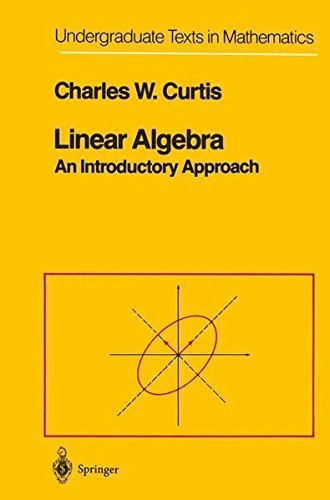
This revised and updated fourth edition designed for upper division courses in linear algebra includes the basic results on vector spaces over fields, determinants, the theory of a single linear transformation, and inner product spaces. While it does not presuppose an earlier course, many connections between linear algebra and calculus are worked into the discussion. A special feature is the inclusion of sections devoted to applications of linear algebra, which can either be part of a course, or used for independent study, and new to this edition is a section on analytic methods in matrix theory, with applications to Markov chains in probability theory. Proofs of all the main theorems are included, and are presented on an equal footing with methods for solving numerical problems. Worked examples are integrated into almost every section, to bring out the meaning of the theorems, and illustrate techniques for solving problems. Many numerical exercises make use of all the ideas, and develop computational skills, while exercises of a theoretical nature provide opportunities for students to discover for themselves.
User’s Reviews
Reviews from Amazon users which were colected at the time this book was published on the website:
⭐As other readers have noted, this is your standard, terse, theorem-lemma-proof type math text. If you are approaching this text with your only mathematical background being a popular treatment of the calculus like those of Stewart or Larson, the style takes a lot of getting used to. Though a lot of effort is placed into making the text short and packed with information, it is impossible to sit down with this text (or any other upper-division math text, for that matter) and read passively. Curtis leaves out many details in the proofs and examples, asking the reader to follow the ordinary, though annoying, convention of theorem-lemma-proof texts and provide the details him(yes, him)self.In my linear algebra class, we covered the equivalent of the first six chapters, though after the determinants chapter, we stopped following the ordering and pace of the text, and therefore, it’s hard to tell whether the later chapters make an optimal teaching or self-study device. The first four chapters (up to determinants), however, take a theoretical approach to linear algebra with a few scattershot references to the geometric intuitions that it formalizes.My biggest complaint is that in some points of the text, Curtis seems unsure of whether to continue in an informal or an abstract manner. Many of the exercises are numerical problems of the type you see in a non-proof linear algebra class focused on applications, and when Curtis gets to systems of linear equations, he seems confused about whether he is writing a book for a proof-based or a numerical class. As long as you are familiar with induction and proof by contradiction, the exercises that require proofs are fairly easy. Our professor constantly supplemented them with problems that were far more difficult than anything in Curtis.
⭐So far the most rigorous textbook on Linear Algebra!It looks abstract and theoretical at first glance, but it is the only book solving theoretical problems I have ever seen.For example, the determinant problem. Traditional approach is to list definition first and then list some properties. But this book starts from the very beginning of area, then derive properties, at last the definition and calculation. So you will have a whole structure of the knowledge instead of just a memorization of it. And you will understand Jacobian Determinant too – an important but rarely covered topic in either Calculus or Linear Algebra.It suits thinkers who really want to understand Linear Algebra. If you are puzzled by traditional textbook, try this one and you won’t regret!
⭐Not bad. The examples could use some work and the formatting is a bit dated. The exercises were decent if not a bit easy, and most had solutions in the back. I prefer Axler’s Linear Algebra Done RIght, though. I don’t see any reason to use this book over that for an introduction to linear algebra.
⭐The cleanest book I’ve ever bought here
⭐Unless you want to be an algebraist, this is definitely NOT the book you want to have.I just want a reference book that provides proofs for elementary linear algebra, and a good introduction to advanced topics like Jordan forms/bilinear forms/Quadratic forms/dual spaces, etc with proofs.There are also way too many theorems in a chapter. Many of them are not so essential and can be simply left as exercises or for students to discover themselves. The writing style is boring and in an extremely abstract way. I don’t think anyone can still recognize what a polynomial is after reading the author’s introduction…
⭐I’ve just gotten this book, so I can’t speak to the content, but I can speak to the construction. One day after I picked up the book, which I bought new, one side of the spine detached from the side of the pages.I mean, seriously?
⭐I had the good fortune of using this text as my introduction to linear algebra in a reading course by they author, Charles W Curtis. The proofs are somewhat abbreviated, meaning you have to think through the details yourself, but not so much so that you get stalled. An excellent introduction.
⭐This is a fantastic resource for basic linear algebra. It covers the topics from a rather theoretical perspective, which lacks many examples or practical applications, but presents the theory better than most alternate books. The book does include some applications/advanced theory moving past the basic topics of solutions of systems, vector spaces, linear transformations, determinants, and orthogonality, which includes solving differential equations and basic symmetry theory. The book is short and sweet, which is good if you can handle more advanced math textbooks, but not good for those looking for detailed explanation (some of the proofs of basic concepts are even left up to the reader when appropriate). This book is better for those already familiar with the subject matter or those looking for a challenge.
⭐Good
⭐A quite different but brilliant approach to learn linear algebra.
⭐It’s a bit cheating by saying it is Hardcover.
⭐It is a nice book for linear algebra. It also helps to grow up your knowledge deeply in this course.
Keywords
Free Download Linear Algebra: An Introductory Approach (Undergraduate Texts in Mathematics) 4th Edition in PDF format
Linear Algebra: An Introductory Approach (Undergraduate Texts in Mathematics) 4th Edition PDF Free Download
Download Linear Algebra: An Introductory Approach (Undergraduate Texts in Mathematics) 4th Edition 2012 PDF Free
Linear Algebra: An Introductory Approach (Undergraduate Texts in Mathematics) 4th Edition 2012 PDF Free Download
Download Linear Algebra: An Introductory Approach (Undergraduate Texts in Mathematics) 4th Edition PDF
Free Download Ebook Linear Algebra: An Introductory Approach (Undergraduate Texts in Mathematics) 4th Edition