Ebook Info
- Published:
- Number of pages:
- Format: PDF
- File Size: 25.99 MB
- Authors: Richard P. Stanley
Description
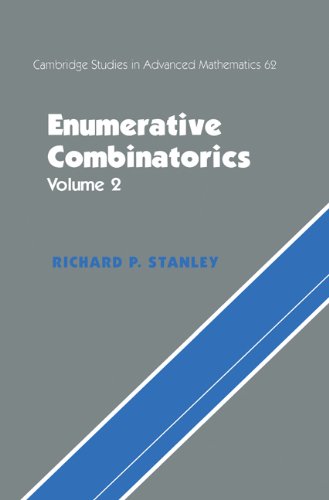
This second volume of a two-volume basic introduction to enumerative combinatorics covers the composition of generating functions, trees, algebraic generating functions, D-finite generating functions, noncommutative generating functions, and symmetric functions. The chapter on symmetric functions provides the only available treatment of this subject suitable for an introductory graduate course on combinatorics, and includes the important Robinson-Schensted-Knuth algorithm. Also covered are connections between symmetric functions and representation theory. An appendix by Sergey Fomin covers some deeper aspects of symmetric function theory, including jeu de taquin and the Littlewood-Richardson rule. As in Volume 1, the exercises play a vital role in developing the material. There are over 250 exercises, all with solutions or references to solutions, many of which concern previously unpublished results. Graduate students and research mathematicians who wish to apply combinatorics to their work will find this an authoritative reference.
User’s Reviews
Reviews from Amazon users which were colected at the time this book was published on the website:
⭐Referred to as the bible of combinatorics. Many challenging problems.
⭐This is an excellent book on combinatorics, but it is quite difficult to understand–written for experts, not novices. The author often chooses a more general framework in which to present things, and this can make the material quite difficult to follow. But the rewards for the diligent reader are great. Occasionally I question how Stanley chooses to present a certain topic, but usually if I look closely enough, I see that there are deep reasons for his choice of notation or presentation.Some of the material in this book is easier than others; some of it depends on earlier chapters, but some stands on its own. People interested in partially ordered sets and lattices may want to jump ahead to that chapter–much of this chapter stands on its own, and it is an excellent exposition of that topic, and I think somewhat easier to understand than the rest of the book.The most precious thing about this book is that the author manages to provide several comprehensive frameworks for solving large classes of enumeration problems. Combinatorics seems a hodge-podge subject to many mathematicians, but Stanley manages to see it as a unified subject with a number of general theories and common techniques. This book is truly the only text I have ever read that has this perspective on the subject.I would recommend this book only to someone who has a strong background in mathematics and wants a challenging text that can take them to a deeper level of understanding. Students of combinatorics may want to take this book out of the library and read the introductory pages; there are some particularly useful comments right at the beginning. As a final note, the exercises in this book are also helpful and of diverse difficulty levels–and Stanley classifies the exercises by their difficulty level. People who find this book difficult to follow may want still benefit from some of the easier exercises. Students wanting an easier-to-follow text might want to check out Cameron’s “Combinatorics”, or Wilf’s “Generatingfunctionology”. As a final note I would like to remark that this book is very reasonably priced, especially when you consider the wealth of material it contains.
⭐Excellent book but very dense. Not meant for the novice, and a very hard read for even the intermediate. This book is meant to be “read” with pencil and paper in hand. The presentation clearly comes from an author who just loves to “count”, and is an expert at it. The clarity of thought is appreciated. Some will appreciate the conciseness, others might wish for a little more explanation. The coverage is exhaustive and the book can also serve as a reference.
⭐It’s a good book, but I haven’t done much surveying of texts in this subject.
⭐didn’t like it very much
⭐So far so good 🙂
⭐Good condition, great book.
⭐Awesome book to read for a math major!
⭐This is a definitely a must-have if one has interested in enumerative Combinatorics. It provides solid foundation to post-graduate and beyond.It’s packed solid with relevant content and exercises and worked examples. There is a volume 2 to take you to post-graduate and to research level.However, be warned EC1 is not easy reading; it’s not for the beginner and it’s not for the faint-hearted.The book is probably best read as the main book for an undergraduate course.
Keywords
Free Download Enumerative Combinatorics: Volume 2 (Cambridge Studies in Advanced Mathematics Book 62) in PDF format
Enumerative Combinatorics: Volume 2 (Cambridge Studies in Advanced Mathematics Book 62) PDF Free Download
Download Enumerative Combinatorics: Volume 2 (Cambridge Studies in Advanced Mathematics Book 62) PDF Free
Enumerative Combinatorics: Volume 2 (Cambridge Studies in Advanced Mathematics Book 62) PDF Free Download
Download Enumerative Combinatorics: Volume 2 (Cambridge Studies in Advanced Mathematics Book 62) PDF
Free Download Ebook Enumerative Combinatorics: Volume 2 (Cambridge Studies in Advanced Mathematics Book 62)