

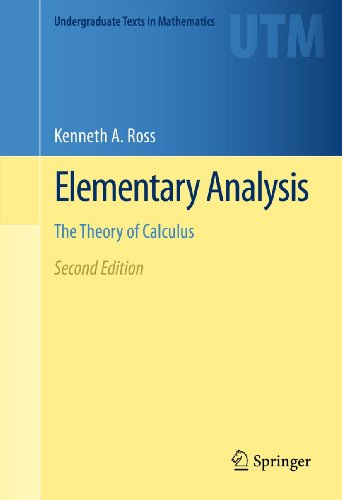
Ebook Info
- Published: 2013
- Number of pages: 412 pages
- Format: PDF
- File Size: 3.17 MB
- Authors: Kenneth A. Ross
Description
For over three decades, this best-selling classic has been used by thousands of students in the United States and abroad as a must-have textbook for a transitional course from calculus to analysis. It has proven to be very useful for mathematics majors who have no previous experience with rigorous proofs. Its friendly style unlocks the mystery of writing proofs, while carefully examining the theoretical basis for calculus. Proofs are given in full, and the large number of well-chosen examples and exercises range from routine to challenging.The second edition preserves the book’s clear and concise style, illuminating discussions, and simple, well-motivated proofs. New topics include material on the irrationality of pi, the Baire category theorem, Newton’s method and the secant method, and continuous nowhere-differentiable functions.
User’s Reviews
Reviews from Amazon users which were colected at the time this book was published on the website:
⭐This is an excellent book to give you insight into how calculus was originally developed. It starts with the basic principles and builds up to the derivative and the integral. If one closely follows the information presented it allows you to look much deeper into the underlying basics so you don’t have to take things on faith so to speak. It would be good for anyone trying to learn calculus to study this book or at least I think so.
⭐The book is obviously not Rudin, at times over explains things, but is a solid introduction to the topic.
⭐Consensus on this book changes depending on how you like to do things.Quick rundown. Real analysis (at the undergraduate level) is an axiomatization of all concepts of single-variable calculus.This is a class that changes in difficulty surprisingly according to how you learn it (took it at UC Berkeley, math 104 fall 2017). Our class used Principles of Mathematical Analysis by Rudin and it was a horrendous experience. Everything I write will be from that point of view.The good:Ross’ elementary analysis is a really forgiving textbook. He explains all results thoroughly (almost to a fault), but that’s good for people who are completely new to this. Topic-wise, he covers only the most basic parts of analysis, but he explains every theorem thoroughly and I really like how he starts with explaining the real numbers and keeps the scope of the book in real numbers. That’s one thing Ross does very well, he keeps the scope of the book very centered on the real number system and it’s properties (completeness, Archimedean property, Q as a dense subset, etc.) and it serves the reader very well. I thought it was a really easy read, but that’s probably because I’ve read through Rudin chapters 1-7 about 5 times. Not much to say content-wise, but it’s really solid. No one section is outstanding, but they are all of good quality and it feels like he’s trying to develop all concepts in equal weight.The bad:Not as much to say here, but I think he’s a little too verbose and not enough math going on. He has a tendency’s to almost converse as he’s writing the material to you and it makes it kind of bad as a reference text. If I need a theorem or part of a proof really quickly while I’m doing a physics problem or other math, I certainly do not want to read 3 pages explaining 2 theorems when the proof+theorems would take half the page at most. But that’s really a matter of opinion and what level you’re at. Obviously, if you’ve never seen analysis before, you want as verbose an explanation as possible so you have more guidance and less racking your brain for explanations. But if you’re already past that level, then it’s not as good a text for you. I also didn’t like that Ross didn’t develop topology of the real numbers initially. I feel like that belonged in chapter 2 after he developed properties of the real numbers. The idea of open and closed sets and compactness and boundedness are all really important and could have been used immediately to shorten up proofs and I think it’s generally a better way to have analysis students think. A point of view with topology is extremely valuable. Results from real analysis can be quickly generalized with little trouble and slight adjustment if defined topologically.Overall, I recommend for undergraduates who have never seen analysis before. It will have you sufficiently prepared for future math.
⭐Absolutely fantastic book introducing real variables and their associated proofs.
⭐I received the paperback version of this book.The mathematical content of the book is fantastic, thanks to the author’s meticulous writing.I cannot say the same about the quality of the product. The paper material and print quality are awful.The publisher should be ashamed of taking such high quality mathematical information and reproducing it with the cheapest, lowest quality materials available. The print is faint and almost unreadable; the paper is rough and dusty. What a disappointment!
⭐This book is well organized, sentence structure is clear, and there are plenty of examples. The author takes his time to explain analysis concepts. I would have probably failed my analysis class if I did not get this book. If you are looking for an easy to read beginners analysis textbook, get this one.
⭐I used this book to self teach myself rudimentary Analysis during a Summer break before actually taking my first course on the subject in the following Fall semester.Positives: The book does present the concepts in a very detailed manner that I feel makes everything clear for absolute beginners to the subject. However, one more neglected benefit is the gradually decreasing amount of depth in explanations as the book progresses. This makes it so that a more serious Mathematics major has the opportunity to fill in the details themselves more after they’ve gotten their feet wet with the most basic ideas the book touches on. In addition, the exercises are very well constructed with the initial ones testing that someone has simply acquired the most essential material, and the later ones actually requiring more genuine critical thinking skills.Negatives: If I can criticize one thing, it’s that I feel like the book could have included more proper Mathematical notation such as universal and existential quantifiers. After all, this book is written primarily for a Mathematics major in mind, and it wouldn’t have been too big of a jump in difficulty to simply include an upgrade in notation.
⭐I got the kindle version. Definitely wish I had gotten a hard copy. You will be flipping back and forth between pages, and doing it on a kindle or PC is really tedious. Difficult content, but if you enjoy upper level mathematics, more power to you
Keywords
Free Download Elementary Analysis: The Theory of Calculus (Undergraduate Texts in Mathematics) 2nd Edition in PDF format
Elementary Analysis: The Theory of Calculus (Undergraduate Texts in Mathematics) 2nd Edition PDF Free Download
Download Elementary Analysis: The Theory of Calculus (Undergraduate Texts in Mathematics) 2nd Edition 2013 PDF Free
Elementary Analysis: The Theory of Calculus (Undergraduate Texts in Mathematics) 2nd Edition 2013 PDF Free Download
Download Elementary Analysis: The Theory of Calculus (Undergraduate Texts in Mathematics) 2nd Edition PDF
Free Download Ebook Elementary Analysis: The Theory of Calculus (Undergraduate Texts in Mathematics) 2nd Edition