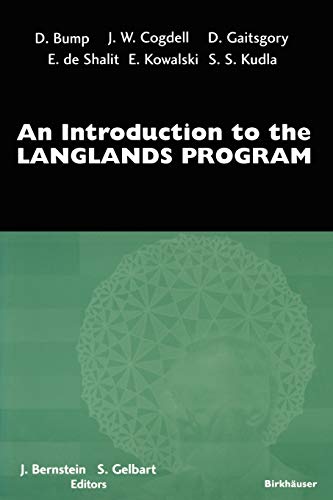
Ebook Info
- Published: 2004
- Number of pages: 288 pages
- Format: PDF
- File Size: 6.05 MB
- Authors: Joseph Bernstein
Description
This book presents a broad, user-friendly introduction to the Langlands program, that is, the theory of automorphic forms and its connection with the theory of L-functions and other fields of mathematics. Each of the twelve chapters focuses on a particular topic devoted to special cases of the program. The book is suitable for graduate students and researchers.
User’s Reviews
Editorial Reviews: Review From the reviews:”The six chapters of this monograph give a broad, user-friendly introduction to the Langlands program, that is, the theory of automorphic forms and its connection with the theory of L-functions and other fields of mathematics. First-year graduate students and researchers will benefit from this beautiful text.”–Zentralblatt Math”. . . the present volume constitutes the most readable entree into the subject to date, suitable both for serious reading and for browsing, and should attract a new generation to this exciting subject. . . . Recommended.”–CHOICE“I suspect this book will find its way into the hands of many graduate students. Perhaps it will also motivate a few of them to learn more, get involved, and make their own contributions.” (MAA REVIEWS) From the Back Cover For the past several decades the theory of automorphic forms has become a major focal point of development in number theory and algebraic geometry, with applications in many diverse areas, including combinatorics and mathematical physics. The twelve chapters of this monograph present a broad, user-friendly introduction to the Langlands program, that is, the theory of automorphic forms and its connection with the theory of L-functions and other fields of mathematics. Key features of this self-contained presentation: A variety of areas in number theory from the classical zeta function up to the Langlands program are covered. The exposition is systematic, with each chapter focusing on a particular topic devoted to special cases of the program: • Basic zeta function of Riemann and its generalizations to Dirichlet and Hecke L-functions, class field theory and some topics on classical automorphic functions (E. Kowalski)• A study of the conjectures of Artin and Shimura–Taniyama–Weil (E. de Shalit)• An examination of classical modular (automorphic) L-functions as GL(2) functions, bringing into play the theory of representations (S.S. Kudla)• Selberg’s theory of the trace formula, which is a way to study automorphic representations (D. Bump)• Discussion of cuspidal automorphic representations of GL(2,(A)) leads to Langlands theory for GL(n) and the importance of the Langlands dual group (J.W. Cogdell)• An introduction to the geometric Langlands program, a new and active area of research that permits using powerful methods of algebraic geometry to construct automorphic sheaves (D. Gaitsgory)Graduate students and researchers will benefit from this beautiful text.
Reviews from Amazon users which were colected at the time this book was published on the website:
⭐Very loosely speaking, the Langlands program can be viewed as an attempt to study to what extent L-functions are really different from each other. L-functions have their origins in number theory as a method for counting or manipulating various arithmetic objects, such as prime numbers. As such the use of L-functions is somewhat surprising, since they are objects coming from analysis, and not number theory. The connection of L-functions to arithmetic is however made more believable if one remembers how the gamma function is defined for all real numbers instead of just the natural numbers. Once this definition is made the gamma function satisfies interesting recursive relations, with similar types of relations being satisfied by more “general” L-functions.The most famous example of an L-function is of course the Riemann zeta function, which was used by the mathematician Leonhard Euler to give an “analytic” proof that there are an infinite number of primes. Other fascinating properties of this L-function are shown in the first article of this book, in particular its analytic continuation in the complex plane and the functional equation that it satisfies. The author views the presence of the gamma function in this functional equation as being somewhat mysterious, and he points to another article in the book as serving as the best resolution of this mystery. This article concerns the thesis of the mathematician John Tate, and is advertised as a way of unifying the analytical continuation and functional equation of L-functions.Thus it is the connection to number theory that makes the study of L-functions so important, and one would like to understand to what extent the mathematical properties of L-functions are particular to each individual L-function or are instead common to all of them. Commonality would seem to imply that there is a “unified theory” of L-functions, and the focus of research would be to then find and characterize this theory.To this end, and remembering a common practice in mathematics of characterizing objects by studying their representations, the Langlands program involves the study of L-functions from the standpoint of automorphic forms. As the editor of this book comments in the preface, an L-function is defined in the Langlands program as being an automorphic L-function on the general linear group of n x n matrices. A consequence of this program is that all L-functions are essentially “one and same object” to quote the editor.One would expect that the strategy of the Langlands program would be more complicated the higher the value of n, and so studying automorphic forms and their relation to L-functions should first be done for low values of n. This is done in this book for n = 1and n = 2 in the first eight chapters, and for the most part these chapters are accessible to the non-expert (such as the reviewer) in number theory, but they sometimes require specialized knowledge in algebra, such as class field theory. The rest of the book is formidable, but the article on the `geometric’ Langlands program could be approached by the physicist reader, since it has enormous ramifications in areas such as quantum field theory and superstring theory. The geometric Langlands program has been widely discussed since this volume was published and some interesting (but sometimes non-rigorous) results have been published. The article on the geometric Langlands program could serve as a concise introduction to this research.Of particular interest to the algebraist reader is the article by J.W. Cogdell on the Langlands conjectures for GL(n) since it touches on how to use automorphic representations to study the Galois group of an extension field. The use of automorphic representations for this purpose is to be contrasted with the “ordinary” approach using finite dimensional representations, which as expected for number fields, this approach involves L-functions, the latter of which form invariants for these representations (at least for low values of n). In this article the author discusses the status of research at the time of publication for a slight variant of this problem that deals with the n-dimensional representations of the Galois group in terms of the automorphic representations of GL(n, A), where A is the adele ring of the field in question. Some of the content of this article is related to the work of Andrew Wiles on Fermat’s Last Theorem and so readers interested in the proof of this result could view this article as a prelude to it.Of particular importance in this article is the appearance of the Weil-Deligne group, which is a kind of specialization of the ordinary Weil group to non-archimedean fields and therefore is essentially a generalization of local class field theory. Even the well-prepared reader may not have knowledge of this group. The reviewer found it helpful to review some of the fundamentals behind the construction of the Weil-Deligne group before studying the article. An understanding of this group is enhanced by studying for example the profinite completion of the integers with a topology given by the Krull topology since the Weil group is thought of as being “less profinite” than the Galois group. The Weil-Deligne representations can deal with the infinite image of l-adic Galois representations by extracting it out and “encoding” it as nilpotent endomorphism. The local Langlands program deals with Weil-Deligne representations and not Galois representations. The connection with the Langlands conjecture for GL(n) comes in for the case of non-archimedean locally compact fields F and their Galois closures F’. For n greater than or equal to 2 the Langlands conjecture for GL(n) predicts a canonical correspondence between isomorphism classes of degree n continuous complex representations of Gal(F’/F) and isomorphism classes of irreducible complex representations of GL(n,F). This correspondence is a bijection if Gal(F’/F) is replaced by the Deligne-Weil group.
⭐of course, this is only a SURVEY MONOGRAPH based on a series on lectures, so the coverage is concise to the extreme, and of course the reader must come prepared with sufficient background in algebraic number theory (Cassels/Fröhlich) and modular forms (Diamond/Shurman) but to expect otherwise would be unreasonable. this well-written monograph provides an efficient overview of the work on the Program so far and an invaluable guide for anyone hoping to gain deeper understanding of the conjectures. Not perfect, but I’m giving it 5 stars to balance out the abundance of unfairly negative reviews.
⭐some typos here and there…
⭐I personally have formed a very poor opinion of this book, specially seeing that it is written by six experts. The reason for my poor opinion is that it lacks that perspective and that cement which should connect any field, especially mathematics, and especially to power of ten, the Langlands program.Because……Langlands program is all about connections and relations between the same thing having different (and difficult) mathematical forms. The book looks more like a quotation (collection) of mathematical equations rather than the fascinating connections between the equations which should fire ones imagination into seeing the web of relations – this is what perspective is all about.Thanks to the recent proof of Fermat Last Theorem, excellent books have appeared about a special case of Langlands Program related to Elliptic curves. Even after knowing this special case, it will be very difficult to get a perspective of the general case from this book. In a difficult field like Langlands program such a perspective cannot come just by staring at a collection of equations, but by the use of some sort of “Genetic Method” to use Harold Edwards term. The present book completely lacks this Genetic Method.In short, after reading this book, you can memorise some equations, and write them on a blackboard for your students, but you will not have the faintest idea about the essence and beauty of Langlands Program.
⭐
⭐
Keywords
Free Download An Introduction to the Langlands Program 2004th Edition in PDF format
An Introduction to the Langlands Program 2004th Edition PDF Free Download
Download An Introduction to the Langlands Program 2004th Edition 2004 PDF Free
An Introduction to the Langlands Program 2004th Edition 2004 PDF Free Download
Download An Introduction to the Langlands Program 2004th Edition PDF
Free Download Ebook An Introduction to the Langlands Program 2004th Edition