Ebook Info
- Published: 2014
- Number of pages: 244 pages
- Format: PDF
- File Size: 8.21 MB
- Authors: Dwight E. Neuenschwander
Description
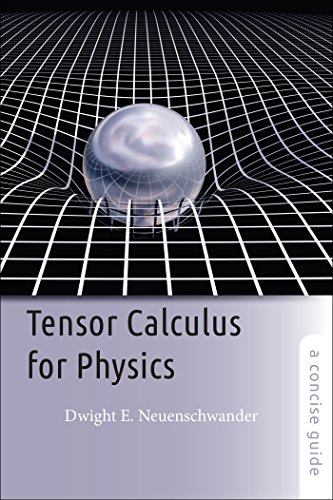
Understanding tensors is essential for any physics student dealing with phenomena where causes and effects have different directions. A horizontal electric field producing vertical polarization in dielectrics; an unbalanced car wheel wobbling in the vertical plane while spinning about a horizontal axis; an electrostatic field on Earth observed to be a magnetic field by orbiting astronauts—these are some situations where physicists employ tensors. But the true beauty of tensors lies in this fact: When coordinates are transformed from one system to another, tensors change according to the same rules as the coordinates. Tensors, therefore, allow for the convenience of coordinates while also transcending them. This makes tensors the gold standard for expressing physical relationships in physics and geometry. Undergraduate physics majors are typically introduced to tensors in special-case applications. For example, in a classical mechanics course, they meet the “inertia tensor,” and in electricity and magnetism, they encounter the “polarization tensor.” However, this piecemeal approach can set students up for misconceptions when they have to learn about tensors in more advanced physics and mathematics studies (e.g., while enrolled in a graduate-level general relativity course or when studying non-Euclidean geometries in a higher mathematics class). Dwight E. Neuenschwander’s Tensor Calculus for Physics is a bottom-up approach that emphasizes motivations before providing definitions. Using a clear, step-by-step approach, the book strives to embed the logic of tensors in contexts that demonstrate why that logic is worth pursuing. It is an ideal companion for courses such as mathematical methods of physics, classical mechanics, electricity and magnetism, and relativity.
User’s Reviews
Reviews from Amazon users which were colected at the time this book was published on the website:
⭐Why are sellers even selling this book??? There are so many parts of formulas missing, starting with an obviously-missing sigma expression near the bottom page 8. But it will fool a casual observer, since for some reason the rest of the print is there.These are taken from the 2015 printing. These are just a couple of examples, but there are HUNDREDS of affected pages, making it useless for study. This book should have been recalled by the publisher!!DON’T BUY IT — (SADLY…) THIS IS A BOOK YOU SHOULD SIMPLY AVOID.
⭐I am yet another buyer of this book now returned to Amazon for refund. And, the reason is as others have said. The printing has serious and major flaws making the book totally unusable for study. But, from what I did read, I think it is an excellent book and it has all the merits of being great when these printing problems get fixed. I am writing this because Amazon needs to yank these printings of this book with the flaws from their shelves and save others from the disappointment and hassle of returning the book to Amazon. It would be nice if Amazon had some kind of alert system so that they can let us know when a fixed printing of the book is available.The one-star review is unfortunate — Amazon calls this level “I Hate It” — but, I don’t hate the book, just the flawed manufacture of the book!
⭐Very quickly; this book may be the best introduction to tensors there is. However, earlier I had given the book 1 star based upon that particular printing which was unspeakably bad and which made the book unreadable. Therefore I had sent the book back to Amazon. I heard nothing from anybody about it but I noticed simply by using the “Look inside” feature that the printing had been corrected. I have now secured a second copy from Amazon which is perfect, and I needed to correct the record!
⭐This is for the paperback version.This copy has many of the greek letters missing (throughout the entire book) making it impossible to read. It is incredibly obvious so I wonder how this got through the proof reading??
⭐An excellent book, though, not as lucid as Fleich’s “A Student’s Guide to Vectors and Tensors.” After reading Fleich’s, this book is an excellent study for those wishing to learn more about tensors and their applications. It is more mathematically rigorous than Fleich’s, but not a book , I would think, for mathematicians.
⭐Imagine a serious book on mathematics without equations! Almost EVERY equation has parts of it that are simply not printed. Certain letters in words are not printed either. There are simply gaps in words where letters would have gone. Defective book! Because others have had the same problem, I am asking for a refund.
⭐The topics are great and the book condition was excellent. The only issue was that every topic was covered briefly and there weren’t many illustrations. A lot of reading and essentially no problems to solve. This is a good book for people interested in the philosophy of tensor calculus and it’s application to higher level physics.
⭐It is quite helpful ! I feel sad because some costumers received a bad impression with some printed mistakes. However my sample was marvelous.It a very good reference.
⭐a beautifully written and book that serves as a fantastic introduction to tensor calc. Certainly a must read for all physics students, particularly if you intend to take astrophysics further.
⭐A good text. Too bad it wasn’t there when I was at the university. The author fulfills his promise to give the reader a global, cohesive presentation of tensors. To get five stars, however, the book should contain a lot more exercise. Or at least some links to the exercises and/or exams that the author certainly gives to his students.
⭐Perfect for physics students in their 2-6 semester if youre studying in Europe. In the US i would recommend this book to grad- students.
⭐The book titles itself to give an introduction to tensors for students. But in fact you should be well advanced in Maxwell-Theory and at least familiar with Minkowski’s space time to gain advantage and insight from the examples chosen. While chapters 1-3 take a nice start to the tensor novice, chapter 4 leaves the reader quite surprised how Christoffel’s symbols come along. I would have appreciated some more educational wording instead of an index battle field. Chapters 5-8 were understood as a kind of advertisment and I have to state, that especially 7 and 8 give a extremely helpful first glance to differential forms and the methodology behind. In an easy to follow manner Poincaré’s Lemma is explainded and the reader is satisfied by understanding the famous shortcuts concerning Stokes Law.
Keywords
Free Download Tensor Calculus for Physics: A Concise Guide in PDF format
Tensor Calculus for Physics: A Concise Guide PDF Free Download
Download Tensor Calculus for Physics: A Concise Guide 2014 PDF Free
Tensor Calculus for Physics: A Concise Guide 2014 PDF Free Download
Download Tensor Calculus for Physics: A Concise Guide PDF
Free Download Ebook Tensor Calculus for Physics: A Concise Guide