Ebook Info
- Published: 2007
- Number of pages: 500 pages
- Format: PDF
- File Size: 9.93 MB
- Authors: Slavik Vlado Jablan
Description
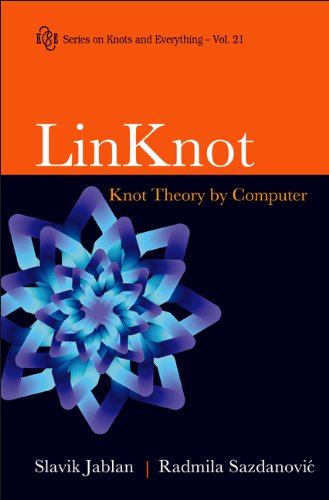
LinKnot — Knot Theory by Computer provides a unique view of selected topics in knot theory suitable for students, research mathematicians, and readers with backgrounds in other exact sciences, including chemistry, molecular biology and physics.The book covers basic notions in knot theory, as well as new methods for handling open problems such as unknotting number, braid family representatives, invertibility, amphicheirality, undetectability, non-algebraic tangles, polyhedral links, and (2,2)-moves.Hands-on computations using Mathematica or the webMathematica package LinKnot and beautiful illustrations facilitate better learning and understanding. LinKnot is also a powerful research tool for experimental mathematics implementation of Caudron’s ideas. The use of Conway notation enables experimenting with large families of knots and links.Conjectures discussed in the book are explained at length. The beauty, universality and diversity of knot theory is illuminated through various non-standard applications: mirror curves, fullerens, self-referential systems, and KL automata.
User’s Reviews
Reviews from Amazon users which were colected at the time this book was published on the website:
⭐A truly astonishing book that explains and computerizes, inter alia, the brilliant work of Alain Caudron, while extending, ad infinitum, the curious world of eccentric Perko knots (further explored by these authors at page 165 of “Introductory Lectures on Knot Theory” (World Scientific, 2012)). Not for the timid reader, it is profusely well-illustrated and its excellent discussion of the history of by-hand enumeration and classification is generally quite accurate. (Minor exception at page 30: David Lombardero [Princeton senior thesis, 1968] and Alain Caudron [Structuration de la classification des noeds et des enlacements, Notes de reserche 76/77/78, E.N.S.E.T. deTunis (1979)] first tabled the four knots not listed by Conway. I just observed that they were missing, creditingtheir discoverers in MR 57#13910 (1979) and 81k:57005 (1981). Also, there seems to be a misprint in Corollary 1.1at page 34. Perhaps the authors meant to say “a chiral” although this seems inconsistent with their more general practice of dropping English articles.) Attention Shoppers: You can get this book for a lot less than full price. I pickedone up on the internet for about $40. (But wait, there’s more: the authors’ “History of Knot Theory” in Chapter 3 errs in asserting on page 377 that the nineteenth century knot tabulators “succeeded in making a list of all alternatingknots up to 11 crossings.” They missed 11 of the 367 11-crossing examples, a failure rate roughly half again aslarge as in Conway’s non-alternating table. As has been computer verified, nothing escaped the watchful eyes ofAlain Caudron.) ( Note also that on page 167 of the authors’ above-cited 2012 paper five knots are missing from their list of “positive” 12-crossing Perko knots: n594, n638, n640, n644 and n647.)
⭐
⭐
⭐
Keywords
Free Download Linknot: Knot Theory by Computer (Knots and Everything) in PDF format
Linknot: Knot Theory by Computer (Knots and Everything) PDF Free Download
Download Linknot: Knot Theory by Computer (Knots and Everything) 2007 PDF Free
Linknot: Knot Theory by Computer (Knots and Everything) 2007 PDF Free Download
Download Linknot: Knot Theory by Computer (Knots and Everything) PDF
Free Download Ebook Linknot: Knot Theory by Computer (Knots and Everything)