

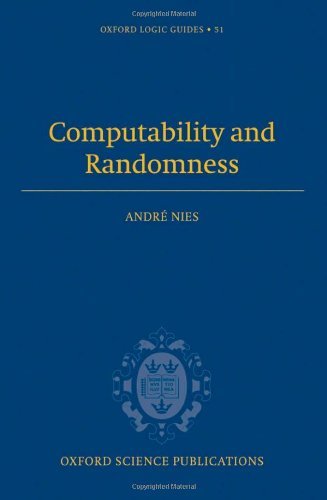
Ebook Info
- Published: 2012
- Number of pages: 918 pages
- Format: PDF
- File Size: 2.34 MB
- Authors: André Nies
Description
The interplay between computability and randomness has been an active area of research in recent years, reflected by ample funding in the USA, numerous workshops, and publications on the subject. The complexity and the randomness aspect of a set of natural numbers are closely related. Traditionally, computability theory is concerned with the complexity aspect. However, computability theoretic tools can also be used to introduce mathematical counterparts for theintuitive notion of randomness of a set. Recent research shows that, conversely, concepts and methods originating from randomness enrich computability theory.The book covers topics such as lowness and highness properties, Kolmogorov complexity, betting strategies and higher computability. Both the basics and recent research results are desribed, providing a very readable introduction to the exciting interface of computability and randomness for graduates and researchers in computability theory, theoretical computer science, and measure theory.
User’s Reviews
Reviews from Amazon users which were colected at the time this book was published on the website:
⭐This book is just awesome. It has clearly stated theorems and proofs. Highly recommended!
⭐perfect in every way
⭐The book is intended for graduate students and researchers in mathematical logic, foundations of mathematics, and theoretical computer science. It includes a detailed treatment of Turing’s theory of computability and unsolvability as subsequently developed by Kleene, Post, Friedberg, and many other researchers up to the present. The book starts at the beginning and moves systematically to advanced material. The majority of the book is devoted to currently active research topics: algorithmic randomness (Martin-Lof, Kucera, …) and string complexity (Kolmogorov, Chaitin, Levin, …). Professor Nies is a leading researcher in these areas, and their treatment here is encyclopedic. The book is very timely, very well written, and very authoritative. Bravo!
⭐This book is currently *the* place to find clear proofs of results in the area of algorithmic randomness. The author borrows a “page” from Sipser’s
⭐, prefacing each detailed proof with a “proof idea” paragraph. Actually, that book would be a useful prequel to the study of Nies’ book, although many readers would also want to include a study of e.g. the first chapters of Soare’s
⭐before being ready for “Computability and Randomness”. One hopes that the next edition of this book will use a larger font and larger margins.
⭐André Nies provides an unvaluable up to date introduction to the field of randomness in connection to computability. The book can be used both as a reference and as a textbook for a one-semester course in advanced algorithmic randomness and computability theory. Read the full review online from the (ACM) Reviews.com (requires password)[…]
⭐This is a particularly well written book. What should be a common feature of mathematical books is in fact unfortunately rarely pursued. In this sense, this book is a pleasant exception. What is particulary appreaciable, is the way concepts are introduced and explained: mathematical definitions are not simply brutally given, but the reasons of their importance are very well described through the logical comparison of concepts and results. Nice reading!
Keywords
Free Download Computability and Randomness (Oxford Logic Guides Book 51) in PDF format
Computability and Randomness (Oxford Logic Guides Book 51) PDF Free Download
Download Computability and Randomness (Oxford Logic Guides Book 51) 2012 PDF Free
Computability and Randomness (Oxford Logic Guides Book 51) 2012 PDF Free Download
Download Computability and Randomness (Oxford Logic Guides Book 51) PDF
Free Download Ebook Computability and Randomness (Oxford Logic Guides Book 51)