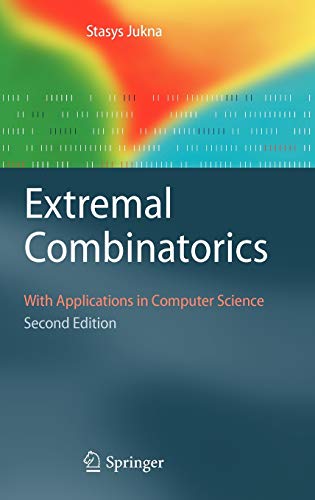
Ebook Info
- Published: 2011
- Number of pages: 436 pages
- Format: PDF
- File Size: 5.56 MB
- Authors: Stasys Jukna
Description
This book is a concise, self-contained, up-to-date introduction to extremal combinatorics for nonspecialists. There is a strong emphasis on theorems with particularly elegant and informative proofs, they may be called gems of the theory. The author presents a wide spectrum of the most powerful combinatorial tools together with impressive applications in computer science: methods of extremal set theory, the linear algebra method, the probabilistic method, and fragments of Ramsey theory. No special knowledge in combinatorics or computer science is assumed – the text is self-contained and the proofs can be enjoyed by undergraduate students in mathematics and computer science. Over 300 exercises of varying difficulty, and hints to their solution, complete the text.This second edition has been extended with substantial new material, and has been revised and updated throughout. It offers three new chapters on expander graphs and eigenvalues, the polynomial method and error-correcting codes. Most of the remaining chapters also include new material, such as the Kruskal―Katona theorem on shadows, the Lovász―Stein theorem on coverings, large cliques in dense graphs without induced 4-cycles, a new lower bounds argument for monotone formulas, Dvir’s solution of the finite field Kakeya conjecture, Moser’s algorithmic version of the Lovász Local Lemma, Schöning’s algorithm for 3-SAT, the Szemerédi―Trotter theorem on the number of point-line incidences, surprising applications of expander graphs in extremal number theory, and some other new results.
User’s Reviews
Editorial Reviews: Review From the reviews of the second edition:“This is an entertaining and impressive book. I say impressive because the author managed to cover a very large part of combinatorics in 27 short chapters, without assuming any graduate-level knowledge of the material. … The collection of topics covered is another big advantage of the book. … The book is ideal as reference material or for a reading course for a dedicated graduate student. One could teach a very enjoyable class from it as well … .” (Miklós Bóna, The Mathematical Association of America, May, 2012)”[R]eaders interested in any branch of combinatorics will find this book compelling. … This book is very suitable for advanced undergraduate and graduate mathematics and computer science majors. It requires a very solid grounding in intermediate-level combinatorics and an appreciation for several proof methods, but it is well worth the study.” (G.M. White, ACM Computing Reviews, May 2012)“This is the second edition of a well-received textbook. It has been extended with new and updated results. Typographical errors in the first edition are corrected. … This textbook is suitable for advanced undergraduate or graduate students as well as researchers working in discrete mathematics or theoretical computer science. The author’s enthusiasm for the subject is evident and his writing is clear and smooth. This is a book deserving recommendation.” (Ko-Wei Lih, Zentralblatt MATH, Vol. 1239, 2012)“This is an introductory book that deals with the subject of extremal combinatorics. … The book is nicely written and the author has included many elegant and beautiful proofs. The book contains many interesting exercises that will stimulate the motivated reader to get a better understanding of this area. … author’s goal of writing a self-contained book that is more or less up to date … and that is accessible to graduate and motivated undergraduate students in mathematics and computer science, has been successfully achieved.” (Sebastian M. Cioabă, Mathematical Reviews, January, 2013) From the Back Cover This book is a concise, self-contained, up-to-date introduction to extremal combinatorics for nonspecialists. There is a strong emphasis on theorems with particularly elegant and informative proofs, they may be called gems of the theory. The author presents a wide spectrum of the most powerful combinatorial tools together with impressive applications in computer science: methods of extremal set theory, the linear algebra method, the probabilistic method, and fragments of Ramsey theory. No special knowledge in combinatorics or computer science is assumed – the text is self-contained and the proofs can be enjoyed by undergraduate students in mathematics and computer science. Over 300 exercises of varying difficulty, and hints to their solution, complete the text.This second edition has been extended with substantial new material, and has been revised and updated throughout. It offers three new chapters on expander graphs and eigenvalues, the polynomial method and error-correcting codes. Most of the remaining chapters also include new material, such as the Kruskal―Katona theorem on shadows, the Lovász―Stein theorem on coverings, large cliques in dense graphs without induced 4-cycles, a new lower bounds argument for monotone formulas, Dvir’s solution of the finite field Kakeya conjecture, Moser’s algorithmic version of the Lovász Local Lemma, Schöning’s algorithm for 3-SAT, the Szemerédi―Trotter theorem on the number of point-line incidences, surprising applications of expander graphs in extremal number theory, and some other new results. About the Author The author is a professor at the Goethe Universität Frankfurt and he is also a member of the Vilnius University Institute of Mathematics and Informatics. His main fields of research are theoretical computer science and discrete mathematics, in particular complexity. Read more
Reviews from Amazon users which were colected at the time this book was published on the website:
⭐This book worth 4.5 stars.It is a comprehensive review of Extremal Combinatorics, though the book mainly presents connections between Combinatorics and Theoretical Computer Science.The book is up to date and has chapters on current techniques and research topics.The down sides of this book are:1.There are a few typos and ambiguities throughout the book which often make it hard to read.2.Each excersice follows immediately by a hint, which often give a glimpse to the solution. Hint section would be more preferable.
⭐The author covers exactly what the title promises: How to calculate bounds for combinatorial objects. To this end various methods are introduced and carefully explained.The proofs are generally not too difficult – and many would qualify for Erdös’ famous “God’s book of perfect proofs”!While the formal mathematical prerequisites are rather minimal, I feel the book requires some maturity in math. (However, I am just a hobby mathematician, so do not take this too seriously!)The author, no question!, seems a master of his subject: The style or writing is “lean”, every word counts, but one does never feel like anything is missing.For anybody interested in “beautiful mathematics” this is certainly a book to read!There a not too many typos in the book, and most of them are easily recognized, they do not distract at all.The book contains many excercises ( with exhaustive hints), but I did not do them, so I cannot comment.
⭐Good
Keywords
Free Download Extremal Combinatorics: With Applications in Computer Science (Texts in Theoretical Computer Science. An EATCS Series) in PDF format
Extremal Combinatorics: With Applications in Computer Science (Texts in Theoretical Computer Science. An EATCS Series) PDF Free Download
Download Extremal Combinatorics: With Applications in Computer Science (Texts in Theoretical Computer Science. An EATCS Series) 2011 PDF Free
Extremal Combinatorics: With Applications in Computer Science (Texts in Theoretical Computer Science. An EATCS Series) 2011 PDF Free Download
Download Extremal Combinatorics: With Applications in Computer Science (Texts in Theoretical Computer Science. An EATCS Series) PDF
Free Download Ebook Extremal Combinatorics: With Applications in Computer Science (Texts in Theoretical Computer Science. An EATCS Series)