

Ebook Info
- Published: 2009
- Number of pages: 224 pages
- Format: PDF
- File Size: 13.28 MB
- Authors: Wilson A Sutherland
Description
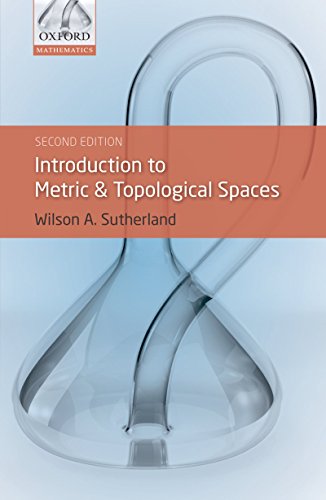
One of the ways in which topology has influenced other branches of mathematics in the past few decades is by putting the study of continuity and convergence into a general setting. This new edition of Wilson Sutherland’s classic text introduces metric and topological spaces by describing some of that influence. The aim is to move gradually from familiar real analysis to abstract topological spaces, using metric spaces as a bridge between the two. The language ofmetric and topological spaces is established with continuity as the motivating concept. Several concepts are introduced, first in metric spaces and then repeated for topological spaces, to help convey familiarity. The discussion develops to cover connectedness, compactness and completeness, a triowidely used in the rest of mathematics.Topology also has a more geometric aspect which is familiar in popular expositions of the subject as `rubber-sheet geometry’, with pictures of Möbius bands, doughnuts, Klein bottles and the like; this geometric aspect is illustrated by describing some standard surfaces, and it is shown how all this fits into the same story as the more analytic developments.The book is primarily aimed at second- or third-year mathematics students. There are numerous exercises, many of the more challenging ones accompanied by hints, as well as a companion website, with further explanations and examples as well as material supplementary to that in the book.
User’s Reviews
Reviews from Amazon users which were colected at the time this book was published on the website:
⭐It gives a concrete treatment of metrics before delving into point-set topology.
⭐not bad for beginner.
⭐I purchased Introduction to Metric and Topological Spaces two years ago. I was unprepared for its rigor. I am not a mathematics major, but I enjoy reading mathematics. My background includes calculus, linear algebra, differential equations, and other applied mathematics, but I have not had a course in real analysis. W. A. Sutherland intended this text as the next step after analysis.After a brief foray, I retreated, placed Sutherland back on my bookshelf, and attacked some marginally easier introductory texts: Metric Spaces by Victor Bryant, Introduction to Topology by Bert Mendelson, and most recently, several chapters in Introduction to Analysis by Maxwell Rosenlicht. I periodically return to W. A. Sutherland’s text to measure my understanding. I am now working on chapter five, Compact Spaces.I doubt that Introduction to Metric and Topological Spaces would be foreboding to students that are familiar with real analysis. Sutherland understands that the abstractness and generalization can be difficult and shows concern with motivating the student. He repeatedly attempts to illustrate the value of generalization, especially in the study of continuity.Sutherland often uses a lengthy series of examples of increasing difficulty to illustrate abstract concepts. In his discussion of metric spaces, we begin with Euclidian n-space metrics, and move on to discrete metric spaces, function spaces, and even Hilbert sequence spaces. He introduces open sets and topological spaces in a similar fashion.The author occasionally suggests that the student might wish to make a geometrical diagram to help clarify some subtle point, but Sutherland includes few geometrical drawings in his text. His focus is clearly on proofs using the axioms of metric spaces and topological spaces.Sutherland highlights sections that either require more knowledge of abstract algebra, or for other reasons are thought to be more severe.Despite Sutherland’s use of Introduction in the title, I suggest that any reader considering independent study might defer tackling Introduction to Metric and Topological Spaces until after completing a more basic text. Possibly a better title might be A Second Introduction to Metric and Topological Spaces.
⭐I enjoyed reading this book because of its clarity, conciseness, and nice way of relating topological and metric spaces. This book is ideal for the student who is learning about these subjects for the first time, whether or not they intend to do more advanced work on the subject. The reader who wants to go on and learn about more advanced topics, should consult Munkres’s book.
⭐A lot of books on topology assume some basic knowledge of real analysis, which can throw a lot of readers off. This book starts from the very beginning, and thus is truly a great introduction. Each section has some good exercises, with even a few pointers at the back of the book for the more challenging ones. It starts with topological aspects, and then refers to them in the case of metric spaces (amongst many others), which is a much better approach than most other books, as the reader doesn’t take the details of the specific to the general. A great little book, which is a must for most advanced maths Analysis courses.
⭐I needed a text to introduce me to Topological Spaces that was accessible without in depth understanding of real analysis. This book fit the bill because it stands on its own and develops ideas as they are needed. Lots of good examples and good problem sets makes it a very workable text for self study or class use.
⭐I haven’t finished reading the book yet, but my initial impression is that it is a reasonable book. I don’t have a maths degree, but i have some exposure to maths. The initial part of the book was reasonably readable. There are a couple of very useful “what does this mean” and “why do we want to do this” type sections. However, there are also a number of proofs, which are quite terse but sometimes mixed up with commentary, which i found a little hard to split from the proof in some case. I think a clearer split between proof and commentary and more commentary would be useful to help make certain sections of the book more readable. Whilst it is good that there is a lot of support material on the companion website, at times i found it a bit irritating that I had to stop reading and refer to the website and it would have been nicer to have a large proportion of the support material in the book, so that the flow is not interrupted.
⭐One of the best introductions to metric and topological spaces there is. Bear in mind that it is an introductory book but for that purpose it is truly excellent. It has a very strong grounding in making sure that clear explanations and meaningful carefully laid out proofs are given throughout the book.In particular, the notions behind continuity, uniform continuity and compactness are very well explained in the context of metric spaces (and maths in general) and tied together to then easily step off into topological spaces.It shows you exactly why topological spaces arose in mathematics as very natural generalisations/companions to metric spaces.You will find that you will turn back to this book many times in order to keep grounded in the clear explanations and illuminating proofs given here when you go much deeper into the subject.A very solid 2nd year undergraduate pure maths book. Highly recommended @ Warwick University and Imperial College London.
⭐This is a great book and will actually get you through a good amount of different university modules (intro analysis, point set topology, general analysis which extends to metric spaces and also the background topology needed for differentialriemannian geometry). The proofs given in the text are very clear and well explained and are often much better than a lecture; it’s ideal of self study.
⭐An excellent text, perfect for 2nd/3rd year undergraduate students. It does not require much mathematical maturity to read, but also is not dishonest about results (in the sense that generality is not omitted where it adds little complexity). The perfect balance!
⭐A fantastic beginner’s text in general topology that I woul thoroyghly recommend for undergraduates. The exercises in the text are interesting as well as useful. The book is written very clearly.
Keywords
Free Download Introduction to Metric and Topological Spaces (Oxford Mathematics) 2nd Edition in PDF format
Introduction to Metric and Topological Spaces (Oxford Mathematics) 2nd Edition PDF Free Download
Download Introduction to Metric and Topological Spaces (Oxford Mathematics) 2nd Edition 2009 PDF Free
Introduction to Metric and Topological Spaces (Oxford Mathematics) 2nd Edition 2009 PDF Free Download
Download Introduction to Metric and Topological Spaces (Oxford Mathematics) 2nd Edition PDF
Free Download Ebook Introduction to Metric and Topological Spaces (Oxford Mathematics) 2nd Edition