Ebook Info
- Published: 2012
- Number of pages: 624 pages
- Format: Epub
- File Size: 1.01 MB
- Authors: Robert Tressell
Description
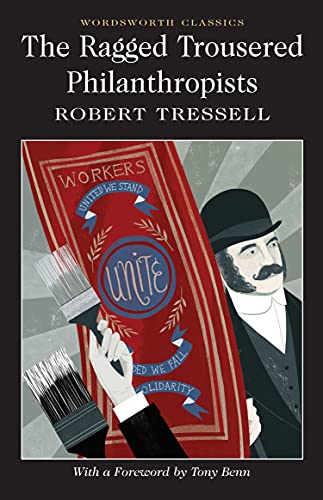
The Ragged Trousered Philanthropists is a classic representation of the impoverished and politically powerless underclass of British society in Edwardian England, ruthlessly exploited by the institutionalized corruption of their employers and the civic and religious authorities. Epic in scale, the novel charts the ruinous effects of the laissez-faire mercantilist ethics on the men, women, and children of the working classes, and through its emblematic characters, argues for a socialist politics as the only hope for a civilized and humane life for all. This Wordsworth edition includes an exclusive foreword by the late Tony Benn.
User’s Reviews
Review The first great English novel about the class war, The Ragged Trousered Philanthropists is spiked, witty, humorous, instructive and full of excitement, harmony and pathos. Alan Sillitoe Some books seem to batter their way to immortality against all the odds, by sheer brute artistic strength, and high up in this curious and honourable company must be counted The Ragged Trousered Philanthropists. Robert Tressell s unfailing humour mixes with an unfailing rage and the two together make a truly Swiftian impact. Evening StandardRobert Tressell has complete familiarity with the idiom of his characters. His language is bizarre, vital, highly inventive and precisely heard it is a complete and living archaeology of the speech of a particular human group. A brilliant and very funny book. Spectator –Alan Sillitoe
Reviews from Amazon users, collected at the time the book is getting published on UniedVRG. It can be related to shiping or paper quality instead of the book content:
⭐ Just getting started but the first few chapters are great.
⭐ Good book, there are very few books of this type. Jack London did one, George Orwell did a couple, Henry Mayhew did one, and Dickens sprinkled observations of how life is for the bottom 10% all through his books. So if you like this type of book, this is one of the handful that exist.
⭐ One of my favorite books. In my hands again. Thanks
⭐ This is a fascinating novel that sets the working class of late 1800’s England as its main characters. If you are interested in socialist thought, whether for or against, this book is an excellent read.
⭐ An extraordinary book especially helpful in understanding the financial inequalities that we recognize today. By turns amusing and appalling it describes the lives of working stiffs and their families and the hypocrisy of those who profit from the toil of the lowly workers.
⭐ I don’t think that “most helpful critical review” is correct. This is the 1955 edition, not the shorter 1914 edition, and it is unabridged as far as I can tell.This is an excellent book, and I’m glad Wordsworth is making it available at low cost, but the new copy I just received uses cheap paper and ink, and it consequently smells bad! Better get a different edition or an e-book if you have a sensitive nose.
⭐ essential reading
⭐ A absolute classic. A must read for anyone with a social conscience.
⭐ My husband had read this book years ago and I have found it to be very enlightening and sad at the same time. It is so vividly written and you can picture exactly what the author is wishing to convey. Astoundingly hard times for those men at the supposedly “bottom of the food chain”.I bought the paper back for my husband as he had lent his copy and not had it returned.Diane
⭐ “Ragged-Trousered Philanthropists”: Great socialist novel marks 100th anniversary, by: Tom PepperPeopleswold.org, August 22, 2914In an era when most works of art are meant to leave us satisfied, glutted with special effects and violence and fantasy and sex, motivated only to buy the DVD or look forward to the sequel, such radical art seems hard to come by. So perhaps it is time to recall a great work of socialist literature from the past: The Ragged-Trousered Philanthropists, by Robert Tressell, published 100 years ago this year.Tressell was the pen name of Robert Noonan, a British house painter and socialist who was born in Ireland in 1870 and died in England of tuberculosis in 1911 at the age of 41. The novel was published, with the help of his daughter, three years after his death, and has remained popular in England ever since, sometimes credited with helping promote the Labour Party in the United Kingdom.Writing in the early part of the 20th century, Tressell describes the gradual decline in prosperity of the working class following the 1907 depression, a decline that seemed to have no end in sight, with each passing year seeing more men out of work, more families becoming homeless, and an increasingly difficult struggle to survive on sporadic work and multiple low-paying jobs. Tressell’s novel is set in a time before computers and cell phones, when the automobile was new and uncommon. But the economic hardship faced by the working class following a financial crisis from which the rich “recovered” while workers were forced to accept lower wages and a diminished standard of living … well, that sounds all too familiar, right?Tressell seems to have written the novel in an attempt to solve the great problem that has always faced socialists: how do we overcome the power of capitalist ideology? Throughout the book, we hear Tressell’s frustration, often given voice by the character Frank Owen, a socialist house painter who repeatedly attempts to convert his coworkers to his way of thinking. Late in the book, during a parliamentary election campaign, Owen once again faces despair: “They did not know the causes of their poverty, they did not want to know, they did not want to hear.” The majority of the working men support the conservative Tory party, sure that this party will give them “plenty of work” by means of some rather obscure financial and tax reforms.Despite his obvious frustration, Tressell rejects the cynical path taken by one socialist in the novel, who gets tired of being abused by those he is trying to help and turns to writing campaign speeches for the Tory party. For Tressell, the only hope for our children, for the future of the majority of the human race, is to keep working to produce a socialist party. This novel is one part of such work, and it attempts to combine two different approaches to achieve this end.One part of the novel is a traditional melodrama reminiscent of many Victorian novels. We witness men out of work struggling to make the rent, buy food, and clothe their children; older workers sent to the workhouse and early death; and the wives of these working men putting in 14-hour days doing piecework sewing at home or cleaning houses, until several characters contemplate suicide as the only escape. The focus, in this part of the narrative, on the despair of the women and children is clearly meant to be motivational. The workers “do not want to know,” and Tressell hopes, by showing them the awful effects of this lingering economic recession, to make them feel the need to know.The other part of the novel, probably the bulk of the writing, consists of social and economic satire, meant to expose corruption and to explain the inherent injustice in “The System.” Tressell tries, in multiple chapters, to find ways to explain the inherent contradictions of capitalism and the solutions offered by socialism, reminding us again and again that it isn’t a matter of a few corrupt and greedy individuals, that the capitalist system itself requires poverty and inequality. And his explanations are very well done, lucid and compelling.Of course, as he also repeatedly reminds us, no matter how clearly explained, most people will just not want to understand, or if they do, will remain convinced that there’s nothing they can do to change things. This is where socialist art comes in, however. A novel like this should leave us frustrated and exasperated, motivated to work together to educate and agitate, to produce a socialist party. Our children’s lives depend on it.Tressell didn’t live to see his novel published, but it has remained in print continuously for a century now, first in an abridged edition, then after 1955 in an edition that restored the novel, as closely as possible, to its original manuscript form. Today, it is available in a relatively cheap edition from Wordsworth Classics, as well as in free or very inexpensive digital formats.Tressell’s depiction of the real daily life of ordinary working men and women is engaging and will likely ring true to anyone who has worked in such trades even today. And certainly all socialists can share his experience of frustration at the difficulty of the work to be done, the very hard work of helping people break through their illusions and misconceptions. His novel can serve as an inspiration to us, both to follow the example of his characters and work for a socialist future, and, hopefully, to write more such novels today, depicting the reality of working life with no fantasy Hollywood endings. The only solution is collective political effort, Tressell tells us. Part of that effort, he shows by example, is the creation of socialist art. Can we listen to him today?
Keywords
Free Download The Ragged Trousered Philanthropists (Wordsworth Classics) in Epub format
The Ragged Trousered Philanthropists (Wordsworth Classics) Epub Free Download
Download The Ragged Trousered Philanthropists (Wordsworth Classics) 2012 Epub Free
The Ragged Trousered Philanthropists (Wordsworth Classics) 2012 Epub Free Download
Download The Ragged Trousered Philanthropists (Wordsworth Classics) Epub
Free Download Ebook The Ragged Trousered Philanthropists (Wordsworth Classics)