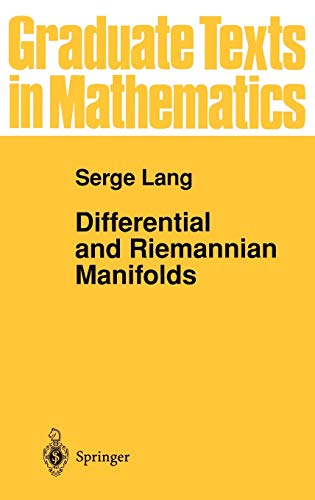
Ebook Info
- Published: 1995
- Number of pages: 378 pages
- Format: PDF
- File Size: 21.10 MB
- Authors: Serge Lang
Description
This is the third version of a book on differential manifolds. The first version appeared in 1962, and was written at the very beginning of a period of great expansion of the subject. At the time, I found no satisfactory book for the foundations of the subject, for multiple reasons. I expanded the book in 1971, and I expand it still further today. Specifically, I have added three chapters on Riemannian and pseudo Riemannian geometry, that is, covariant derivatives, curvature, and some applications up to the Hopf-Rinow and Hadamard-Cartan theorems, as well as some calculus of variations and applications to volume forms. I have rewritten the sections on sprays, and I have given more examples of the use of Stokes’ theorem. I have also given many more references to the literature, all of this to broaden the perspective of the book, which I hope can be used among things for a general course leading into many directions. The present book still meets the old needs, but fulfills new ones. At the most basic level, the book gives an introduction to the basic concepts which are used in differential topology, differential geometry, and differential equations. In differential topology, one studies for instance homotopy classes of maps and the possibility of finding suitable differentiable maps in them (immersions, embeddings, isomorphisms, etc.).
User’s Reviews
Editorial Reviews: Review S. LangDifferential and Riemannian Manifolds”An introduction to differential geometry, starting from recalling differential calculus and going through all the basic topics such as manifolds, vector bundles, vector fields, the theorem of Frobenius, Riemannian metrics and curvature. Useful to the researcher wishing to learn about infinite-dimensional geometry.”―MATHEMATICAL REVIEWS From the Back Cover This text provides an introduction to basic concepts in differential topology, differential geometry, and differential equations, and some of the main basic theorems in all three areas: for instance, the existence, uniqueness, and smoothness theorems for differential equations and the flow of a vector field; the basic theory of vector bundles including the existence of tubular neighborhoods for a submanifold; the calculus of differential forms; basic notions of symplectic manifolds, including the canonical 2-form; sprays and covariant derivatives for Riemannian and pseudo-Riemannian manifolds; applications to the exponential map, including the Cartan-Hadamard theorem, and the first basic theorem of calculus of variations. These are all covered for infinite-dimensional manifolds, modeled on Banach and Hilbert spaces, at no cost in complications, and some gain in the elegance of the proofs. In the finite-dimensional case, differential forms of top degree are discussed, leading to Stokes’ theorem (even for manifolds with singular boundary), and several of its applications to the differential or Riemannian case.
Reviews from Amazon users which were colected at the time this book was published on the website:
⭐As other reviewers have indicated this text is a rarity in that it presents and analyzes infinite dimensional differential manifolds, hence the need for the Banach space setting at the outset. Adequate preparation is given in the author’s text on real and functional analysis. He uses the language of categories to tidy up the various theories in the reviewed text but this is used more in a descriptive way. Category theory merely formalizes common notions of mathematical objects and their correspondences or mappings. Examples are sets and functions or mappings between them, groups and homomorphisms, etc. Properties of the mappings involve composition as well as inverse and more extended constructs. Categories just axiomatize this common behavior. His brief review is really enough as the main results are proven independent of categories-but category theory will allow or show the results to hold in other settings or theories. The author’s famous text on algebra gives a rigorous and self contained presentation on categories if you’re not satisfied. Lang believed in giving you the most bang for your buck-being a Bourbakist. He even proves the full version of Sard’s theorem which most texts on differential topology relegate to references. If you’ve been through a more elementary text like Boothby and would like to see a more chiseled, formal, and modern approach get this book. Not for newbies.
⭐Well, we have here another book on differential manifolds, and another book by Serge Lang. Lang is well-known by writing (lots of) books on different topics in analysis and algebra, all of them in a quite “Bourbaki-like” style: attaining maximum generality, with less motivation than most students would like. This is no surprise, because Lang himself is a Bourbakist.So, what’s interesting about D&RM? It’s a book very much like Lang’s other books, only that here the Bourbakist’s approach is quite happy: it’s one of the very few books on his subject to present most of his results in infinite-dimensional (Banach) version, a must if you are interested in nonlinear functional analysis or dynamical systems. The exposition is very clean and clear: Lang uses categories all the way to estabilish the main relations between the different differential-topological structures and tools, and he does not hesitate in stating and using tools from analysis, such as Lebesgue measure and functional analysis’ main theorems. The proofs are very polished and, in a certain sense, beautiful, a philosophy that permeates most of the book. As if it weren’t enough, the book still contains an appendix with a Von Neumann’s seminar about the spectral theorem.All things considered, it’s a quite “state-of-the-art” book about the basics of differential manifolds, from an analyst’s perspective. This perspective provides differential topology with a lot of additional clarity and power. I don’t know if most physicists would like this book, because its motivations, if any, are sparse and sometimes quite obscure, as long as physical applications are concerned. For a mathematician, however, this book is a gem: it’s Lang at its best, and the perfect opening door to global analysis (the nonlinear analysis on infinite dimensional manifolds, a vast field of mathematics that encompasses dynamical systems and nonlinear functional analysis). Despite all that, I would also recommend to physicists to at least tackle this book, as an antidote to all the crap that the so-called “differential topology for physicists” books put on their heads, because I don’t know a cleaner and more precise presentation of differential manifolds so far.
⭐Lang’s book is definitely not useful as textbook for classes or for self-guided study (learnt this the hard way). He is rather abstract and provides zero motivation for the theory. The book is obviously made for people who learnt diff. geometry elsewhere but want to read a cleaner and more modern treatment. To this end, Lang’s book is useful. The best part is that manifolds are infinite-dimensional right away. This is probably the only reason for buying Lang instead of/in addition to Dieudonne as a reference. Otherwise, the book is a little too terse; fiber bundles are merely hinted at. Moreover, I think some of the proofs are unnecessarily complicated, such as the one for Frobenius theorem.
⭐This book is a proper subset of Lang’s later book “Fundamentals of Differential Geometry (Graduate Texts in Mathematics, 191)”.
Keywords
Free Download Differential and Riemannian Manifolds (Graduate Texts in Mathematics, 160) 3rd Edition in PDF format
Differential and Riemannian Manifolds (Graduate Texts in Mathematics, 160) 3rd Edition PDF Free Download
Download Differential and Riemannian Manifolds (Graduate Texts in Mathematics, 160) 3rd Edition 1995 PDF Free
Differential and Riemannian Manifolds (Graduate Texts in Mathematics, 160) 3rd Edition 1995 PDF Free Download
Download Differential and Riemannian Manifolds (Graduate Texts in Mathematics, 160) 3rd Edition PDF
Free Download Ebook Differential and Riemannian Manifolds (Graduate Texts in Mathematics, 160) 3rd Edition