Ebook Info
- Published: 2017
- Number of pages: 344 pages
- Format: PDF
- File Size: 23.63 MB
- Authors: Dwight E. Neuenschwander
Description
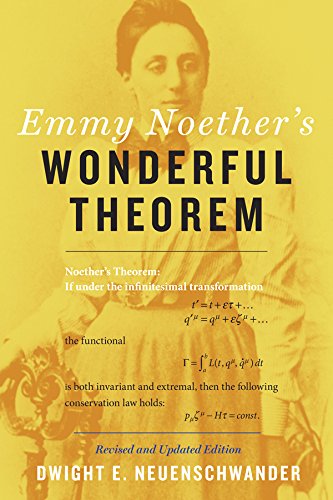
“In the judgment of the most competent living mathematicians, Fräulein Noether was the most significant creative mathematical genius thus far produced since the higher education of women began.”—Albert EinsteinThe year was 1915, and the young mathematician Emmy Noether had just settled into Göttingen University when Albert Einstein visited to lecture on his nearly finished general theory of relativity. Two leading mathematicians of the day, David Hilbert and Felix Klein, dug into the new theory with gusto, but had difficulty reconciling it with what was known about the conservation of energy. Knowing of her expertise in invariance theory, they requested Noether’s help. To solve the problem, she developed a novel theorem, applicable across all of physics, which relates conservation laws to continuous symmetries—one of the most important pieces of mathematical reasoning ever developed.Noether’s “first” and “second” theorem was published in 1918. The first theorem relates symmetries under global spacetime transformations to the conservation of energy and momentum, and symmetry under global gauge transformations to charge conservation. In continuum mechanics and field theories, these conservation laws are expressed as equations of continuity. The second theorem, an extension of the first, allows transformations with local gauge invariance, and the equations of continuity acquire the covariant derivative characteristic of coupled matter-field systems. General relativity, it turns out, exhibits local gauge invariance. Noether’s theorem also laid the foundation for later generations to apply local gauge invariance to theories of elementary particle interactions. In Dwight E. Neuenschwander’s new edition of Emmy Noether’s Wonderful Theorem, readers will encounter an updated explanation of Noether’s “first” theorem. The discussion of local gauge invariance has been expanded into a detailed presentation of the motivation, proof, and applications of the “second” theorem, including Noether’s resolution of concerns about general relativity. Other refinements in the new edition include an enlarged biography of Emmy Noether’s life and work, parallels drawn between the present approach and Noether’s original 1918 paper, and a summary of the logic behind Noether’s theorem.
User’s Reviews
Reviews from Amazon users which were colected at the time this book was published on the website:
⭐I love this book! It isn’t an easy read but if you are willing to spend the time to read it thoroughly (for me that meant reading it from cover to cover over 7 times before I felt I had a reasonable understanding of the subject) you will understand why Einstein and others of his generation considered Dr. Noether to be one of the greatest mathematicians during the early years of the 20th century. I have a reasonable math background (a B.S. in Applied Mathematics) which was a real help with the subject matter of the book. If you are an upper division math or physics major you should be able to understand the importance of Noether’s work. Dr. Neuenschwander does a good job of organizing and presenting the material.
⭐The author states “The reader I have in mind is a junior or senior under graduate physics student, or a beginning physics graduate student. Well do I remember being one of those students myself. Those memories include the frustration of trying to read a manuscript loaded with jargon that assumed a fluency I was still struggling to master. At that point in one’s career, details that are incidental trifles to experts can become major sticking points for novices (see the following list of questions for example).” This quote comes from page XI, on page XV and XVI is the list of PRIMARY and AUXILLARY QUESTIONS which he leaves to “us” to discover the answers too. The other thing the author states is before we read this book we should get hold of Emmy Noether’s original paper, which the author could have given us in the book (it is public domain). Once you get through this book with understanding of the subject you will be able to write a better explanation of the theorem.
⭐Pedagogic physics starts with specific non-provable rules and derives mathematical statements that lead into mechanics, fields, optics, etc.These rules include the conservation of energy, momentum, etc. This little gem of a book lays the foundation to understand Emmy Noether’s work to try to reverse that understanding to state the Lagrangian or Hamiltonian and then if you can establish symmetry then you can prove those assumed rules. The mathematics is beautiful, but the philosophy is not so firmly established. Instead you may have a tautology where the Hamiltonian is just another statement of the conservation law that you are trying to prove. The foundations of the math itself are not independent of assumption. Frankly, I was delighted to find that I could read and comprehend the level of mathematics presented in this book. For me, the most important point was that conservation laws depend upon symmetry or more simply they have qualifying statements. Thus the evolution of physics is really trying to understand the qualifying statements and the logic that variations imply. Thus, we are not stuck with the “Ten Commandments of Physics” but we may strive to find and establish new and more comprehensive rules about the way things work. By all means, read this book.
⭐This book addresses an important gap in the landscape of textbooks on theoretical mechanics. I strongly feel this is the way the subject should be approached as Noether’s theorem has such far reaching implications beyond just classical mechanics.Yet, there are annoying glitches. E.g. the oversight on p.28 with regards to the fundamental lemma of the calculus of variations as has been pointed out in a previous review.On page 99 the equation (6.3.1) for the Hamiltonian density is incorrect. The way it is written the first term sums over all coordinate indexes. Correct would be to only have time i.e. index zero appear in the first term and sum over all field components if we deal with more than a simple scalar field.Other times the authors just presents an equation without a modicum of information of how we got there. I.e. the alternative form of the Rund-Trautman identity (RTI II) is given on p.68. It’s easy enough to see how the right side follows from RTI I when substituting the canonical variables and using the product rule, but how does the left side of RTI II come about? How does the Euler-Lagrange identity reappear there? (I attached a comment to this review if you are looking for the answer).Still, I enjoy the book but I would have liked to like it even better.
⭐References to the Noether’s theorem are aplenty in modern physics books, with various levels of depth depending on a specific usage. This book is special in focusing on the theorem itself and in providing all necessary conceptual environment for complete understanding of its meaning, sources, consequences, and limitations. I enjoyed clear explanations with careful attention to subtle details.
⭐This book has the the bare essentials for finding the mathematics for general relativity, but also that every conservation law also corresponds to a symmetry law.
⭐I found this a very accessible introduction to Emmy Noerther’s theorem. Physics is very much my weak point but the explanations are instructive and I enjoyed the read.
⭐Very well written book. Strikes a good balance between explaining the mathematical concepts of the calculus of variations and the physical insights that Noether’s theorem supplies into the conservation of energy, momentum, etc. Very illuminating, I would recommend it to anyone with a reasonable mathematical background (a couple of years,say, at undergrad level)
⭐well done
⭐The Maths invoved were too much for me to comprehend the text properly
Keywords
Free Download Emmy Noether’s Wonderful Theorem in PDF format
Emmy Noether’s Wonderful Theorem PDF Free Download
Download Emmy Noether’s Wonderful Theorem 2017 PDF Free
Emmy Noether’s Wonderful Theorem 2017 PDF Free Download
Download Emmy Noether’s Wonderful Theorem PDF
Free Download Ebook Emmy Noether’s Wonderful Theorem