

Ebook Info
- Published: 2002
- Number of pages: 364 pages
- Format: PDF
- File Size: 10.99 MB
- Authors: Mr. Roy A. Harrisville
Description
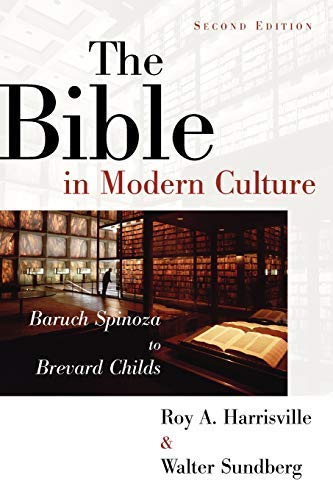
Historical-Critical Method in Biblical Scholarship has been a Pandora’s box for the intellectual life of the church. No achievement of modern scholarship has been more effective in understanding the Bible, yet it has also seriously challenged a church trying to preserve the integrity of its cherished theological traditions. In this critically acclaimed book Roy Harrisville and Walter Sundberg trace the development and drama of historical-critical method by surveying the major figures who created and employed it – from Baruch Spinoza in the seventeenth century to present-day interpreters. This expanded second edition of The Bible in Modern Culture includes three new chapters detailing the work of Adolf Schlatter, Paul Ricoeur, and Brevard Childs.
User’s Reviews
Reviews from Amazon users which were colected at the time this book was published on the website:
⭐This is a heavy duty thought provoking theology text. It helps answer the question as to why is Christianity looking at the liberal spectrum of religion.
⭐Everything was fine.
⭐This book is under 300 pages, so it is amazing that Harrisville and Sundberg manage to squeeze in so much important information.In fact, the search for the historical Jesus has lasted, depending on how you calculate it, some 500 years. Especially since the time of Reimarus, in the mid 1700’s, the hunt for the ‘real’, the ‘historical’ Jesus (which of course liberal scholars assumed could never have been the Jesus of the bible) the search has been a thorn in the side of every Christian.Reimarus argued that Jesus had proclaimed a wonderful kingdom that never arrived. Catholics have always claimed the Catholic church was the visible sign on earth of the kingdom, but Reimarus assumed the early Christians were all idiots. They took Christ at his most literal, and expected lots of wine and rich food, not to mention gold and a triumph over the Romans. None of which ever arrived. So of course Reimarus thought the entire thing a colossal failure. (Funny thing about all those millions of churches.)Soon after came Strauss. Instead of Christian idiots, Strauss proclaimed the early Christians liars, since of course none of the things they claimed were true. Reimarus had been bad enough; from the time of Strauss, believers by the thousand were being turned into nonbelievers, especially when Darwin arrived.Then there was Baur, ‘whose research directly challenged the verbal inspiration of scripture” (p 114) and Baur would argue the apostles were split into “Hebrews and Hellenists” (p 117), an idea endlessly put forth today by internet atheists of limited education.All these people and their camp followers moaned on about how “the Protestant ideas of faith will require the scientific means of historical research and psychology for their explanation” (p 164) from now on. Because, they assumed, all such scientific inquiry would prove that the bible was a fraud.Churches in America began to be split into liberal and the more orthodox. In 1910 “The Presbyterian General Assembly responded to the challenge…by passing a five-point resolution in 1910 defining the basics of orthodox belief” (p 188).This is a fascinating book for anyone interested in the history of biblical scholarship and I enjoyed it very much.In fact, today, the liberal scholars are in shambles, their arguments tattered and frayed by cogent arguments put forth by fine Protestant scholars. Here are the names of some of the more important Protestant biblical scholars of the last thirty years: Richard Bauckham, Larry Hurtado, N T Wright, and Martin Hengel.
⭐A quick survey of important figures engaging scientific methods for numerous theological issues, people spanned from Spinoza to Kasemann, and of course with Strauss and Baur. Each ‘section’ contains biography, major work and assessment, this arrangement certainly gives multifarious contents for the development of historical criticism, and successfully demonstrate the strengths of scholars at different era. The book testifies more to the Augustinian faith than the enlightenment individualism, yet still knowing the latter cannot be shunned away. The latter part of the content (including Bultmann and Troeltsch) is hard to be condensed or simplified, but still the crucials are extracted. However, to expand the discussion of historical Jesus may add persuasion to the book. Again the greatest strength of the book is to ‘map’ the relationship of theologicans/ historians and their thoughts one after another, which is very important for readers to review and see the correct treatment of the approach itself.
Keywords
Free Download The Bible in Modern Culture: Baruch Spinoza to Brevard Childs 2nd Edition in PDF format
The Bible in Modern Culture: Baruch Spinoza to Brevard Childs 2nd Edition PDF Free Download
Download The Bible in Modern Culture: Baruch Spinoza to Brevard Childs 2nd Edition 2002 PDF Free
The Bible in Modern Culture: Baruch Spinoza to Brevard Childs 2nd Edition 2002 PDF Free Download
Download The Bible in Modern Culture: Baruch Spinoza to Brevard Childs 2nd Edition PDF
Free Download Ebook The Bible in Modern Culture: Baruch Spinoza to Brevard Childs 2nd Edition