Ebook Info
- Published: 2011
- Number of pages: 770 pages
- Format: PDF
- File Size: 4.06 MB
- Authors: Brevard S. Childs
Description
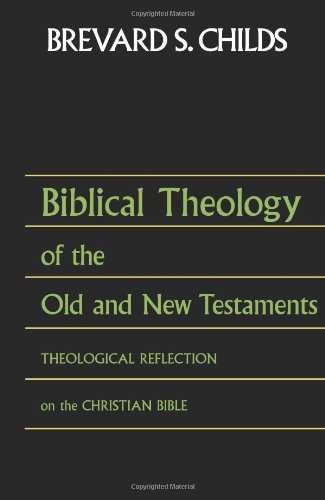
This monumental work is the first comprehensive biblical theology to appear in many years and is the culmination of Brevard Child’s lifelong commitment to constructing a biblical theology that surmounts objections to the discipline raised over the past generation. Childs rejects any approaches that overstress either the continuity or discontinuity between the Old and New Testaments. He refuses to follow the common pattern in Christian thought of identifying biblical theology with the New Testament’s interest in the Old. Rather, Childs maps out an approach that reflects on the whole Christian Bible with its two very different voices, each of which retains continuing integrity and is heard on its own terms.
User’s Reviews
Reviews from Amazon users which were colected at the time this book was published on the website:
⭐This is a well-written book by a 1st class theologian. I ordered it to expand and deepen my understanding of the main issues relating to the relationship of the complete Bible, consisting of Old and New Testaments, to an understanding of the basic presuppostions of my Christian faith. I believe that studying this work will facilitate my progress toward that goal.
⭐very good
⭐The book is very helpful if your studying theology and surprisingly it has many theological topics which I find interesting and useful.
⭐Excellent book on Biblical theology.
⭐Excellent book on Old Testament Theology
⭐The first half of this book is complete critical academic jargon. I don’t know why the author even wrote it except to show his scholarship ability and quote other academics. I am hoping the second half is much better, but I had to lay aside for a while and picked up gk beale’s New Testament Theology which is slightly more conservative but just as academic and along the same lines as this book; viewing the NT in light of the OT for theology. I hope to upgrade this rating in the future.
⭐What is the relation between the Bible and Theology? What is the goal of the enterprise called Biblical Theology? What method respects the proper nature of that which has been handed down and received as normative for a community of faith?The compelling answers of Brevard S. Childs to these questions have earned him international acclaim as the pioneer of the “canonical approach” and have ensured that his touchstone work, The Biblical Theology of the Old and New Testaments, will endure the test of time.For the author, the Bible and Theology are inextricably intertwined. They should be distinguished, not divorced. The fundamental goal of Biblical Theology is “to understand the various voices within the whole Christian Bible, New and Old Testament alike, as a witness to the one Lord Jesus Christ, the selfsame divine reality” (BTONT, p. 85).The New Testament’s use of the Old Testament cannot always be easily reconciled with the Old Testament’s own witness, which constitutes a “fundamental problem.” Its answer is a “major thesis of this book”: the solution lies in “the object toward which these witnesses point, that is, to their subject matter, substance, or res.” (BTONT, p. 80).In chapter six, entitled “Theological Reflection on the Christian Bible” (arguably the heart of the entire work), Childs applies his theological method to ten biblical themes: 1) The Identity of God; 2) God, the Creator; 3) Covenant, Election, People of God; 4) Christ, the Lord; 5) Reconciliation with God; 6) Law and Gospel; 7) Humanity: Old and New; 8) Biblical Faith; 9) God’s Kingdom and Rule; and 10) The Shape of the Obedient Life: Ethics.A concrete example will help illustrate Child’s method: let us take the theme of “kingdom” (number 9 above). To understand the “kingdom” biblically, the first step—from the canonical perspective of the Old Testament as Christian scripture—entails hearing the discrete witness recorded in the context of Israel. In a second moment, a Biblical theologian must consider the context of the canonical whole, which testifies to the incarnation of the kingdom in the person of Jesus Christ. The Biblical theologian must be careful to juxtapose—not substitute—this second witness, lest he destroy “the theological integrity of the Old Testament and silence its true canonical witness” (BTONT, p. 77). The tension created by the juxtaposition of different witnesses operates as a “theological check” against invalid interpretations. For example, though some individual texts might suggest it, the kingdom is not reducible to an internal, moral realm, because some texts characterize it as a new creation under God’s universal reign (e.g., cf. Ps. 95). “Conversely, the New Testament’s profile of the kingdom as the reign of love and justice revealed in Jesus Christ corrects any Old Testament tendencies toward understanding the kingdom as the national domain of one chosen people” (BTONT, p. 651).Even if the reader cannot subscribe to every particular theological conclusion, he can readily appreciate the fruitfulness of Childs’ canonical approach. I highly recommend this work to any student of Biblical Theology.
⭐As a conservative evangelical I was afraid to see what Childs had to say regarding the theological role of the Bible. However, after finishing this daunting book, I found many thought-provoking insights and interesting conclusions that may challenge Christians (especially those of the fundamentalist stripe) to re-think how they do biblical theology. Childs book is really divided into two main sections: The first section deals with theological methodology and the canonical shape of both testaments. The second section deals with the theological themes of the Bible. Many will find the first section quite dry and tedious (although his chapters [2 and 3] on models of biblical theology are quite interesting and informative). Here Childs deals with methodological and canonical issues that shaped the Christian bible. He gets into the details of the sources of the beliefs that shaped the religion of Israel and the early church. Depending on what your interests are you may find this section quite useful or useless. The second section is what many may find interesting and illuminating. He deals with major topics of biblical theology like God, covenant, law and gospel, humanity, etc. Many traditional and conservative readers may not like some of the conclusions Childs draws but one cannot ignore them as irrelevant to the church’s theological mission. Childs’ main sticking argument is the theological and canonical integrity of the OT in light of the revelation of Christ in the NT. How does the Christian understand the OT as a Christian text without doing damage to the textual and theological integrity of the OT? This is a common question Childs like to bring up in the book. Though many evangelicals will not like the way he handles the unity of the bible issue he does an admirable job trying to give the OT a voice of its own without relying on some overarching Christian theological construct (e.g., covenant theology, dispensationalism, salvation-history, etc.). This is a valuable resource for students who want to study more about biblical theology in a more moderate evangelical context.
⭐This book gives a first rate scholarly overview not only of Biblical theology in general, but more importantly of how the the two testaments, old and new, can be related. The depth of this relation is not merely in chronology, or overwriting the old testament witness with Christian theology, but in genuine theological dialogue. The language is clear and should be within the reach of the average reader, and certainly students will find it invaluable in giving up to date summaries of contemporary scholarship on Biblical research. Although it falls into the domain of a text book, it is nonetheless enjoyable to read, and is right in the mainstream of both Jewish and Christian faith traditions. It is a welcome demonstration of how scholarship can aid rather than undermine the everyday life of faith communities and congregations.
⭐Great Book
⭐The print looks like (and probably is) a photocopy of a photocopy of a photocopy. Guys, it’s 2014, digital print has been invented for a while now, how can this happen?
Keywords
Free Download Biblical Theology of the Old and New Testaments: Theological Reflection on the Christian Bible in PDF format
Biblical Theology of the Old and New Testaments: Theological Reflection on the Christian Bible PDF Free Download
Download Biblical Theology of the Old and New Testaments: Theological Reflection on the Christian Bible 2011 PDF Free
Biblical Theology of the Old and New Testaments: Theological Reflection on the Christian Bible 2011 PDF Free Download
Download Biblical Theology of the Old and New Testaments: Theological Reflection on the Christian Bible PDF
Free Download Ebook Biblical Theology of the Old and New Testaments: Theological Reflection on the Christian Bible