

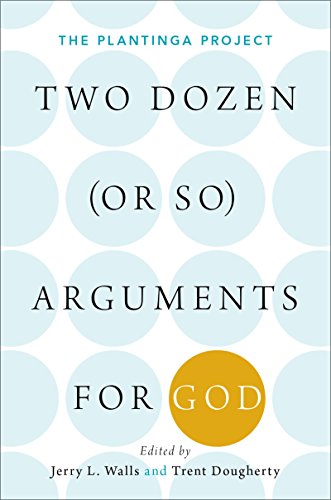
Ebook Info
- Published: 2018
- Number of pages: 496 pages
- Format: PDF
- File Size: 13.15 MB
- Authors: Jerry Walls
Description
Thirty years ago, Alvin Plantinga gave a lecture called “Two Dozen (or so) Theistic Arguments,” which served as an underground inspiration for two generations of scholars and students. In it, he proposed a number of novel and creative arguments for the existence of God which have yet to receive the attention they deserve. In Two Dozen (or so) Arguments for God, each of Plantinga’s original suggestions, many of which he only briefly sketched, is developed in detail by a wide variety of accomplished scholars. The authors look to metaphysics, epistemology, semantics, ethics, aesthetics, and beyond, finding evidence for God in almost every dimension of reality. Those arguments new to natural theology are more fully developed, and well-known arguments are given new life. Not only does this collection present ground-breaking research, but it lays the foundations for research projects for years to come.
User’s Reviews
Reviews from Amazon users which were colected at the time this book was published on the website:
⭐If you are not familiar with Alvin Plantinga’s reformed epistemology or any of his writings you will find this a slow read. Since the two dozen plus arguments are built around his seminal work in which he proposed these two dozen plus arguments for the existence of God, it may be hard to appreciate them. These can be read in “God and Other Minds”, in “Knowledge and Christina Belief” and some other works.Concerning this work, each of the contributors brings the best of these 24 arguments, plus 3 as a bonus, to the table for discussion. They are clear, for the most part, and constructive. I read the book for a post graduate course at HBU and with extensive class discussion gathered helpful knowledge on the arguments.Two chapters were much too technical for me, but that is not a reflection on the style of writing as much as the topics. If read carefully you will discover very convincing arguments for the existence of God. No doubt!
⭐This is a great resource for people looking for newish arguments for God’s existence. These thinkers put great effort into explaining and analyzing the arguments from Plantinga’s famous paper “Two dozen or so theistic argument. Highly recommend!
⭐Excellent
⭐Around thirty or so years ago, Alvin Plantinga gave a talk on two dozen arguments for the existence of God. It’s my understanding these were brief synopses of some arguments. Some Plantinga favored and some he didn’t. These are also generally outside of the usual classical traditional arguments. You won’t find the Thomist arguments in there and Bill Craig adds in the Kalam and the moral argument isn’t there as much and even the fine-tuning argument has some updating to it.Now that topic has been fleshed out further and each of these arguments has a fuller explanation of it given. Some arguments people will like more than others. Each should give the reader something to think about. It will be interesting to see what replies come from the other side in response to this project.Let me start with a criticism here also. I consider myself a classical theologian and think in those philosophical terms. As it was, most of the arguments in the book then I did not understand the logic of. I don’t speak in terms of modal logic and possible worlds and much of the symbolism found did not make sense to me. This work then I would say is not really layman friendly. It would be nice to see another work done like this that would work on the popular level for the rest of us.My favorite essay then in the book was actually Tim McGrew’s on the argument from miracles. This is because much of it spoke to my area of history and there were even side notes in there I can use such as problems with the argument from silence, a favorite of mythicists and others on the internet. Other arguments did give me something to think about when it came to things that I did understand.Consider something like the argument from numbers. Does this point to an eternal mind? The same kind of idea could be at work in my debate with Dan Barker where Barker actually said that 2 + 2 = 4 was not true in the time of the dinosaurs. If that is the case, then that would mean all truths like that would be truths that depend on us for their making. If we make them, we can change them. That would also include the moral truths that Barker emphasizes such as behaviors he thinks are evil when done by God, which would refute his whole argument.The book also has an appendix with a brief interview of Plantinga discussing various questions about the project. Many people could be interested in his answers to questions about day to day Christian living. There is a notes section at the end looking at the arguments in the book, but I found it unclear if this was Plantinga’s musings going on or something else.Those who enjoy philosophy will appreciate this book, but I think it will be those who enjoy philosophy of a certain kind. For the layman, I recommend waiting for a version to come out friendly to the layman. I hope the editors will seriously consider that as it would be another great gift for the man in the pew.In Christ,Nick PetersDeeperwatersapologetics.com
⭐The book is very good anyway. I know it sounds bias, but it was a refreshment for my soul to find Thomas Reid, Alvin Plantinga and William Lane Craig in it. Of course, there are other very good philosophers who contributed to the book, but Reid`s epistemology is formidable, grounded in reality itself; to refute it means to refute the reality.
⭐I’ve read it, it’s a really good book, undoubtedly Alvin Platinga is one of the best intellectuals of Philosophy in this century.(I did not buy the book in amazon, but I read it already)
⭐This book is just wonderful, the authors are great and it is a pleasant read. Lots of great ideas!
⭐I reckon the main purpose of an Argument for God is to tell us something about God that we didn’t know before. Judged by this criterion, the most illuminating of the arguments presented here is given by Robin Collins in chapter E. He considers how various physical constants of the universe might have been different, and concludes that the universe is not only able to engender life (unsurprising, given that we’re here) but also fine-tuned to allow us to probe its workings to a surprising depth. God, therefore, if there is a God, clearly wants us to understand as well as inhabit his great work of art: the universe is, as it were, Bach, not Muzak.Bradley Monton (arguments L and M) writes as a non-theist, but makes a point about “Boltzmann brains” that reinforces Collins’ arguments.Timothy McGrew (argument W) and makes a fair case for God being prepared – as Christians claim – to intervene miraculously in the affairs of the Universe in exceptional circumstances. His exposition is hindered rather than helped by appeal to probability theory, which really is not the right tool for the job. He is, though, not the only philosopher who appears to think Bayes’ Theorem a substantive result: properly stated it’s a mere a-priori triviality.Most so-called “ontological” arguments fail, in my view, by trying to prove too much, namely that God is a “necessary being” (in modern parlance, “exists at all possible worlds”). In this volume Elizabeth Burns, taking on the (probably hopeless) job of patching Plantinga’s Ontological Argument, turns to a severe modern moralist, Iris Murdoch, for help, with predictably unlovely results. A much better chapter by Brian Leftow, near the end of the book, preserves the a-priori flavour of an ontological argument, but aims for less than complete necessity and therefore manages both to persuade and to inform. I would however quibble about one of Leftow’s uses of Ockham’s razor: by cutting down to one the number of non-material beings, he risks making God into a control-freak boss. Elsewhere, he uses Ockham’s razor as it should be used, cutting down species rather than individuals. Leftow’s chapter overlaps and largely supersedes a well-written earlier chapter by Alexander Pruss.A chapter by Philip Tallon (arguments U and V) could be read as reinforcing the view of God-as-Bach that I’ve derived from Collins’s chapter. All the same I’m not happy with Tallon’s approach. Plantinga’s argument is based on the premise that what we appreciate in art (presumably, when we are “functioning properly” as Plantinga would say) is objectively good. Some justification for the premise is needed, surely – but all Tallon can come up with to explain away our frequent failures to function properly is that a “vast consensus of experts accrues” around the greatness of (allegedly great) artists. No doubt it does – just as it “accrued” around the impossibility of Continental Drift, until facts faced it down.Chapters by Christopher Menzel (B) and Tyron Goldschmidt (C) argue from the fact that mathematics is radically infinite and incomplete, to the need for an infinite God. I’m left wondering how much this tells us – for example, does God know whether the Continuum Hypothesis is true, and if so, HOW does He know it?William Craig expounds the “Kalam” argument: his chapter should be of interest to anyone who believes that the Universe (or Multiverse, or Whatever-there-is) had a beginning in time.I guess the book as a whole is a pretty useful report on the state of play with regard to Plantinga’s chosen arguments (and a few others). Most of the writers are verbose, as is the way of recent philosophers, so the book could have been shorter and cheaper – but then publishers have to make a living.
⭐Too complicated, Terminologies are not properly defined.Even a theist will become an athiest by reading this. I’m disappointed by this Book.
⭐Provides some deep philosophical arguments for theism
Keywords
Free Download Two Dozen (or so) Arguments for God: The Plantinga Project in PDF format
Two Dozen (or so) Arguments for God: The Plantinga Project PDF Free Download
Download Two Dozen (or so) Arguments for God: The Plantinga Project 2018 PDF Free
Two Dozen (or so) Arguments for God: The Plantinga Project 2018 PDF Free Download
Download Two Dozen (or so) Arguments for God: The Plantinga Project PDF
Free Download Ebook Two Dozen (or so) Arguments for God: The Plantinga Project