Ebook Info
- Published: 2009
- Number of pages: 404 pages
- Format: PDF
- File Size: 1.39 MB
- Authors: Daniel Boyarin
Description
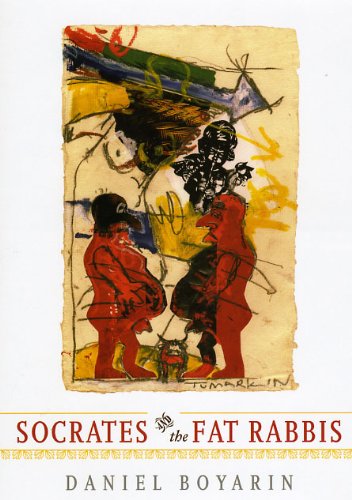
What kind of literature is the Talmud? To answer this question, Daniel Boyarin looks to an unlikely source: the dialogues of Plato. In these ancient texts he finds similarities, both in their combination of various genres and topics and in their dialogic structure. But Boyarin goes beyond these structural similarities, arguing also for a cultural relationship.In Socrates and the Fat Rabbis, Boyarin suggests that both the Platonic and the talmudic dialogues are not dialogic at all. Using Michael Bakhtin’s notion of represented dialogue and real dialogism, Boyarin demonstrates, through multiple close readings, that the give-and-take in these texts is actually much closer to a monologue in spirit. At the same time, he shows that there is a dialogism in both texts on a deeper structural level between a voice of philosophical or religious dead seriousness and a voice from within that mocks that very high solemnity at the same time. Boyarin ultimately singles out Menippean satire as the most important genre through which to understand both the Talmud and Plato, emphasizing their seriocomic peculiarity.An innovative advancement in rabbinic studies, as well as a bold and controversial new way of reading Plato, Socrates and the Fat Rabbis makes a major contribution to scholarship on thought and culture of the ancient Mediterranean.
User’s Reviews
Reviews from Amazon users which were colected at the time this book was published on the website:
⭐I am not a student of this field, but only a reader interested in philosophy and religion. The idea expressed is not mainstream, so I found it intriguing. The author has excellently footnoted and referenced his work, so that the reader has the opportunity for further study of all viewpoints. I learned much through his treatment of Plato’s Symposium. However, it is not always easy to read. It is an academic work so the author uses jargon. He also has not met a comma he doesn’t like due to his overuse of parenthetical asides that disrupt sentence continuity. For example, this happens in order to show obeisance to political correctness such as gender equality dropped into the middle of a sentence concerning Plato’s writing about rhetoric. Maybe this is not a problem for someone who is more familiar with the ideas being expressed. Overall, I found the difficult reading worth the effort in order to get at the ideas.
⭐Daniel Boyarin gets it right … both the Greek world in its highest thought and the Talmudic world, the perception of which is not often so free of confusion. There are perhaps only two “Eternal Cities”: Athens and Jerusalem. Professor Boyarin leads a couple of tours into the heart of each of these places of the mind, the spirit and indeed the soul. His vehicle is, oddly enough, a modern understanding of the novel, but looking back to the ancient world. But as the map is not the territory, the vehicle is not the destination. His tours are tours de force, compelling consideration of both love and truth, as reflected in the ancient texts. If modernity rejects both notions, modernity is all the poorer for that. Some acquaintance with Greek philosophical thought and at least Steinsaltz’s English rendering of parts of the Talmud are helpful, but if Boyarin’s title intrigues, then his book will likely repay a close and attentive reading. It is not, however, a text for the faint of heart; I am grateful to my teachers over many years to whom I attribute my willingness to meet the challenge of this book. ##
⭐Natural Law, Science, and the Social Construction of Reality
⭐
⭐Art Matters: The Art of Knowledge/The Knowledge of Art
⭐The early 20th century philosopher said that all Western Philosophy is a footnote to Plato. Boyarin develops this idea not just with regards to philosophy but with regards to literature as well.The argument of the book is quite complex and has a number of layers to it, but everything comes nicely together at the conclusion.The first part of the book looks at new ways of reading Plato. The main argument—which most of us have thought but never quite articulated—is that Plato’s dialogues are really monologues in that, while opposing views are mentioned, they are not really given fair hearings and all of Socrates’ opponents are forced, by rhetoric or logical fallacy, or whatever, to agree with Socrates’ view of things.Boyarin uses the critical writings of Mikhail Bakhtin to show that Plato, in his use of rhetoric, and of his use of mixing the serious with the comic, many of the dramatic devices Plato uses, are consistent with Bakhtin’s view of the use of these factors in the modern novel.Boyarin then discusses the Babylonian Talmud, written about 1,000 years after Plato. Boyarin argues that the Talmud uses many of the same techniques. The various stories related by the ‘fat rabbis” in the Talmud are presented in much the same way as Plato presents his arguments in the dialogues. While there is dissent and disagreement, the arguments all lead to a specific view. A secondary point here is to show the Hellenic influence on the Talmud.Boyarin then returns to Plato to argue that Plato’s real concern was to argue against the prevailing views of Athens and to establish his views of the academy and of philosophy. He does this with a very interesting reading of The Symposium.And he finally concludes by arguing that because of the uses of combining the serious with the comic, and in the Talmudic uses of Hellenic satire, both Plato’s dialogues and the Talmud should be seen as precursors of the modern novel, especially on Bakhtin’s view.In short a very stimulating book on a number of levels. And now I have to go back and re-read some of Plato and the Talmud.
Keywords
Free Download Socrates and the Fat Rabbis in PDF format
Socrates and the Fat Rabbis PDF Free Download
Download Socrates and the Fat Rabbis 2009 PDF Free
Socrates and the Fat Rabbis 2009 PDF Free Download
Download Socrates and the Fat Rabbis PDF
Free Download Ebook Socrates and the Fat Rabbis