Ebook Info
- Published: 2002
- Number of pages: 288 pages
- Format: PDF
- File Size: 1.29 MB
- Authors: J. J. C. Smart
Description
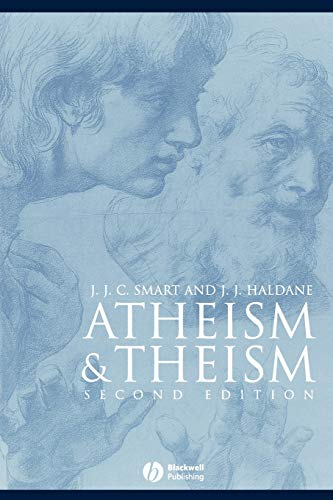
In this book two philosophers, each committed to unambiguous versions of belief and disbelief, debate the central issues of atheism and theism. Considers one of the oldest and most widely disputed philosophical questions: is there a God? Presents the atheism/theism issue in the form of philosophical debate between two highly regarded scholars, widely praised for the clarity and verve of their work. This second edition contains new essays by each philosopher, responding to criticisms and building on their previous work.
User’s Reviews
Editorial Reviews: Review “Smart and Haldane are both remarkable philosophers. Each in his own way possesses the rare combination of formidable dialectical skills, an original vision for philosophy, and immense personal integrity … I do not see how anyone could read this book and not feel that it represents the finest kind of intellectual encounter …”Hilary Putnam, Harvard University “Philosophers of both theistic and atheistic persuasions will find this important new debate on theism particularly interesting for themselves and for their students. Haldane an Smart show that the dispute over the existence of God is very much alive among the best philosophers at the end of the twentieth century.” Linda Zagzebski, University of Oklahoma “This book show contemporary academic philosophy at its best.” Scientific and Medical Network Review From the Inside Flap The issue of whether or not there is a God is one of the oldest and most widely disputed philosophical questions. It is a debate that spreads far across the range of philosophical questions about the status of science, the nature of mind, the character of good and evil, the epistemology of experience and testimony, and so on. In this book two philosophers, each committed to unambiguous versions of belief and disbelief, debate the central issues of atheism and theism. Smart opens the debate by arguing that theism is philosophically untenable and seeks to explain metaphysical truth in the light of total science. Haldane continues the discussion by affirming that the existence of the world, and the possibility of our coming to have knowledge of it, depend upon the existence of a creating, sustaining, personal God. This is followed by replies, where each philosopher has the chance to respond and to defend his position. This second edition contains new essays by each philosopher, responding to criticisms and building on their previous work. From the Back Cover The issue of whether or not there is a God is one of the oldest and most widely disputed philosophical questions. It is a debate that spreads far across the range of philosophical questions about the status of science, the nature of mind, the character of good and evil, the epistemology of experience and testimony, and so on. In this book two philosophers, each committed to unambiguous versions of belief and disbelief, debate the central issues of atheism and theism. Smart opens the debate by arguing that theism is philosophically untenable and seeks to explain metaphysical truth in the light of total science. Haldane continues the discussion by affirming that the existence of the world, and the possibility of our coming to have knowledge of it, depend upon the existence of a creating, sustaining, personal God. This is followed by replies, where each philosopher has the chance to respond and to defend his position. This second edition contains new essays by each philosopher, responding to criticisms and building on their previous work. About the Author J. J. C. Smart is Emeritus Professor at the Australian National University. He is the author of many books, including Philosophy and Scientific Realism, Ethics, Persuasion and Truth and (with Bernard Williams) Utilitarianism: For and Against. J. J. Haldane is Professor of Philosophy in the University of St Andrews and Director of the Centre for Ethics, Philosophy and Public Affairs. He recently held the Royden Davis Chair in Humanities at Georgetown University. He has published widely in metaphysics, philosophy of mind and social philosophy. He is co-editor of several volumes and author of The Intelligent Person’s Guide to Religion (2003). Read more
Reviews from Amazon users which were colected at the time this book was published on the website:
⭐John Jamieson Carswell Smart (1920-2012) was an Australian philosopher who was Emeritus Professor at Australian National University; he has written books such as
⭐,
⭐, etc. J.J. Haldane is professor of Philosophy at the University of St. Andrews; he has also written books such as
⭐, etc. [Haldane is also “an orthodox Roman Catholic believing in such Credal doctrines as the Trinity, and… the divinity of Jesus Christ.” Pg. 87]They note in the Introduction to this 1996 book, “The format of the exchange is straightforward. In chapter 1 Smart lays out his case for atheism; in chapter 2 Haldane develops his argument for theism; chapters 3 and 4 consist of replies… the volume ends with a brief afterword in which we reaffirm our commitment to metaphysical realism, be it that we have different views about what reality contains… our hope, however, is that you will be prompted to enter in and contribute to the continuing debate between atheism and theism.” (Pg. 5)Smart criticizes the so-called “Free Will Defense” of the Problem of Evil: “I will not grant the theist the notion of libertarian free will, which seems to me to be an absurd one… I hold that any sensible notion of free will is compatible with determinism… Compatibilism [i.e., free will and determinism are compatible ideas] seems right in relation to any sensible account of free will. Indeterminism does not confer freedom on us: I would feel that my freedom was impaired if I thought that a quantum mechanical trigger in my brain might cause me to leap into the garden and eat a slug.” (Pg. 69-70)Haldane says, “there is a good deal of life remaining in the ‘old style’ design arguments. Evolutionary theory, and naturalism more generally, are not equipped to explain three important differences which common sense and philosophically unprejudiced science both recognize: those between the inanimate and the animate; the non-reproductive and the reproductive; and the non-mental and the mental.” (Pg. 119)Haldane argues, “Just as in making a world of living things God indirectly causes and continuously permits the obstruction and destruction that results from the flow of life, so in making free agents he is causally responsible for circumstances in which wrongs are done; but in neither case does God directly bring about evil.” (Pg. 157)This is an excellent debate book, and will be of considerable value to anyone interested in Christian apologetics, or the philosophy of religion.
⭐This is a good introduction to many of the main arguments concerning theism and atheism. Smart and Haldane manage to cover most of the main issues while at the same time making original contributions to the debate. The book is especially helpful for giving clear account of the issues surrounding the “fine-tuning” argument due e.g., to Richard Swinburne.As they mention in the Introduction, neither Smart nor Haldane is a specialist precisely in philosophy of religion–both are well known especially for contributions to philosophy of mind–and this affects the book’s overall approach. Smart begins with a defense of physicalism (the view that only objects whose existence is required by physical theory exist), arguing that this position should be accepted on the methodological ground that it is most compatible with the results of modern science. Smart also responds to various theistic arguments and defends a version of the “problem of evil” objection to theism. Haldane follows this with a series of arguments against materialist reductionism, taking the failure of reductionism to entail some kind of design and so theism. Haldane also defends versions of the cosmological (“firt cause”) argument and attempts a solution to the problem of evil. Smart then briefly responds to Haldane and Haldane to Smart. For Smart, atheism is part of a general commitment to physicalism, whereas Haldane seems no less interested in defending a general antireductionism (e.g., with respect to intentionality) than in defending theism specifically.The book covers a great deal of ground and offers much food for thought. The downside to this is discussions of particular issues are sometimes sketchier than one would like. Perhaps it would have been more effective to focus the book more tightly on the aspect of the debate that raises issues of reductionism vs. antireductionism. I also wish the book had been organized so as encourage a more extended response from Smart to Haldane’s antireductionist arguments. Smart’s methodological principles may well establish a presumption against theism, but surely this presumption is defeasible, and Haldane’s contribution is effect an attempt to defeat precisely this presumption.
⭐I have some reservations about giving this title only three stars, for I greatly enjoyed reading it, but the work has some significant shortcomings. Parts of the essays are highly technical, which suggests a target audience of professional philosophers. Nonetheless, recent scholarship is often covered either inadquately or not at all. An example is Smart’s treatment of the argument from religious expreience. While Smart is discerning and even witty, he shows no awareness of the positions of thinkers such as William Alston and Alvin Plantinga who have pursued the discussion on a much deeper level and who (some might even say) have made treatments such as Smart’s irrelevant. Other parts of the book are marred by similar omissions.For a person with some experience reading contrmporary analytic philosophy, I would recommend the title. Just don’t think you’re getting anything even close to an overview of what cutting edge thinkers have to say about the atheism/theism debate. That being said, it is well written, interesting, and thought inspiring.Greg Klebanoff
⭐This is the way atheism vs. theism debates should always be. First, Smart and Haldane are very respectful of one another, as well they should be. Second, they are not afraid to delve deep into the true complexities of philosophy of religion, and are both equal to the task. This debate is very unlike typical debates, in which scholarship is subordinated to rhetoric, and readers are likely to come away having learned something about how truly difficult philosophy of religion is.
⭐Thank you for prompt delivery. Book was just as described. Will be ordering more again soon.
Keywords
Free Download Atheism and Theism 2nd Edition in PDF format
Atheism and Theism 2nd Edition PDF Free Download
Download Atheism and Theism 2nd Edition 2002 PDF Free
Atheism and Theism 2nd Edition 2002 PDF Free Download
Download Atheism and Theism 2nd Edition PDF
Free Download Ebook Atheism and Theism 2nd Edition