Ebook Info
- Published: 2019
- Number of pages: 176 pages
- Format: PDF
- File Size: 1.17 MB
- Authors: Michael D. Coogan
Description
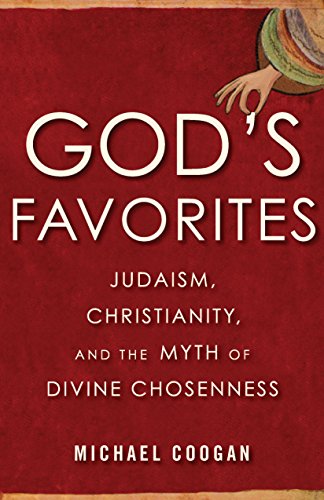
A noted biblical scholar explores how the claim of divine choice has been used from ancient times to the present to justify territorial expansion and prejudice.The Bible describes many individuals and groups as specially chosen by God. But does God choose at all? Michael Coogan explains the temporally layered and allusive storytelling of biblical texts and describes the world of the ancient Near East from which it emerged, laying bare the power struggles, the acts of vengeance, and persecutions made sacred by claims of chosenness.Jumping forward to more modern contexts, Coogan reminds us how the self-designation of the Puritan colonizers of New England as God’s new Israel eventually morphed, in the United States, into the self-justifying doctrines of manifest destiny and American exceptionalism. In contemporary Israel, both fundamentalist Zionists and their evangelical American partners cite the Jews’ status as God’s chosen people as justification for taking land—for very different ends. Appropriated uncritically, the Bible has thus been used to reinforce exclusivity and superiority, with new myths based on old myths.Finally, in place of the pernicious idea of chosenness, Coogan suggests we might instead focus on another key biblical concept: taking care of the immigrant and the refugee, reminding the reader of the unusual focus on the vulnerable in both the Hebrew Bible and New Testament.
User’s Reviews
Reviews from Amazon users which were colected at the time this book was published on the website:
⭐I always admire M. Coogan’s work for its scholarship and clarity. This book, however, was not terribly enlightening. It tracks the well-known covenant promises of Israel’s elect nature, but for me at least this was merely a review of what every Old Testament reader already knows without much analysis of this crucial element of the Bible. The book then highlights how the “elect” language becomes appropriated by Christianity and enters America through the Puritans. Again, however, this is well-known and is much more deeply investigated by Americanists like the late Sacvan Bercovitch. Overall, the book seemed to be a kind of undergraduate lecture series for people who don’t know much about the Bible. Still, Coogan is always a wonderful writer who brooks no nonsense, which I very much admire.
⭐As with all of Coogan’s works, this book was excellent. I highly recommend it. A timely message of reason and clarity from one of the great biblical scholars of our day, taking head-on the tribalism that is so prevalent in humans, and in particular, religion. It was shorter than I expected. I actually wish it was longer with even more detail. But an excellent book.
⭐Doctrinally from a Universalist Unitarian perspective.
⭐Fascinating and well-argued book that gives real insight into Biblical scholarship.
⭐Michael Coogan’s God’s Favorites: Judaism, Christianity, and the Myth of Divine Closeness is based on the claim that the while the Old and New Testaments of the Bible are chock full of wisdom, they are not divine documents; rather, they are human documents laden with tribalistic prejudices in which the writers project their self-interest into their notion of their god.The Bible writers who make claims of divine closeness are being tribalistic and painting a binary world: us vs. them. The belief that one’s tribe is chosen has “pernicious effects.”Coogan studies the “capricious god” of the Old Testament and argues that writers imposed a rational actor to massage over the wanton acts of the Old Testament Yahweh.The New Testament God continues to be a tribalist serving the interests of the biblical writers. When confronted with biblical passages of tribalism in which God loves one person and hates another, St. Paul tries to gloss over such a cruel despot but does so unconvincingly. Coogan also shows how Paul’s notion of Christianity is in conflict with Matthew’s, which is in conflict with St. John’s.The New Testament pivots away from calling the Jews as the chosen people to calling the Christians the chosen ones by engaging in what Coogan calls “supersessionism.”At the end of the book, Coogan critiques American exceptionalism and concludes that all forms of exceptionalism are based on the narcissism and arrogance of tribalism.Real faith and real humanity, Coogan argues in his conclusion, are based on loving the stranger and letting go of one’s binary tribalistic view of the world. In about 130 pages of well written prose, this book is very readable and instructive. Recommended.
⭐God’s Favorites: Judaism, Christianity, and the Myth of Divine Chosenness by Professor Michael Coogan asks the question: “Does God … have favorites? Does God really prefer some individuals and groups over others?” Throughout his book he argues that it is neither reasonable nor rational to think that God would focus God’s attention on the Jews, a small, isolated, relatively unimportant group of people. Baruch Spinoza, a Dutch/Jewish philosopher of the 17th Century was excommunicated by the Jews for holding that same opinion. Spinoza was a great scholar and philosopher who analyzed the Bible thoughtfully and carefully. Like Michael Coogan, Spinoza demonstrated again and again that the Bible is “faulty, mutilated, tampered with, and inconsistent.” Spinoza and Coogan point out that “we don’t know the authors, circumstances, or dates of many biblical books. Moreover, “we cannot say into what hands they fell, nor how the numerous varying versions originated; nor, lastly, whether there were other versions, now lost.” As Coogan points out again and again, the Bible is a good and instructive story, but we cannot trust its truth value as history. He says that we should read the Bible “not as divine revelation… but rather as what different writers thought about God and how they projected on God their own views.”In his last chapter Coogan tells us that in his view “gods do not choose people, either groups or individuals. Rather, people choose a god and then assert that that god has chosen them or their ancestors… We should abandon the myth of divine chosenness…. Fundamentally, we are all one tribe, one species, with no group, ancient or modern, specially chosen.”Michael Coogan is a former Jesuit who is now a professor at the Harvard Divinity School. His book is carefully argued and presented with many footnotes included at the end of his book that I found helpful and instructive. His book is carefully organized and written for a general audience. That said, scholars and his students at Harvard will find that he has been rigorous in his approach to his subject, but has been careful to be clear and avoid the jargon that makes some academic writing pretentious and unreadable. His conclusions seem reasonable to me, but those readers who are true believers in the Bible as literally the Word of God are going to find much to object to in Coogan’s book.
Keywords
Free Download God’s Favorites: Judaism, Christianity, and the Myth of Divine Chosenness in PDF format
God’s Favorites: Judaism, Christianity, and the Myth of Divine Chosenness PDF Free Download
Download God’s Favorites: Judaism, Christianity, and the Myth of Divine Chosenness 2019 PDF Free
God’s Favorites: Judaism, Christianity, and the Myth of Divine Chosenness 2019 PDF Free Download
Download God’s Favorites: Judaism, Christianity, and the Myth of Divine Chosenness PDF
Free Download Ebook God’s Favorites: Judaism, Christianity, and the Myth of Divine Chosenness