

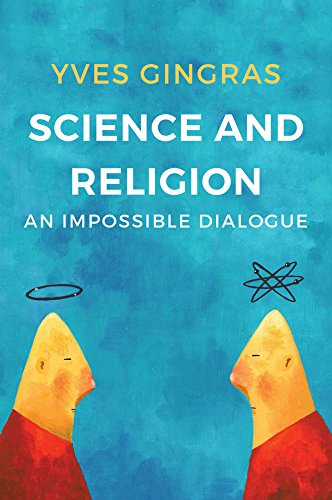
Ebook Info
- Published: 2017
- Number of pages: 272 pages
- Format: PDF
- File Size: 2.58 MB
- Authors: Yves Gingras
Description
Today we hear renewed calls for a dialogue between science and religion: why has the old question of the relations between science and religion now returned to the public domain and what is at stake in this debate?To answer these questions, historian and sociologist of science Yves Gingras retraces the long history of the troubled relationship between science and religion, from the condemnation of Galileo for heresy in 1633 until his rehabilitation by John Paul II in 1992. He reconstructs the process of the gradual separation of science from theology and religion, showing how God and natural theology became marginalized in the scientific field in the eighteenth and nineteenth centuries. In contrast to the dominant trend among historians of science, Gingras argues that science and religion are social institutions that give rise to incompatible ways of knowing, rooted in different methodologies and forms of knowledge, and that there never was, and cannot be, a genuine dialogue between them. Wide-ranging and authoritative, this new book on one of the fundamental questions of Western thought will be of great interest to students and scholars of the history of science and of religion as well as to general readers who are intrigued by the new and much-publicized conversations about the alleged links between science and religion.
User’s Reviews
Reviews from Amazon users which were colected at the time this book was published on the website:
⭐Together with many people, I have given thought to the relationship between science and religion and have read books from a variety of perspectives. I was glad to have the opportunity to read and review this new book “Science and Religion: An Impossible Dialogue” by Yves Gingras, Canada Research Chair in History and Sociology of Science at the University of Quebec at Montreal. The book was translated from the French by Peter Keating.There are many ways of seeing the relationship between science and religion: some people find science and religion, properly understood, fully compatible, some find them in inevitable conflict, and some find they address different issues or “spheres”. Some writers on science and religion, including, I think, this book properly remind the reader that there almost always is a political dimension to the discussion. In my opinion, the question of the relation between science and religion is getting renewed attention because of the strong polarization of opinion and the attempt of individuals of all views to find religious warrant for what they believe.Gingras writes from a perspective I find refreshingly rationalistic. He is aware, at the outset, of the vagueness of the question of the relation between science and religion and the need to pin it down. He argues that the sciences, both natural and social sciences involve “attempts to provide reasons for observable phenomena by means of concepts and theories that do not call upon supernatural causes.” It is harder to categorize religion. For purposes of his study, Gingras finds religion consists of a particular institution which appeals to a specific text and which generally involves a belief in a personal God. Judaism, Christianity, and Islam are religions in this sense while pantheism or vague forms of spirituality outside denominational religion might not be.Gingras’ study has both a historical and critical component. He begins with a close examination of the conflict between Galileo and the Catholic Church in the early 17th Century over the movement of the earth. He follows through the history of the conflict until 1992 when Pope John Paul II at last revoked the condemnation of Galileo. Gingras examines many other incidents of conflict between religious and scientific institutions involving, in particular, geology, biology, and Darwinism, and the historical, naturalistic approach to the human sciences, including the historical approach to Biblical texts. In these and other matters, Gingras finds that religious institutions and leaders took an antagonistic approach to science when in seemed to challenge what were taken to be Biblical or theological teachings.Gingras examines what he finds to be largely contemporary (beginning in the late 20th Century with some earlier antecedents) to promote “dialogue” or “conversation” between religion and science. Instead of finding conflict, this approach tries to promote harmony. Gingras finds several sources of the change in approach from conflict to dialogue. He points to the change in attitude of the Catholic Church and other religious bodies and also relies as well on the growth of foundations, such as the Templeton Foundation, which sponsors through large cash awards and grants scholarly work purporting to show the harmonious relationship between scientific findings and religious belief.Gingras is highly skeptical of the possibility of dialogue between science and religion. He argues, I think with a great deal of merit, that in seeking non-supernaturalistic explanations for observable human and natural phenomena, science takes a metaphysical and epistemological stance that cuts it off from religious explanation. Many individual scientists may well be deeply and profoundly religious persons. Their religious commitments may well influence the way the approach science or the sorts of questions they choose to examine. However, their scientific work remains subject to the standards of scientific discipline which remains naturalistic and peer-determined. Thus the religiosity of individual scientists would be irrelevant to establishing the harmony between science and religion in terms of supernaturalism. Gingras examines in a rather cursory way some of the many writings purporting to show harmony between science and religion. He argues that they tend to rely on a superficial understanding of science or on a restatement of the argument from design that has had a long philosophical and scientific history. Gingras finds modern restatements of the argument from design philosophically and scientifically redundant. Thus, Gingras argues that there can be no dialogue between science and religion because each deals with a different things. Science is naturalistic and relies on institutional agreement among trained observers while religion is not so much wrong as inherently subjective and personal. Among Gingras’ philosophical heroes are Scotus, whose philosophical voluntarism was opposed to Aquinas, and Kant.Gingras’ book is thoughtful and learned with many historical examples, including the fascinating recent case of the “Kennewick Man” in the United States and the conflict it posed between scientific and religious approaches to discovery. Gingras is probably, in the distinction drawn by William James, a tough-minded rather than a tender-minded thinker. I found his approach and his rationalism refreshing particularly in light of other approaches to the subject I have read. Still, he may be too quick with a large body of writing in support of “dialogue” that he does not discuss fully. He also, in my view, may move too quickly towards finding religion “subjective” without considering that it may be different from science and warrant consideration on its own. I agree with Gingras that any attempt at “dialogue” or, in the modern jargon, “conversation” should not give religion the right to interfere with any findings or investigations of science. These findings and investigations stand on their own. There may be a broader philosophical, metaphysical approach than that taken in this book. If so, there may be a sense in which “dialog” between science and religion is possible, but not the sense that Gingras critiques.Gingras has written a thoughtful, provocative book for readers with a serious interest in the relationship between science and religion.
⭐The author does not only all encompassing job of covering the subject matter at hand; he also finely narrows its scope, by corralling some ambiguous terms, toward contextual meanings that are as precise as the author’s arguments.The relations between science and religion have an extensive history, that on many occasions, have been quite fraught. These days; however, the authority of science is pretty much undisputed[chapter 6]; and often obliges promoters of religion to seek legitimacy through sciences. For example, one such science lies within the mysteries of quantum physics, a theory that seems to challenges both logic and common sense. This created a platform for the institutions of the oldest spiritual traditions by to bridge the scientific gap by purposely obfuscating certain scientific principles within the science. The author shows this to his readers by deftly defining terms such as religion, science, knowledge, institutions, an others – to shine a light on what is science and what is religion. Another area that religion and science are purposely blurred is between the institutions of science and the scientist themselves; by singling out individual scientists beliefs. As usual, analyses such as these reduce everything to individuals’ beliefs and ideas by ignoring the institutions and the relative autonomy of sciences, with regard to their social spheres.This search for middle grounds, also has the effect of minimizing the importance of the conflicts between science and religion that have occurred since the beginning of the seventeenth century. Examining, the before & after, of the 17th century provides a clue as to why the battleground is an ever continuing war of ideas to be waged. Although the author briefly touches on this, he does not breach it: the subject, in regards to – power.Early in the history of man, organized religion assumed an inherent power. Some of the elite priest specialized in the financial aspects of the time. When science came on the seen, it was fought against intensely; so as to not share in this power of the few. Today, this power is commanded by the finance cartels, through governments and multinational corporations. This power is, and has corrupted, not only religions; but science itself. Today we have studies on GMOs, vaccines, physics, and other information-based knowledge that is being paid to arrive at certain profitable conclusions. So, although the author succinctly defines the differences and symptoms of this conflict between sciences and religions; he does not really get into the reasons they have become so tenacious. It is simply not one of belief/ideas; but also based upon power, and tools that fashion those markets; not only of beliefs & ideas, but of financialized markets – controlled by institutions like Wall Street, banking cartels, and multinational corporations.Today’s religion is one of market fundamentalism, where the market is a God that can do no wrong. The media controls the message/story. Big Data and Deep State actors are now entering the space of religions and sciences; they are corrupting both, and in the process – mankind himself. A new science of Transhumanism is fraught with coming danger, as are the new technologies[GRIN] being generated by the military and corporations.In the author’s conclusion, he finally does address these issues; but ignores the fact that sciences can be corrupted just as religions can. Science is attempting to replace nature through robotic bees; genetic engineering, transhumanism, synthetic biologies and the like. The author himself does say this/…the technosciences have also created pollution, atomic bombs, nuclear waste, etc. But we must distinguish science from technology. The first is only a way of explaining phenomena by natural causes, whereas the second develops artifacts(technology) for civilian or military purpose.Yet, despite this, some of those applied technologies he endorse like vaccinations, etc. and contradicts himself doing so.With the caveat regarding the aforementioned power and the technologies; the book is a fine example of showcasing the difference between science & religion – using history, dialogues, definitions, reasoning and logic – to inform the reader.He appropriately quotes George Canguilhem in his conclusion/Even at the price of being considered narrow minded, one must stand for Reason. The author certainly believes he does; and strives, in this fine work, to do so.
⭐I have long been a fan of Carl Sagan and Stephen Jay Gould. Many years ago Gould coined the term “non-overlapping magisteria” and that framing of the issue has been my default approach when examining questions around faith vs science.This book takes a slightly different take. I still prefer the writing style of Gould and Sagan but they wrote their best works decades ago. This book refreshes the subject matter, taking into account the lessons learned since the 1990’s.
⭐A meaningful discussion of this very topic needs to be philosophically deep. However, the whole book only focus on the historical aspect of the topic. I give it more than one star since I had fun in reading those history. Nevertheless, not a single argument in this book is worth a discussion, since they are easily dismissible by every readers who think into them; for those who skim through this book, it may just become another source of poor arguments and unjustified personal opinions which definitely not worthy your time unless you are interested in reading some history.
⭐I agree with much of this book. The dialogue between Science and Religion is a very difficult one. The book makes the case that it is not possible to harmonise Religion with Science, so the calls for dialogue between Science and Religion is impossible. The book is not the most accessible so I had to struggle with some of its content, because it is too verbose and academic. However, it is one I am happy to have read and own because I struggle to reconcile my belief in God and my Scientific beliefs. Not sure, but it may leave me even more confused.I was raised in a very religious Country. I also studied Biology (Bachelor of Science). So the dialogue between Religion (Christian) and the Sciences ring true.I remember having spirited discussions with friends from the Engineering and Physics. One of these guys had a Ph.D. in Mechanical Engineering and was a University Lecturer and a Church Elder. The other, though grew up as Christian, was an atheist by the time he completed his MSc in Physics. So in our discussions, one side argued that Science backs the claim of the Christain God while the more fiery side argued that Science does not prove the existence of God. An impossible Dialogue, may be.
⭐This may not be quite the book you think it will be… The basic premise of this book is that science and religion work in such different ways that it is impossible for them to be in dialogue, that much is clear from the title itself. But the way that Gingras approaches the subject may leave UK readers a little puzzled, because this seems to be a book that derives from a very different world. The author is a respected French Canadian academic whose background is in the history and sociology of science which gives him a very different perspective from that of British writers, writing as he does from a worldview that is dominated both by the Roman Catholic Church and by the religious scene of North America, although linking the election of the Democratic President Carter with the rise of the Religious Right in America seems like a deliberate misreading of the US political and religious situation.Gingras begins by detailing the controversy between Galileo and the Catholic Church, arguing, against some other writers, that Galileo underwent two trials, and insisting that he was in fact effectively imprisoned after his second trial. He deals briefly with the different situation faced by Kepler who lived under a more ‘liberal’ Lutheran regime, but returns again and again to the dominant position of the Roman Catholic Church as the primary representative of repressive Christianity/religion. Dealing with other brands of mainstream Christianity means that Gingras is looking for exceptions, such as William Lawrence who was censured by the Anglican Church which allegedly controlled educational establishments in the mid-19th century, and he barely mentions the Lutheran Churches at all.As the book moves on, after much detailed analysis, Gingras turns his fire on the Templeton Prize which attempts to foster dialogue between science and religion, and finally attacks the way in which anthropology has been hampered by the traditional beliefs of First Nation Americans, and the fact that some fundamentalist religious groups forbid medical treatment, relying instead on the power of prayer.As I said, the book tells a story which seems foreign and alien to the British scene, where the power of the monolithic Roman Catholic Church has never held sway, and where fundamentalist forms of religion are very much the exception rather than the norm. Gingras may well be right that meaningful dialogue between religion and science is ultimately impossible. However, he is, I feel, too sanguine about the absolute rationality of science (scientists are in fact human beings who sometimes collectively get things wrong even in the face of the evidence – the slow adoption of the theory of tectonic plates would be one example), and it also feels like he overplays his hand with regard to the power of religious institutions.
⭐Disappointed – from the advertisement I thought I was getting a reasoned argument that put both pints of view.If I have understood the book correctly it can be summer up as science is rational, undergirded by rigorous experiment and research thus will always be superior to a faith based approach which by implication can not be subjected to such objective tests.I think it has failed to appreciate how nuanced the concept of faith is among its adherents. Certain aspects of some teachings are presented as incredulous and thus meaning that religion is just too unworthy to even start to have a dialogue.Faith in God is primarily about a dialogue between humanity and God. Anyone who is part of a family knows that such relationships are often irrational and based on things that are believed in – love, compassion, kindness none of which can be subject to rigorous logic because it is examining an entirely different sphere of our lives – yet can exist alongside the carefully explained natural world that science has investigated and catalogued but probably destroying the soul of the world in the process.The whole idea of a faith is that while accepting that things run according to natural laws there is the possibility that there is a supernatural element to life and very occasionally this is seen. If it were commonplace then there would be no need of faith because faith implies belief in something hoped for yet unseen. Irrational – yes I guess so.Two examples of where I feel the statements are overly generalised. On pages 100 – 103 there is a discussion of how science can effectively demolish the theological arguments for transubstantiation. This is Roman Catholic doctrine and many Christians do not accept it at all. There are other statements which are used to decry religion – I will agree the religious institutions have from time to time got things wrong in the past. Have scientists always got it right?Then there is the example of evolution. Here also seemed to be a suggestion that all religions were against evolution. This may be more prevalent in the USA where there is a strong fundamentalist Christianity. As an aside these people call themselves evangelical but their approach is very different to those in the UK, for example, who would call themselves evangelical – an example of the need for a much better understanding of the groups you are out to condemn. For me – a person who has a Christian faith but also accepts evolution and sees no inconsistency in this – made the whole argument rather facile.The book is fine if your mind is already determined that science is superior and there is no point for dialogue, as it will underline that view. But if you were looking for a balanced genuine debate – you will need to look elsewhere, as I shall.
⭐This book, by a Canadian academic and translated from French, is intended to debunk the fashionable calls for dialogue between science and religion. He argues that they are incompatible ways of knowing, and that there have been too many instances of science disproving religious claims. Nowhere does he state any unbelief in religion, still less that he is an atheist, but I would guess he probably is. His complaint is not so much with religion as with religious institutions which insist on particular beliefs as “facts” hwhich have been effectively disproved by science. it should be noted that when, for example, the Bible states that the earth was made in 6 days, this was never intended to be a scientific statement of fact, a concept which in any event was unknown back in the mists of time when it was first written. It has been wrongly interpreted as such by fundamentalists and literalists.A large chunk of the first half of the book is a detailed account of the well-known story of Galileo’s tussles with the Catholic Church and subsequent controversies involving not just astronomy but also geology and biology, including of course Darwin. He goes on to demonstrate the increasing calls for dialogue between the two disciplines, including an ever-increasing number of books, conferences, etc. on the subject in recent years, and explains why he thinks it is all a waste of time and effort. He even has graphs showing things like “the number of books published with the words “science” and “religion” in their title, 1712-2009″, split between French and English books, demonstrating the huge increase in the later years. He goes on, in a somewhat exasperated tone, to criticise the Templeton Foundation which gives huge grants to practitioners in the science-and-religion field, and, more understandably, American states and politicians who allow various sects to practise faith-healing on their sick children, to the detriment of those children. One section I found particularly interesting was the effect of atomism (the precursor of modern atomic theory claiming that all matter consists of atoms whose movement can cause change in material things) on the Catholic belief in the Eucharist. As a Catholic I do think the Church should consider changing the language it uses on this subject; “transsubstantiation” is a most ungainly word in my view, nor do I particularly like the use of words like “accidents” and “substance” in this connection, it seems rather too specific for what surely remains a mystery.There is no mention whatsoever of the two events in the Christian Faith which sceptics repeatedly refute, namely the Virgin Birth and, especially, the Resurrection. Presumably this is because they were once-and-for-all supernatural events which are unrepeatable in principle, so cannot be disproved by science. Nor is there any mention of the miracles of Jesus.In short, this is a very well researched though polemical book which should be seen as a challenge to fundamentalist interpretations of religion, though the author does allow his irritation to show rather too much when discussing the Templeton Foundation.
Keywords
Free Download Science and Religion: An Impossible Dialogue 1st Edition in PDF format
Science and Religion: An Impossible Dialogue 1st Edition PDF Free Download
Download Science and Religion: An Impossible Dialogue 1st Edition 2017 PDF Free
Science and Religion: An Impossible Dialogue 1st Edition 2017 PDF Free Download
Download Science and Religion: An Impossible Dialogue 1st Edition PDF
Free Download Ebook Science and Religion: An Impossible Dialogue 1st Edition