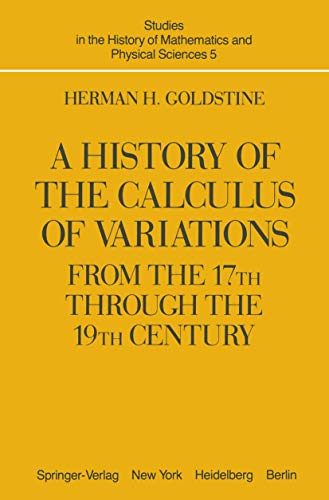
Ebook Info
- Published: 1980
- Number of pages: 410 pages
- Format: PDF
- File Size: 8.32 MB
- Authors: Herman. H. Goldstine
Description
The calculus of variations is a subject whose beginning can be precisely dated. It might be said to begin at the moment that Euler coined the name calculus of variations but this is, of course, not the true moment of inception of the subject. It would not have been unreasonable if I had gone back to the set of isoperimetric problems considered by Greek mathemati cians such as Zenodorus (c. 200 B. C. ) and preserved by Pappus (c. 300 A. D. ). I have not done this since these problems were solved by geometric means. Instead I have arbitrarily chosen to begin with Fermat’s elegant principle of least time. He used this principle in 1662 to show how a light ray was refracted at the interface between two optical media of different densities. This analysis of Fermat seems to me especially appropriate as a starting point: He used the methods of the calculus to minimize the time of passage cif a light ray through the two media, and his method was adapted by John Bernoulli to solve the brachystochrone problem. There have been several other histories of the subject, but they are now hopelessly archaic. One by Robert Woodhouse appeared in 1810 and another by Isaac Todhunter in 1861.
User’s Reviews
Reviews from Amazon users which were colected at the time this book was published on the website:
⭐This is a rather mediocre history of the calculus of variations. The mathematical exposition is often stilted and opaque, and Goldstine’s historical sensibilities at times appear infinitesimal. The book is peppered with speculative claims that “probably” some historical mathematician understood such-and-such, and “presumably” he realised the importance of this or that result, and so on. To illustrate how unreliable these speculations are we may consider Goldstine’s account of Leibniz’s solution to the brachistochrone problem.First Goldstine claims that Leibniz’s letter to Bernoulli containing his solution “probably also contained the extensive addendum [Mathematische Schriften, I.3, pp. 290-295]” and laments that “There is unfortunately nothing in Gerhardt’s edition to indicate whether that material headed Beilage was sent then, later, or never, or whether it was merely Leibniz’s note for himself” (p. 35). But in fact Gerhardt makes it perfectly clear in his introduction (p. 117) that the Beilage in question was a private manuscript that was not sent.Then on the next page Goldstine lunges into speculation again: “It is remarkable that nowhere in his letter or its addendum does [Leibniz] mention that the curve is a cycloid. He presumably knew in 1686 that his differential equation defines the cycloid but makes no mention of it.” (p. 36)I say that Leibniz’s letter indicates that he did not know this. For in his letter he prefaces his statement of the differential equation with an apologetic note, saying that the problem “demands more intense meditation”. He then asks Bernoulli to “accept in the meantime this attempt … which leads to a differential equation”, even though this in itself is “merely subsidiary”. [Mathematische Schriften, I.3, p. 288]Thus we see that Goldstine’s speculations—presented without any argument or evidence other than the authority of the author—are plainly undermined twice in as many pages by even the most cursory examination of the primary literature.
Keywords
Free Download A History of the Calculus of Variations from the 17th through the 19th Century (Studies in the History of Mathematics and Physical Sciences) in PDF format
A History of the Calculus of Variations from the 17th through the 19th Century (Studies in the History of Mathematics and Physical Sciences) PDF Free Download
Download A History of the Calculus of Variations from the 17th through the 19th Century (Studies in the History of Mathematics and Physical Sciences) 1980 PDF Free
A History of the Calculus of Variations from the 17th through the 19th Century (Studies in the History of Mathematics and Physical Sciences) 1980 PDF Free Download
Download A History of the Calculus of Variations from the 17th through the 19th Century (Studies in the History of Mathematics and Physical Sciences) PDF
Free Download Ebook A History of the Calculus of Variations from the 17th through the 19th Century (Studies in the History of Mathematics and Physical Sciences)