

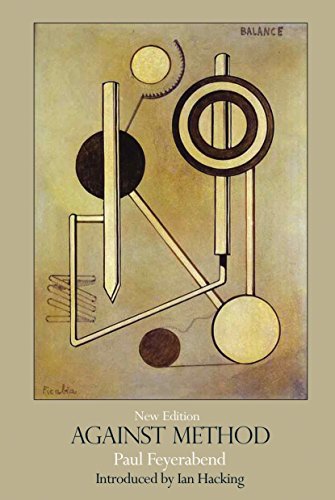
Ebook Info
- Published: 2010
- Number of pages: 336 pages
- Format: PDF
- File Size: 3.91 MB
- Authors: Paul Feyerabend
Description
Paul Feyerabend’s globally acclaimed work, which sparked and continues to stimulate fierce debate, examines the deficiencies of many widespread ideas about scientific progress and the nature of knowledge. Feyerabend argues that scientific advances can only be understood in a historical context. He looks at the way the philosophy of science has consistently overemphasized practice over method, and considers the possibility that anarchism could replace rationalism in the theory of knowledge. This updated edition of the classic text includes a new introduction by Ian Hacking, one of the most important contemporary philosophers of science. Hacking reflects on both Feyerabend’s life and personality as well as the broader significance of the book for current discussions.
User’s Reviews
Editorial Reviews: Review “A devastating attack on the claims of philosophy to legislate for scientific practice.”—New Society“A brilliant polemic.”—New Scientist“Since it was first published in 1975, Against Method has followed Popper’s The Logic of Scientific Discovery and Kuhn’s The Structure of Scientific Revolutions into becoming a classic text in the debate about scientific methodology and scientific reasoning.”—The Philosopher“A powerful critique.”—London Review of Books“Against Method is more than a book: it is an event.”—Archives de Philosophie About the Author Paul Feyerabend was Professor of Philosophy at UC Berkeley, and Professor of the Philosophy of Science at the Federal Institute of Technology at Zurich. He died in 1994. His books include Philosophical Papers, Farewell to Reason, and Against Method.Ian Hacking is Emeritus Professor of Philosophy at the University of Toronto. He is the author of Historical Ontology, Scientific Revolutions, and The Emergence of Probability.
Reviews from Amazon users which were colected at the time this book was published on the website:
⭐If you are a researcher (any field), or just interested in how “science” is supposed to work, read this book. The basic principle of the author is “The only principle that does not inhibit progress is: anything goes.”Needless to say, our current system is the exact opposite of this, and Feyerabend would likely despise (and rightly so) the granting systems of NIH, or other federal organizations. The book was originally publishes in 1975, following the decades of probably the most successful medical advances (optimization of antibiotics, chemotherapy, discovery of the DNA structure, etc). Those conditions (abundant funding, absolute meritocracy, little corporate influence) were likely unimaginable for todays scientist, who mostly work on writing grants for “mechanistic” research. Did Francis Collins read Against method? Doubtful.Brilliant book, strongly recommended.
⭐I immediately liked the format of the book. Instead of short non-descriptive title chapters, he instead gives a short sentence of the main point he’s making.He also front loads a lot of his useful points. I got halfway through the book and found that to be convincing enough for my tastes.Some people might not like him swinging with hot takes right away, but I found it to be helpful since it establishes the apparent absurdity of his claims and the difficulty of defending his position.Some claims he makes:- science is essential anarchic- truth is discovered by comparison and not analysis- we should take the sophists maxim to always be striving to make the weaker argument stronger- a theory could clash with its evidence because the evidence is contaminated- No theory is consistent with all the facts. “There is no theory that is not in some trouble or other”At this point I’ll stop. I hope you get the idea. The guy is sometimes touted as a kooky anarchist. I personally don’t find anarchic philosophies endearing, and I don’t think this description does him justice.
⭐Every physicist anf mathematician needs to read this. Every anarchist needs to read this. Feyerabend was friends with Feynman. Read the funny anecdote about Feyerabend driving in with Feynman to Berkeley over the Goldengate.
⭐A must read classic if one is to learn to think.
⭐Always a fan of Feyerabend! A page turner and you’ll get stuck to it from start to finish!
⭐This book does precisely what it says it will do – challenge the scientific method’s claim as The Epistemology. The body of the work is a detailed historical case study which he uses to make a historicist argument against the current scientific method, and the argument is both interesting to follow and rigorous. The Appendices are more impressive in my opinion, although noticeably more difficult. In there Feyerabend creates a larger system of argument and attempts to attack the scientific method not only empirically, but also theoretically. The last chapter is of course a completely different species, and in my opinion fundamentally elevates the work. Read it for yourself to find out.
⭐Give man 1,000 years and he will discover that the Earth goes around the sun. I read this waiting for Paul to say, “to hell with science!” But he never advocated anything so destructive. And this is good because technology is so dependent on research and development. Give credit where credit is due. If we ever enter a new paradigm, it will include all that we have accumulated and discard quite a bit as well. This paradigm may never even question what we were tinkering around with in the sciences. We can only hope that technology doesn’t give rise to anarchy. Wisdom of crowds will dominate and the lonely laboratory technician will send the sheep to the next stage of our evolutionary history. The method of science is sound for now and we should count our blessings that we have discovered most of what was there to be discovered. Let’s hope we can find our way to prosperity, truth, and beauty.
⭐Unlike Popper or Kuhn, Feyerabend’s views just do not seem coherent to me. I am not quite clear on why he is “against method”, nor how this antagonism translates into a larger picture on the theory of science.
⭐This book should not be reduced to one of its statements, “anything goes”, because Feyerabend’s argument is much more complex than that. Feyerabend tells us in a convincing way that the progress of science is made possible by people who do NOT act according to established rules and by people who put ostensibly obvious truths into question. Feyerabend was a very educated man, and his book should be read by every scientist, but also by the public at large – at last as long as we are free to think on our own.
⭐True masterpiece
⭐I read this book ‘to know my enemy’ mainly to destroy the arguments used by my old postmodernist college teacher. As you may have figured out I originally stood in complete opposition to this book, rallying behind the likes of Alan Sokal and Richard Dawkins.However, after reading Thomas S. Kuhn’s: “The structure of scientific revolutions” on paradigm theory (read this first), I felt I had to study Feyerabend’s take. After doing this, I can at least concede that I have taken on board some of his relativist criticisms albeit I have done so with a large pinch/grain of salt. I am still by no means a postmodernist and as usual I stay close by to my copy of “beyond the hoax”.A quick word of warning about most pre-postmodernist “dada” or any postmodernist literature, it can be very wordy at times, so to those very lost lay-men out there…watch out! I think that with a good head on your shoulders you should be able manage it while it coincides with your A levels.Also be very careful when reading this book, always approach it with a skeptical mind because it is very tempting to fall for ‘woo’ when it is written so well. If you feel you are falling for empty rhetoric return to your Sokal immediately.Five stars for the sheer cheek of Feyerabend!
⭐I’m not a scientist, but like anyone else on the internet, I like to pretend I could be one. I like to pretend that I know academia and what’s wrong with science more than academics do. I didn’t study any science beyond Grade 12 Chemistry. Feyerabend’s Against Method makes me feel more confident in my thoughts I could be a scientist, because what is “science?” It’s basically whatever you want.You know how Galieo fought against “the man” (evil Church) and won? You know how that proves how great “science” is? Feyerabend argues this is a lie. He was basically a troll who used every means at his disposal (including trickery and propaganda) to convince people he was right. In many ways, the Church followed “science” in saying he was wrong. They didn’t know back in the day that telescopes were good at. The image they provided was significantly distorted compared to the naked eye. It wasn’t until later when optics were studied more that this was figured out and corrected.By following methods of any capacity, we limit ourselves. We limit the ideas we can have and the explanations we can produce. We don’t know what is “right” or a “fact” now, and many people believe the case could be proven to be wrong. Consistency with the past is often a hindrance. There is many opportunities if you take up Feyerabend’s motto of “anything goes.” Have more crazy ideas.”There is no idea, however ancient and absurd, that is not capable of improving our knowledge.”
⭐A bit heavy to read on the philosophy side, need some familiarity with Popper, Kant, Lenin, Marx, Hegel, Kierkigaard – get my drift, but apart from that, its pretty comprehensive review of the power and lack of power science has to explain things much less itself
Keywords
Free Download Against Method in PDF format
Against Method PDF Free Download
Download Against Method 2010 PDF Free
Against Method 2010 PDF Free Download
Download Against Method PDF
Free Download Ebook Against Method