Ebook Info
- Published: 2014
- Number of pages: 331 pages
- Format: PDF
- File Size: 1.99 MB
- Authors: Terence Parsons
Description
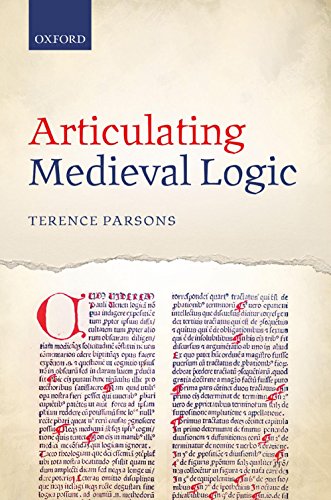
Terence Parsons presents a new study of the development and logical complexity of medieval logic. Basic principles of logic were used by Aristotle to prove conversion principles and reduce syllogisms. Medieval logicians expanded Aristotle’s notation in several ways, such as quantifying predicate terms, as in ‘No donkey is every animal’, and allowing singular terms to appear in predicate position, as in ‘Not every donkey is Brownie’; with the enlarged notation comeadditional logical principles. The resulting system of logic is able to deal with relational expressions, as in De Morgan’s puzzles about heads of horses. A crucial issue is a mechanism for dealing with anaphoric pronouns, as in ‘Every woman loves her mother’. Parsons illuminates the ways in whichmedieval logic is as rich as contemporary first-order symbolic logic, though its full potential was not envisaged at the time. Along the way, he provides a detailed exposition and examination of the theory of modes of common personal supposition, and the useful principles of logic included with it. An appendix discusses the artificial signs introduced in the fifteenth century to alter quantifier scope.
User’s Reviews
Reviews from Amazon users which were colected at the time this book was published on the website:
⭐This is a landmark work in the History of Logic. Parsons illuminates Aristotelian Logic and, most especially, its developments and extensions through the Medieval/Scholastic period. More deeply, he finds just what is the engine, or are the engines, of the further creation and development of Logic in this tradition, which he then puts to work to show how it can be continued to the point that it is at least as strong in its way as the so-called “classical first-order logic”–the symbolic predicate, quantificational logic taught in university logic courses (e.g., Quine’s textbook “Methods of Logic”). Locating the as it were creative engine for developing a logic is a rare event in the History of Logic, and of great philosophical importance. One early part of this book presents a fully satisfying account — which not even Leibniz managed to provide — of just how the syllogisms, etc., are logically derived especially simple syllogism.
⭐
Keywords
Free Download Articulating Medieval Logic 1st Edition in PDF format
Articulating Medieval Logic 1st Edition PDF Free Download
Download Articulating Medieval Logic 1st Edition 2014 PDF Free
Articulating Medieval Logic 1st Edition 2014 PDF Free Download
Download Articulating Medieval Logic 1st Edition PDF
Free Download Ebook Articulating Medieval Logic 1st Edition