

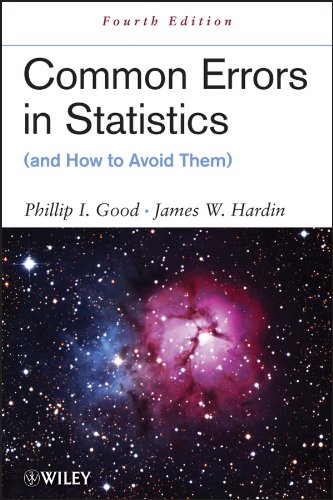
Ebook Info
- Published: 2012
- Number of pages: 352 pages
- Format: PDF
- File Size: 5.79 MB
- Authors: Phillip I. Good
Description
Praise for Common Errors in Statistics (and How to Avoid Them)”A very engaging and valuable book for all who use statistics in any setting.” —CHOICE”Addresses popular mistakes often made in data collection and provides an indispensable guide to accurate statistical analysis and reporting. The authors’ emphasis on careful practice, combined with a focus on the development of solutions, reveals the true value of statistics when applied correctly in any area of research.” —MAA ReviewsCommon Errors in Statistics (and How to Avoid Them), Fourth Edition provides a mathematically rigorous, yet readily accessible foundation in statistics for experienced readers as well as students learning to design and complete experiments, surveys, and clinical trials.Providing a consistent level of coherency throughout, the highly readable Fourth Edition focuses on debunking popular myths, analyzing common mistakes, and instructing readers on how to choose the appropriate statistical technique to address their specific task. The authors begin with an introduction to the main sources of error and provide techniques for avoiding them. Subsequent chapters outline key methods and practices for accurate analysis, reporting, and model building. The Fourth Edition features newly added topics, including:Baseline dataDetecting fraudLinear regression versus linear behaviorCase control studiesMinimum reporting requirementsNon-random samplesThe book concludes with a glossary that outlines key terms, and an extensive bibliography with several hundred citations directing readers to resources for further study.Presented in an easy-to-follow style, Common Errors in Statistics, Fourth Edition is an excellent book for students and professionals in industry, government, medicine, and the social sciences.
User’s Reviews
Reviews from Amazon users which were colected at the time this book was published on the website:
⭐There are some excellent suggestions for the applied statistician/data analyst in this book. These nuggets, however, are buried between many topics I didn’t find particularly helpful. I tend to pick this book up, read a few pages, skip a few pages, and then put it down until I notice it on my bookshelf again.
⭐Very enjoyable. Well written and a lot of good content on bootstrapping. You’ll have to sit down to read this one. I sat down and power read ten or fifteen pages a sitting over two weeks to get through it.
⭐Great book for beginners – helped me get started in the basic concepts and lead me to other more formal texts. If you’re looking for something to start you out in statistics and what they mean this is a great book.
⭐It’s not often I can say a statistics book is enjoyable to read. This volume is quite a joy: well written and full of useful examples so amateur users of statistics (scientists and clinical researchers) cam avoid mistakes that would otherwise ruin your data analysis. References are up to date and very useful as well.
⭐Poorly written. In many places it sounds like a puff piece for Good. Pretty much a waste of time and money
⭐A fast well written user guide for a technical profesional. Would buy again and recomend for most Quality Engineers in all fields.
⭐This is a good book. Its purpose is a noble one- it’s ultimately about helping us tell truth from fiction. It’s about spotting lies made through statistics through leaving things out, distorting findings, torturing data, and generally misbehaving with numbers, This misbehaviour may be innocent but ignorant, or deliberate and deceitful.This book is a thorough description of how to use statistics well, which measurements and tests to use when, and where. It is mostly understandable, but I did not understand the detailed maths within it. I think this is my loss- it’s probably something I should know, and probably something all those who plan and lead experiments should understand. The examples illustrating the main points were well chosen. It is well written with a nice vein of humour running through it. It is written at a high level- I think aimed at university science and maths students and above. It achieves it purpose of teaching us how to get the numbers right, and its second purpose of showing us how to avoid falling into error. The fact that it is so easy to find basic statistical mistakes in published papers should worry us- the errors are sufficient to invalidate these papers and their conclusions. The fact that peer review picks up so few of these errors suggests that statisticians are not part of the reviewing team often enough. It also reduces the credibility of the peer review process showing that it is a process that fails to pick up and prevent errors in published work.After reading Ben Goldacre’s book,
⭐the need for this book is all too obvious. Other books on this theme would include the easier
⭐and
⭐I have a feeling that in my training as a doctor certain topics were left out of the course that should have been taught formally and fully. The design of research should have been covered more- both to do it and to understand its results better, and
⭐should have been a formal course too.This book speaks to a gap in many people’s understanding and use of statistics. If I could understand it fully what Hemingway described as “my internal crap detector” would be strengthened significantly. As it was even though I think understood about half of it, I still feel I got a lot out of it.If you are a science student, or working as a researcher with numerical data then this book will be very useful to you. You will design your experiments better, ask the right questions of your data, and present your results more fairly, and more clearly.
⭐A more proper title might be “Common Errors in Statistics (and How to Avoid Them): A Survey.” It’s a survey book with an excellent reference section. I particularly enjoyed the section regarding the proper use of Multivariable Regression. This should be must reading for any undergraduate studying statistics. And also for every practitioner.
⭐This book has so many good reviews and I have no idea why. It is not that accessible to the reader and some of it is quite misleading. Confused.com and I have statistics and mathematics qualifications at degree and higher degree level.
⭐Der Titel ist etwas weitschweifig. Man sollte selbst einige Erfahrung mit der Bewältigung statistischer Probleme haben, bevor man zu diesem Titel greift. Als “Problemlöser” für den Alltag von Forschenden, die konkrete Fragen oder Probleme haben, ist das Buch meiner Meinung nach nicht geeignet. Vielleicht bin ich auch befangen, da ich mich kürzlich durch einen anderen Titel des Autors gequält habe. Nach etwa 2/3 des Textes habe ich das allerdings kopfschüttelnd abgebrochen. Mir liegen Bücher nicht, die aus der Warte eines “Experten” mit vielen fraglichen Ratschlägen gespickt geschrieben sind. Gerade im Bereich der Statistik ist das eine Gefahr. Es mag amüsant sein, wenn aus dem Nähkästchen geplaudert wird, es kann aber ebenso in die Irre leiten, wenn beispielsweise (mathematische) Behauptungen nicht begründet werden. Und so komme ich ans Ende meiner weitschweifigen Rezension. Wer sie bis zum Ende gelesen hat, hält auch die Lektüre dieses Titels aus.Some books have an inordinate impact on the publishing world. The King James Bible, Lady Chatterley’s Lover, Harry Potter, and now, 50 Shades of Grey. This latter piece of “mummy porn” has had a pervasive impact on publishing, with Mills & Boon-esque heiresses and stable boys thrown out in exchange for the lives of cubicle dwellers with the occasional penchant for things they’ve seen on the Internet. What surprised me was that this mainstreaming of sexual liberalisation should make its way into this, the updated 4th edition of “Common Errors in Statistics (and How to Avoid Them)”. The author, writing under the domineering and sexually charged pseudonym “Dr. Good” lays down the law with an iron fist, presumably clad in some sort of leather glove.It starts off gently enough, drawing in the reader and earning their trust with a warm invitation to candidly share of the human failings that make us who we are. Who could not forgive the occasional lapse of a two-sided test when a one-sided one is more appropriate? The first hint of obsessive tendencies begins on page 19, as we start to explore the concept of the null hypothesis. Forming these is one of the very bedrocks of science, and the well-intentioned reader who picks this book up just wanting to be a better researcher flinches with their first chastisement when we are told in no uncertain terms that it is correctly spelled and pronounced “nil”. Oh but we’ve been doing it wrong for so long – the shame and humiliation a secret thrill. The only redemption that can be sought come with stern instruction; “We have let the tool use us instead of using the tool”. Uh-oh. Now we’re in for it.As a researcher with ten years’ experience, I have formulated some hypotheses in my time. I have hypothesised that inherited forms of disease might incur more severe consequences than apparently idiopathic forms, that right-handed ALS/MND patients will be more likely to get their first disease symptoms in their dominant arm, and I have hypothesised that certain drugs are ineffective. With significantly more experience than I have in hypothesis formulation, the authors decide to build the case for proper hypothesis formation around the following example:”All redheads are passionate” is not a well-formed statistical hypothesis, not merely because ‘passionate’ is ill defined, but because the word ‘all’ suggests there is no variability. The latter problem can be solved by quantifying the term “all” to, let’s say, 80%. If we specify ‘passionate’ in quantitative terms to mean “has an orgasm more than 95% of the time consensual sex is performed” than the hypothesis “80% of redheads have an orgasm more than 95% of the time consensual sex is performed” becomes testable.”At this point in my reading I had to shout my safe word, which confused my wife.Where are the grant calls to apply to perform such research? What sort of a sample would one need to generate to test this hypothesis with a reasonable degree of confidence? Which collaborators of mine might be willing to replicate such findings? (Note to self: might be worth contacting colleagues in Scotland or Ireland to simplify recruitment…) What sort of control group should we use, blondes or brunettes? How redheaded must these people be, would auburn haired people be considered outliers? For consistency’s sake we’d probably also have to control certain variables such as the primary investigator, duration of encounter, and might have to employ sensitive recording equipment to have results evaluated for inter-rater reliability.I’m hoping it’ll be a trilogy. It’s also available as an e-book in case you don’t want other people on the train to know what you’re enjoying on your commute into the lab.
⭐Who would enjoy reading about statistics? Especially a textbook. Statistics are dry and boring. They are a chore that you have to do but you can’t enjoy them and if you don’t enjoy doing statistics then you certainly shouldn’t enjoy reading about them. Well, that is what I thought before I read this book and now I have to say that I really enjoyed this book. Yes, that’s right. A stats book that I couldn’t put it down…..surely that’s not right? Well, I urge you to have a go at this book. The authors provide a valuable insight into the statistical world, using real life examples of what should and should not be done. This book has been extremely useful to me and it has changed the way I look at statistics.Often statistical books focus on what you should do rather than what you should not do. This book turns this around and highlights common errors that occur with statistics and shows you how to avoid them (hence the name). It doesn’t matter what environment you use for your statistics, whether it is R, excel, or even a pen and paper, this book explains the theory and behind it all. It not only shows you how to do the statistics and what the results should be, but it shows you what mistakes to avoid and why some mistakes can make your results and also interpretation invalid. There is also useful information on how the results should be written up in preparation for publication.It is really well written and complicated terms are explained in an easy to understand way. The book is split into 3 parts each with chapters which are also further divided into separate sections, making it easier to read and understand in smaller blocks rather than a wall of text;The first part deals with the foundations of statistics.1. Sources of error – examples of some of the common errors that should be avoided and fundamental concepts that should be followed by any study.2. Hypotheses – how to formulate a hypothesis and the importance of decision making in setting up studies.3. Collecting data – study design and data collection. Including the use of replicates and controls, sample size and randomization.The second part looks at statistical analysis.4. Data quality assessment – If the quality of the data is poor then the results of any statistical test will be both inaccurate and irrelevant. This chapter looks at sampling design and the importance of good data collection.5. Estimation – the desirable properties to look for in an estimation method and how accurate, reliable estimates are essential to effective decision making.6. Testing hypothesis and choosing test statistics – the assumptions underlying testing hypotheses and the impacts of violations of assumptions.7. Strengths and limitations of some miscellaneous statistical procedures – analysis of non-random data and pros and cons of some statistical procedures such as Bayes theorem.8. Reporting results – This is a really useful chapter which tells you what and how to report your methodology and results.9. Interpreting results – Another really useful chapter which helps people who are preparing reports/manuscripts and those who have to interpret them. Really useful for all students.10. Graphics – looks at the mistakes and consequences of selection, creation and execution of graphics, such as choosing between tabular or graphical methods of displaying data.The final part looks at how to build a model and the assumptions, limitations and advantages involved in regression techniques, data mining and analysis.11. Univariate regression – looks at inappropriate models, stratification, linear regression and curve-fitting.12. Alternate methods of regression – looks at linear vs nonlinear regression and the importance of using separate regression equations for each identifiable stratum.13. Multivariable regression – looks at sources of error and how to build a successful model14. Modelling counts and correlated data – the use of generalized linear models and the different approaches for modelling correlated data.15. Validation – a model must be validated before any conclusions can be made. Looks at methods of validation, resampling and sample splitting for validation.I highly recommend this book for students who are just commencing their studies, or even those who have been studying for a while, as there are a lot of important points raised in this book. This is not a book that will replace other statistics book; this is a book that should be used alongside other texts and will become a valuable addition to any scientist’s bookshelf.
⭐If you’re planning to publish a paper that relies on any form of analysis of quantitative results, you may like to read this book first. You may save yourself from making embarrassing, potentially career-changing mistakes. Moreover, if you’re anything like me you will probably enjoy reading it: Dr. Good is apparently a novelist and sports writer as well as a statistician, and he knows how to make a narrative interesting. Similarly, if you’re one of the loyal listeners to BBC Radio 4’s “More of Less”, you’re likely to find this book more than a little interesting.The book is not aimed primarily at statisticians: it’s for “ordinary” people who need to use statistics correctly. It covers a lot of ground in not too much depth, effectively and succinctly summarising all the mistakes that are commonly made. It assumes that you’re capable of grasping an idea that is stated clearly with an accompanying memorable example without the need for repetition. The general form is: ‘here’s an error you might make; in order to avoid it, you should do this’, interspersed with longer explanatory sections. It’s an excellent approach – you don’t necessarily want a detailed discussion, you want to know how to do it right. The layout is clear and easy to read.The “common errors” include elementary mistakes in experimental procedure: you form your hypotheses first, and then test them experimentally, not the other way around, or you will start finding patterns in random variation. Correlation versus cause, another currently popular mistake, is also covered, as are loads of other, generally pretty-obvious-when-you-think-about-it, errors.This book steers that narrow course of being simultaneously accessible and hugely instructive. It will be of use to pretty much anyone who uses or has an interest in statistics and how they are used and abused.
Keywords
Free Download Common Errors in Statistics (and How to Avoid Them) 4th Edition in PDF format
Common Errors in Statistics (and How to Avoid Them) 4th Edition PDF Free Download
Download Common Errors in Statistics (and How to Avoid Them) 4th Edition 2012 PDF Free
Common Errors in Statistics (and How to Avoid Them) 4th Edition 2012 PDF Free Download
Download Common Errors in Statistics (and How to Avoid Them) 4th Edition PDF
Free Download Ebook Common Errors in Statistics (and How to Avoid Them) 4th Edition