Ebook Info
- Published: 2013
- Number of pages: 378 pages
- Format: PDF
- File Size: 6.16 MB
- Authors: Martin Campbell-Kelly
Description
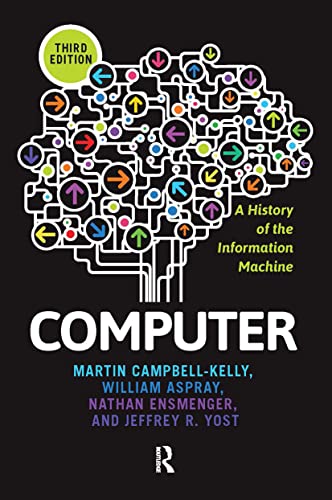
Computer: A History of the Information Machine traces the history of the computer and shows how business and government were the first to explore its unlimited, information-processing potential. Old-fashioned entrepreneurship combined with scientific know-how inspired now famous computer engineers to create the technology that became IBM. Wartime needs drove the giant ENIAC, the first fully electronic computer. Later, the PC enabled modes of computing that liberated people from room-sized, mainframe computers.This third edition provides updated analysis on software and computer networking, including new material on the programming profession, social networking, and mobile computing. It expands its focus on the IT industry with fresh discussion on the rise of Google and Facebook as well as how powerful applications are changing the way we work, consume, learn, and socialize. Computer is an insightful look at the pace of technological advancement and the seamless way computers are integrated into the modern world. Through comprehensive history and accessible writing, Computer is perfect for courses on computer history, technology history, and information and society, as well as a range of courses in the fields of computer science, communications, sociology, and management.
User’s Reviews
Editorial Reviews: Review “I strongly recommend to you the third edition of Computer; it is simultaneously a thorough, accurate, and highly readable history of the evolution of the computer and its impact on all aspects of our society. I am an old guy, having written my first computer program over 50 years ago, and I have personally known many of the people mentioned in the book so I can attest to the accuracy of the events described.” —Bill Wulf, University of VirginiaPraise for Prior Editions: “Terrific! This is the best general history of computing yet written, by two of the field’s most prominent historians. Computer is comprehensive, engaging, and a pleasure to read. Aspray and Campbell-Kelley paint the big picture of the information revolution that is affecting all of our lives.” —David A. Mindell, Massachusetts Institute of Technology, and author of Between Human and Machine: Feedback, Control, and Computing Before Cybernetics“This book is a splendid account of the history of computing machines. From Jacquard’s punch card loom to today’s Dick Tracy-like Internet connectors, the book provides a wealth of fascinating historical and technological information, especially for first-time readers. Highly recommended.” —Choice “A welcome update to the classic text on the history of the computer—sure to extend its relevance to a new generation of students and scholars.” —David Mindell, MIT, author of Digital Apollo: Human and Machine in Spaceflight “This authoritative yet accessible history of computing improves with each edition. This latest version provides enhanced coverage of recent developments such as the Internet, while sharpening and deepening its treatment of earlier events. A balanced, reliable account that holds interest for specialists and provides a ready entry into the topic for students, professionals, and general readers.” —Steven W. Usselman, Georgia Institute of Technology From the Back Cover “A welcome update to the classic text on the history of the computersure to extend its relevance to a new generation of students and scholars.” David Mindell, MIT, author of “Digital Apollo: Human and Machine in Spaceflight” “This authoritative yet accessible history of computing improves with each edition. This latest version provides enhanced coverage of recent developments such as the Internet, while sharpening and deepening its treatment of earlier events. A balanced, reliable account that holds interest for specialists and provides a ready entry into the topic for students, professionals, and general readers.” Steven W. Usselman, Georgia Institute of Technology “Computer: A History of the Information Machine” traces the history of the computer and shows how business and government were the first to explore its unlimited, information-processing potential. Old-fashioned entrepreneurship combined with scientific know-how inspired now famous computer engineers to create the technology that became IBM. Wartime needs drove the giant ENIAC, the first fully electronic computer. Later, the PC enabled modes of computing that liberated people from room-sized, mainframe computers. This third edition provides updated analysis on software and computer networking, including new material on the programming profession, social networking, and mobile computing. It expands its focus on the IT industry with fresh discussion on the rise of Google and Facebook as well as how powerful applications are changing the way we work, consume, learn, and socialize. “Computer” is an insightful look at the pace of technological advancement and the seamless way computers are integrated into the modern world. Through comprehensive history and accessible writing, “Computer” is perfect for courses on computer history, technology history, and information and society, as well as a range of courses in the fields of computer science, communications, sociology, and management. Martin Campbell-Kelly is emeritus professor of computer science at University of Warwick. William Aspray is Bill and Lewis Suit Professor of Information Technologies at University of Texas at Austin. Nathan Ensmenger is associate professor in the School of Informatics and Computing at Indiana University Bloomington. Jeffrey R. Yost is associate director of the Charles Babbage Institute and faculty member in the History of Science, Technology, and Medicine at the University of Minnesota.” About the Author Martin Campbell-Kelly Read more
Reviews from Amazon users which were colected at the time this book was published on the website:
⭐Review of Campbell-Kelly et al’s “Computer” by Paul F. Ross Prompted by a biography of Gordon Moore, recently published (Thackray et al, 2015) and recently read, to read more about the history of “the computer,” Campbell-Kelly’s history (2014) came to my attention. I had just read Ceruzzi’s history (2003), posting my review on Amazon.com along with others’ reviews of Ceruzzi and other reviews of mine covering other titles referenced here. These four authors are____________________________________________________________________________________Campbell-Kelly, Martin, Aspray, William, Ensmenger, Nathan, and Yost, Jeffrey R. “Computer: A history of the information machine” 2014, Third Edition, Westview Press, Boulder CO, xv + 360 pages____________________________________________________________________________________employed by universities, Campbell-Kelly by the University of Warwick, Aspray by the University of Texas, Ensmenger by the University of Indiana, and Yost by the University of Minnesota. They work in the “publish or perish” parts of the world’s economies. Their history is interesting, worth reading. However, as with Ceruzzi’s history, I’m left with some important reservations. The strength of this work is that it examines (in turn) first the purpose of computing, then reviews how computing machinery has entered the activity. This, indeed, is “horse before the cart,” seeing first the social and economic purpose for the human activity, then examining how computing machinery entered the scene. The approach is to be applauded and, for this reader, is an important improvement on Ceruzzi’s history (2003). Very often the entrance of computing machinery has transformed the original activity. These authors treat the theoretical contributions to computing (Babbage, Von Neumann, Turing) as is appropriate. They see and describe the entrepreneurial contributions. They understand and present the social and economic drives (as, for example, US government interest in computing in support of its Cold War effort). While this history understands contributions from Britain, it is a history primarily centered on US experience. That may be appropriate since the US has been at the center of the explosions of usage, 1945 to 2014 … scientific computing, management information systems, introduction of the minicomputer and the personal computer, software as a product separate from hardware, ARPAnet and the internet, internet search capabilities, cell phones and smart phones, and social networking. However the US is not the whole world. The internet got its start at a physics research facility in Switzerland (CERN) and grew out of a need to be in communication with colleagues, quickly, over long distances, sharing large files. The interpersonal communication enabled by smart phones has had political consequences already that these authors are afraid to touch. Egypt’s shutting down of the internet connections with the rest of the world during the Arab Spring, and China’s current demands upon corporate services entering the Chinese markets (as with Yahoo, Google) have implications not addressed in this history. Digital Equipment Corporation’s (DEC) experience in having its computer architecture and software stolen by the USSR, reproduced there, and perhaps advancing Russia’s space capabilities is not touched. If Russia did not steal computer advances from the west, what was the history of their advance and how do their capabilities compare with capabilities in the west? My impression of the Ceruzzi history (2003) was that it traced technological developments, seeing less clearly the underlying needs for information which drove computer usage and opened new markets for the technology. My impression of the Campbell-Kelly history (2014) is that it never gets far from IBM and Microsoft as “hitching posts” and thus loses important trends and insights available from computing over the last 70 or 80 years. The Thackray’s (2015) biography of Gordon Moore is an insightful close up of the development of the printed circuit and its contribution to computing history but, in the larger picture, is a snapshot of a detail. I’m starting my read of Colwell’s (2006) story of the development of a recent aspect of printed circuit computer architecture. Rifkin’s biography of Ken Olsen (1988) and Anderson’s account (2009) of the experience of creating and developing DEC certainly will add detail to the history of computing that is not covered in Ceruzzi or in Campbell-Kelly. The invention of the chip in two places (Reid, 2001) has had something to do with the technological history of computing. I know of no history addressing computing’s and the internet’s impact on education, no history examining the impact of communicating and computing on politics and the world’s sense of direction. There is extensive opportunity here for some insightful historians. Ceruzzi quotes Mark Twain (2003, p 207) who said: “Very few things happen at the right time, and the rest do not happen at all. The conscientious historian will correct these defects.” It is a humorist’s look at the difficult, nearly impossible, task of the historian. Historians seem to have needed a century to see the causes of World War I and understand how that conflict led on into World War II and the Cold War. It may take yet another decade or more before historians are able to see enough of the many aspects of computing, communicating, and their history to write a truly insightful, seeing-the-whole-picture of the phenomena of computing and communication, technologies that clearly are deeply affecting every aspect of our lives. Meantime, those with a need to know can explore the many views provided by the authors referenced here.Bellevue WA15 May 2016Copyright © 2016 by Paul F. Ross All rights reserved.ReferencesAnderson, Harlan E. Learn, earn & return: My life as a computer pioneer 2009, Locust Press, Redding CTCampbell-Kelly, Martin, Aspray, William, Ensmenger, Nathan, and Yost, Jeffrey R. Computer: A history of the information machine 2014, Third Edition, Westview Press, Boulder COCeruzzi, Paul E. A history of modern computing 2003, Second Edition, MIT Press, Cambridge MAColwell, Robert P. The Pentium chronicles: The people, passion, and politics behind Intel’s landmark chips 2006, John Wiley & Sons, Hoboken NJGates, Bill The road ahead 1996, Penguin Books, New York NYLevy, Steven In the Plex: How Google thinks, works, and shapes our lives 2011, Simon & Schuster, New York NYLohr, Steve Go to: The story of the math majors, bridge players, engineers, chess wizards, maverick scientists and iconoclasts – The programmers who created the software revolution 2001, Basic Books, New York NYReid, T. R. The chip: How two Americans invented the microchip and launched a revolution Second edition. 2001, Random House Trade Paperbacks, New York NYRifkin, Glenn, and Harrar, George The ultimate entrepreneur: The story of Ken olsen and Digital Equipment Corporation 1988, Contemporary Books, Chicago ILSchein, Edgar H. DEC is dead; Long live DEC: Lessons on innovation, technology, and the business gene – The lasting legacy of Digital Equipment Corporation 2003, Berrett-Koehler Publishers Inc., San Francisco CASegaller, Stephen Nerds 2.0.1: A brief history of the internet 1998, Oregon Public Broadcasting; see TV Books, New York, NYThackray, Arnold, Brock, David C., and Jones, Rachel Moore’s Law: The life of Gordon Moore, Sillicon Valley’s quiet revolutionary 2015, Basic Books, New York NYWu, Tim The master switch: The rise and fall of information empires 2010, Alfred A. Knopf, New York NY
⭐It’s quite well put together overall. However it nearly completely glosses all of Commodore, completely omitting the Vic20, C64, and Amiga. It also contains inaccuracies about the Commodore PET’s disk drives and keyboards.That aside, it’s pretty well done.
⭐Well written story, easy read
⭐Excellent wide-ranging coverage of the history of computing. Some factual errors versus some of the histories I’ve read and it does gloss over some points, but a worthy read for anyone interested in a good time-line of modern computing.
⭐Complete History a Computer
⭐I was forced to read it for class, which is why I probably have a biased review. It has a lot of detail but the chapters drag to finish reading.
⭐the very best book I have read in a long time.
⭐After finding this in the eBook section of our University library, I decided to use it in my computer literacy class. It is a concise, well done history of the computer and the electronic world written in a way the non-technical student can understand. And, it is inexpensive!Pat GibsonAdjunct LecturerTexas State University
⭐Comprehensive, but rather biased to the American history of computing
⭐I have so far read halfway through the book and so far I am enjoying the book. The book is fairly structured and organized and I like how the book is not too technical for the average reader. The author does not go too technical into the technology and also covers the importance of each major decision not only on the technology aspect but also the social and economic impact it had onto the society and to the company or invention. Furthermore the book covers a wide range of computer advancement in various fields reminding us the impact computers had on various firlds. The book constantly reminds me that it is not the engineering/technical aspect that was needed for the advancement of the computer but also a social and economical aspect. I would recommend it for people who are interested in technology and to students as well. Although not critical, most students (especially those in Computer Science) do not know much about the advancements been made to Computers. Learning about how much different technology was before I started studying about Computers has made me appreciate the subject a lot more and gives me insight on concepts I learn in school or from textbooks that I read time to time when I am bored. Not a long book to read but I find myself reading the book at a very slow pace. Maybe it’s just that I am a slow reader. Would be nice if the author provided pictures of the computer/calculator the author is talking about to help readers visualize instead of just describing the machine. This would be especially helpful for devices that are very old such as the mechanical devices since I have a hard time visualizing them. I did notice the author did provide some images later on but would have been helpful if they were provided when the device was discussed in the book.
Keywords
Free Download Computer: A History of the Information Machine (The Sloan Technology Series) 3rd Edition in PDF format
Computer: A History of the Information Machine (The Sloan Technology Series) 3rd Edition PDF Free Download
Download Computer: A History of the Information Machine (The Sloan Technology Series) 3rd Edition 2013 PDF Free
Computer: A History of the Information Machine (The Sloan Technology Series) 3rd Edition 2013 PDF Free Download
Download Computer: A History of the Information Machine (The Sloan Technology Series) 3rd Edition PDF
Free Download Ebook Computer: A History of the Information Machine (The Sloan Technology Series) 3rd Edition