Ebook Info
- Published: 2004
- Number of pages: 423 pages
- Format: PDF
- File Size: 2.03 MB
- Authors: William A. Dembski
Description
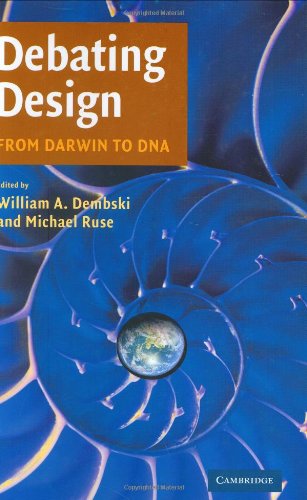
In this book, first published in 2004, William Dembski, Michael Ruse, and other prominent philosophers provide a comprehensive balanced overview of the debate concerning biological origins – a controversial dialectic since Darwin published The Origin of Species in 1859. Invariably, the source of controversy has been ‘design’. Is the appearance of design in organisms (as exhibited in their functional complexity) the result of purely natural forces acting without prevision or teleology? Or, does the appearance of design signify genuine prevision and teleology, and, if so, is that design empirically detectable and thus open to scientific inquiry? Four main positions have emerged in response to these questions: Darwinism, self-organisation, theistic evolution, and intelligent design. The contributors to this volume define their respective positions in an accessible style, inviting readers to draw their own conclusions. Two introductory essays furnish a historical overview of the debate.
User’s Reviews
Reviews from Amazon users which were colected at the time this book was published on the website:
⭐In Debating Design: From Darwin to DNA (2004), Bill Dembski and Michael Ruse edit a compendium of essays representing a range of perspectives on the topic of intelligent design (ID). Conceived as an extension of the “Design and its Critics” conference (2000, Concordia University Wisconsin), this project includes follow-up contributions from some of the most notable personalities in and around the ID debate, such as Francisco Ayala, Ken Miller, Paul Davies, Stuart Kauffman, John Polkinghorne, Richard Swinburne, Michael Behe and Stephen Meyer. Each of the book’s twenty-two authors has previously published in the area of his particular contribution and has also held a prominent professorship in a related field at the time of the book’s release.As joint editors, Dembski and Ruse approach the topic of design from opposing perspectives, yet they agree that ID is a “significant factor on the contemporary landscape [even if only culturally] … and should not be ignored.” A consequence of their agreement is this well-crafted volume which arranges the design debate into four general categories: (I) Darwinism, (II) Complex Self-Organization, (III) Theistic Evolution, and (IV) Intelligent Design. The editors themselves, along with Angus Menuge, author a three-chapter introduction which outlines a brief history of the design argument and surveys the origin and objectives of the modern intelligent design movement. Ruse observes that design has a “long and honorable history,” dating to at least Plato and Aristotle, while Menuge highlights that ID was not conceived as a form of stealth creationism, but was rather initiated as a response by notable scientists (e.g., Bradley, Olsen, Thaxton, and Denton) to what they considered to be a crisis in normal science (cf. Thomas Kuhn).The first of the book’s four sections (“Darwinism”) is represented, in part, by Francisco Ayala, who argues that the Copernican and Darwinian revolutions share common ground in their commitment to the fixity of natural laws (however, any mention of Copernicus’ own perspective on cosmic design was conspicuously absent). Ken Miller also contributes to this section by taking aim at irreducible complexity—namely, the bacterial flagellum, which he dubs the “poster child” of the ID movement. Miller uses the type III secretory system (T3SS) to argue that cooptive adaptation provides a plausible Darwinian pathway to the flagellum’s development, despite the fact that the T3SS has only one-third of the proteins found in the flagellum, none of which contribute to motility.Section II approaches the design debate from the standpoint of complex self-organization. Contra Darwin, Stuart Kauffman writes a “Prolegomenon to a General Biology,” where natural selection has little or no place in a system where physical and chemical laws sufficiently explain biological complexity and order. Bruce Weber and David Depew present the general notion of self-organization as the middle ground between hyper-adaptationist (neo-Darwinian) and design theories, suggesting that dynamical systems facilitate parallel processing which allegedly sidelines the necessary sequentialism of Darwinian processes.Theistic evolution, the subject of section III, also offers what purports to be a middle ground of sorts, albeit more metaphysically orientated than proposals of self-organization. In this vein, John Haught thinks that Darwinists and design theorists make a similar mistake by offering ultimate explanations too soon, and observes that divine providence transcends the limitations that either camp wants to presuppose. John Polkinghorne expounds the issue of providence in the context of theistic evolution by asserting that historical contingency (i.e., chance) is a necessary condition for libertarian freedom, and thus, God’s providence strikes an essential balance between haphazardness and determinism by operating “on the edge of chaos.”The book’s final section (“Intelligent Design”) showcases contemporary design arguments from leading ID proponents. For example, Bill Dembski outlines the logical underpinnings of design by explaining how the presence of complex specified information (CSI) intuitively and mathematically warrants a design inference. Additionally, Walter Bradly interacts with the origin of life in light of information theory and thermodynamics and cites this as the ultimate example of irreducible complexity. Michael Behe exposes how critics of irreducible complexity either misconceive the concept (e.g., Ken Miller, Russell Doolittle) or misrepresent it (e.g., John McDonald). In the book’s final chapter, Stephen Meyer argues that the origination of biological information is not only a steep challenge in origin of life research, but also a Gordian knot for such phenomena as the Cambrian explosion, where the emergence of novel body plans appear suddenly (geologically speaking) in the fossil record.One of Debating Design’s many strengths is the sheer range of perspectives it captures. The compendium format avails its audience of the numerous considerations that come into play with respect to intelligent design, thereby facilitating the development of opinions on the basis of primary sources, vice second-hand renderings which may be unwittingly or deliberately distorted. Since many polemical issues are susceptible to such distortion when written from only one perspective, Debating Design’s anthology style is a prized feature for readers who value a fair and complete hearing of a complex issue. Similarly, the editors should be commended on selecting a field of contributors who are sympathetic, or at least non-antagonistic, toward theism in general. This is a welcome departure from some of the hostile writings of certain crowds (e.g., New Atheists) whose books serve as little more than ‘red meat’ for their anti-theistic patronage. That this project excludes such propagandizing is significant in the context of ID since, as Behe notes, much of the resistance to design has more to do with its philosophical and theological implications than its rational warrant.For all of its advantages, an inescapable liability of having a large number and variety of contributors is that many points may go unanswered due to the sheer volume of content. For example, Bradley devotes much of his chapter to developing an argument to design based on Shannon information theory, yet none of the twenty-one other contributors engage his particular points. One reason for this is clear: not everyone had the opportunity to read everyone else’s essay. And even if they had, a sufficiently-formed response would be nearly impossible given the book’s limited space. This is contrary to something like Zondervan’s Counterpoints Series, where failing to engage a substantial argument would be tantamount to conceding it. Of course, attempting to adopt a Counterpoints-style format is unreasonable, in this case, with so many essays involved; thus, prospective readers should be prepared to avail themselves of additional resources at certain points along the way.An example of an unanswered point would be an observation made by Francisco Ayala where he favorably quotes Darwin with respect to the essence of natural selection: “We may feel sure that any variation in the least degree injurious would be rigidly destroyed. This preservation of favorable variation and the rejection of injurious variations, I call Natural Selection.” The problem with this assessment, which goes mostly unmentioned by the other contributors, is that some of the best examples of natural selection are deleterious. In a subsequent publication (The Edge of Evolution), Behe comments at length on the injurious nature of natural selection, such as sickle-cell disease, which confers a beneficial change in one respect (malarial resistance), but does so at the expense of the organism’s livelihood in other respects (a shortened and debilitated life).The unsurprising absence of a point-counterpoint format notwithstanding, Debating Design is highly recommended for readers who want to engage the greatest amount of substance in the least amount of space by some of the most qualified proponents and opponents of intelligent design. Additionally, since many of the essays assume little to no background information on the part of their audience, this book is recommended for readers as an introduction to ID, but is also suitable for those with a more sophisticated understanding of the topic. On that note, every serious inquirer of intelligent design, regardless of their perspective, should consider making this important volume a part of their library.
⭐This book has quite a bit to recommend it. Most books that attempt to survey the debates between the Darwinian thought, the dominant paradigm in evolution, have a clearly defined axe to grind, but this volume includes an equal number of essays by both defenders of Darwinian orthodoxy and ID theorists. Significantly, it also includes chapters dealing with more nuanced perspectives, including theistic evolution and some of the preliminary work of theorists who suggest an as yet undiscovered “law” of complex organization. This latter group is an important, but often overlooked, set of Darwin critics. Nonetheless, for most readers, and certainly the bulk of reviewers, it will be the debate between the ID theorists and the defenders of NDE that commands the most attention.The first two essays of the book, by Michael Ruse and Agnus Menuge provide a broader context for the debate. Ruse reviews the use of design arguments throughout history and explains why Darwin’s ‘Origin of Species’ was apparently so devastating to most of them. Menuge’s essay reviews some of the recent literature on the debate, in particular Barbara Forrest’s influential
⭐written with Paul Gross. The latter, like many “critiques” of intelligent design was more a misrepresentation and ad hominem attack than a thoughtful study.Perhaps the most interesting exchange in this volume is between Kenneth Miller and Michael Behe. Miller attempts to undermine Behe’s claim that the flagellum is an irreducibly complex structure. Accepting Behe’s argument that such structures have multiple components, and his claim that if any one of those components are missing, the structure ceases to function, Miller proceeds to argue that the flagellum is not irreducibly complex. In particular, he claims the Type Three Secretory System (TTSS) found in some pathogenic bacteria is in fact subset of the materials used to build the flagellum, and since the TTSS is “functional” this in an of itself dismisses with intelligent design, or at the very least, with the concept of irreducible complexity. Behe responds to this, and other criticisms of a similar nature, by noting that Miller has not, in fact, addressed his argument. The flagellum is irreducibly complex because it ceases to function “as a flagellum” if any one part is removed. That portions of a flagellum might have other uses is hardly to the point. Referring back to his famous mousetrap analogy, Behe notes that any given piece of a mousetrap might have some other use: the base, for example, could also be used as a paperweight. But these alternate uses do not mitigate the problem of having all the pieces come together, in a precise and orderly fashion, in order to gain a new function that was neither present beforehand, nor could be subject to natural selection since missing multiple portions renders the function to be selected useless. In short, by pointing to the TTSS, Miller is pointing to yet another irreducibly complex system, and using it to “explain” the flagellum. This reviewer found Miller’s arguments very powerful on a rhetorical level, but Behe’s response convincing. I had a similar reaction to the essays by Robert Pennock and Stephen Meyer.But in this book the design theorists do not always have the last word. The essay by Elliot Sober stands on its own as the most powerful critique of design I have ever read, and none of the other authors, nor indeed the reviewers, seem to have fully taken cognizance of it. In brief, Sober argues that the detection of design requires not one but two filters. The first may well resemble one that Dembski has proposed in his book
⭐but the second is the unspoken assumption that we would recognize the motives of a designer. Of course, we all make design assumptions all the time, as Dembski notes in his own essay. But implicit in those assumptions, according to Sober, is the recognition that we know, if not the motives, at the least the general methods of the designer. We know this because the designers we have encountered in our own lives are human, and therefore much like ourselves. But what can we assume to know about a designer of life and how s/he(it) would, or would not, operate? Frequently advocates of intelligent design point to the SETI project as an example of how design inferences can be applied to a foreign intelligence. But Sober is skeptical that anything, even something as apparently universal as a series of prime numbers, would necessarily be recognized by a truly foreign intelligence as evidence of design. And there is little reason, he adds, for assuming that we would recognize the purposeful designs of other alien intelligences, much less of God.The interesting thing about Sober’s argument is that it apparently undermines not just intelligent design, but also one of the main arguments for Darwinian Evolution. This is the argument from “imperfect” or flawed designs. Darwinians frequently complain that the presence of “flaws” in the designs we observe, for example the panda’s thumb, is evidence against intelligent design. But this argument, which is as old as The Origin of Species itself, and which is made repeatedly in Darwinian apologetics, from Philip Kitcher’s recent
⭐to the essay by Francisco Ayala in this volume, presumes more about that nature of a designer than any ID theorist every has. There is no reason to suppose a designer would chose “perfection” as an object of design. If Sober is correct, identifying non-human design is nearly impossible, because the task requires more knowledge of the designer than we can ever have. And his analysis applies not only to ID, but to a major component of the argument for evolution.As someone who is frankly sympathetic to ID, I am at a loss as to how anyone could respond to Sober’s argument. Certainly neither Ayala, Pennock, nor Dembski attempted to do so in this volume. It would seem to me that both ID theorists and their critics make an implicit assumption that a designer is, in some sense, like us. But this begs the question, on what basis do they make such assumptions? And the answer would be, on the basis of the western Judeo-Christian-Islamic monotheistic tradition, which states explicitly that God made man in the image of himself. This understanding of God so permeates our culture that even those, like Richard Dawkins, who loudly proclaim their atheism, seem bound by it. The central disagreement then between ID theorists and their most responsible critics, involves how God is like us, and how He is not. And indeed, rereading this volume from that perspective, one quickly realizes that the many, if not most, of the arguments made by the group supposedly opposing the intrusion of religion into science are theological in nature. So perhaps Sober’s greatest contribution to this volume, besides his express purpose of cautioning those who would use design arguments indiscriminantly, is in highlighting just how many of the supposedly scientific arguments of our day are permeated by religious thought. This thoughtful essay alone is worth the price of the volume.
⭐This book has to be the best contemporary reference for the ever lasting debate on the philosophical and scientific controversy of creation-evolution. All interested sides in the debate share their point of views in a gentlemen’s dispute where the respective claims are well and elegantly explained. Better yet, it could be seen as today’s gathering of the best devoted minds to the subject around the best possible answers about our origins, from a not-necessarily religious perspective, but also from a critical view of the scientific establishment. It is well dosed, profound and, why not, intelligent.I’d just say that I miss David Berlinski there. Nevertheless, men like Behe, Ruse, Depew, Davies, Kaufmann, etc. are more than worth it.
Keywords
Free Download Debating Design: From Darwin to DNA in PDF format
Debating Design: From Darwin to DNA PDF Free Download
Download Debating Design: From Darwin to DNA 2004 PDF Free
Debating Design: From Darwin to DNA 2004 PDF Free Download
Download Debating Design: From Darwin to DNA PDF
Free Download Ebook Debating Design: From Darwin to DNA