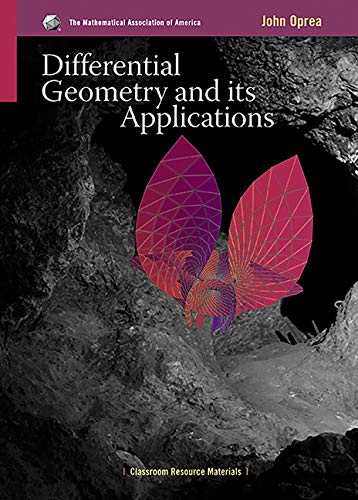
Ebook Info
- Published: 2007
- Number of pages: 487 pages
- Format: PDF
- File Size: 3.33 MB
- Authors: John Oprea
Description
Differential geometry has a long, wonderful history and has found relevance in many areas. This book studies the differential geometry of surfaces with the goal of helping students make the transition from the standard university curriculum to a type of mathematics that is a unified whole, by mixing geometry, calculus, linear algebra, differential equations, complex variables, the calculus of variations, and notions from the sciences. Differential geometry is not just for mathematics majors, but also for students in engineering and the sciences. Into the mix of these ideas comes the opportunity to visualize concepts through the use of computer algebra systems such as Maple. The book emphasizes that this visualization goes hand-in-hand with the understanding of the mathematics behind the computer construction. The book is rich in results and exercises that form a continuous spectrum, from those that depend on calculation to proofs that are quite abstract.
User’s Reviews
Editorial Reviews: Review This is a clearly written book which could serve well as a text for an undergraduate course in differential geometry for either one or two semesters….Overall, this is an impressive book that would be an excellent text for an undergraduate course in differential geometry. –Thomas E. Cecil, Mathematical Reviews Book Description This book studies the differential geometry of surfaces and its relevance to engineering and the sciences. Book Description This book studies the differential geometry of surfaces and aims to help students make the transition from the standard university curriculum to a type of mathematics that is a unified whole, by mixing geometry, calculus, linear algebra, differential equations, complex variables, the calculus of variations, and notions from the sciences. From the Inside Flap Differential geometry has a long, wonderful history it has found relevance in areas ranging from machinery design of the classification of four-manifolds to the creation of theories of natures fundamental forces to the study of DNA. This book studies the differential geometry of surfaces with the goal of helping students make the transition from the compartmentalized courses in a standard university curriculum to a type of mathematics that is a unified whole, it mixes geometry, calculus, linear algebra, differential equations, complex variables, the calculus of variations, and notions from the sciences. Differential geometry is not just for mathematics majors, it is also for students in engineering and the sciences. Into the mix of these ideas comes the opportunity to visualize concepts through the use of computer algebra systems such as Maple. The book emphasizes that this visualization goes hand-in-hand with the understanding of the mathematics behind the computer construction. Students will not only see geodesics on surfaces, but they will also see the effect that an abstract result such as the Clairaut relation can have on geodesics. Furthermore, the book shows how the equations of motion of particles constrained to surfaces are actually types of geodesics. Students will also see how particles move under constraints. The book is rich in results and exercises that form a continuous spectrum, from those that depend on calculation to proofs that are quite abstract. About the Author John Oprea is a Professor of mathematics at Cleveland State University in Ohio and a Lester R. Ford award recipient Read more
Reviews from Amazon users which were colected at the time this book was published on the website:
⭐The other reviewers are correct; that this is an excellent introductory text that fits into the undergraduate curriculum following the normal calculus sequence for scientists and engineers.Sadly, however, its power has been greatly weakened by changes that have been made in MAPLE, an applications program that is used in the book to illustrate geometrical points. Syntactical changes made as MAPLE has evolved from version 10 to version 18 and beyond, have made it impossible to run Oprea’ demonstrations. Without these demonstrations, a very interesting and useful book has been rendered less effective.One can hope that eventual updates and a version three is in the planning process. Perhaps the author can find some interest at MAPLE about speeding up an update of this book.
⭐By far my favorite undergraduate differential geometry textbook. Oprea does a great job of introducing calculus of nth dimensional surfaces, and even gives a sneak peak on the wonderful world of abstract surfaces. His chapter on minimal surfaces could be a book on its own.
⭐Clear and concise examples. The hints for the exercises are very helpful.
Keywords
Free Download Differential Geometry and its Applications (Mathematical Association of America Textbooks) 2nd Edition in PDF format
Differential Geometry and its Applications (Mathematical Association of America Textbooks) 2nd Edition PDF Free Download
Download Differential Geometry and its Applications (Mathematical Association of America Textbooks) 2nd Edition 2007 PDF Free
Differential Geometry and its Applications (Mathematical Association of America Textbooks) 2nd Edition 2007 PDF Free Download
Download Differential Geometry and its Applications (Mathematical Association of America Textbooks) 2nd Edition PDF
Free Download Ebook Differential Geometry and its Applications (Mathematical Association of America Textbooks) 2nd Edition